Researchers assessed 200 farmer fields during the 2022 and 2023 main cropping seasons and found the disease present in every district surveyed, with intensity varying sharply with altitude, season, variety and field drainage.
Faba bean is central to Ethiopian agriculture. The country is the world’s second-largest producer after China and a secondary centre of diversity for the crop, with roughly 4.1 million smallholder farmers cultivating more than 466,000 hectares and producing over a million tonnes of grain at an average productivity of 2.2 tonnes per hectare. Beyond its role as a food and income source, faba bean fixes atmospheric nitrogen and restores soil fertility, reducing dependence on external fertiliser inputs. Yet productivity remains well below potential, partly because indigenous varieties have inherently low yield potential and high susceptibility to biotic and abiotic stresses, including chocolate spot, rust and wilt and root rot complexes.
Faba bean gall adds a formidable new pressure. The disease was first reported in East Africa in 2012 and has since caused substantial yield losses in Ethiopia and China, and in extreme cases complete crop failure over large areas within a short period. Its causal agent was long uncertain: early identifications in Ethiopia pointed to Olpidium viciae based on symptom similarity and resting spores found within galls, but early molecular studies were inconclusive and often matched unrelated fungi that do not induce typical gall symptoms. Studies in China, by contrast, confirmed O. viciae as the agent of faba bean blister disease. Recent integrative morphological and molecular analyses have now resolved the confusion, establishing that the true causal agent of faba bean gall in Ethiopia is Physoderma viciae, a clarification the authors say is critical both for interpreting past research and for designing effective management.
The survey covered the districts of Legambo, Tenta, Woreilu and Kelala, selected purposively for their faba bean production potential, accessibility and area coverage. Within each district, five local administrative units, or Kebeles, were randomly selected, and up to five farmer fields per Kebele were assessed along accessible roads at intervals of roughly five to ten kilometres. In each field, observations were made at five sampling points arranged diagonally in an X pattern, with a one-square-metre quadrat at each point used to count total, infected and healthy plants. Farmers were interviewed about field history, altitude, previous crop, drainage, soil type, variety, cropping system, planting date, weeding, disease management and fertiliser use. Severity was rated on a 0-to-9 scale and converted to a percent severity index.
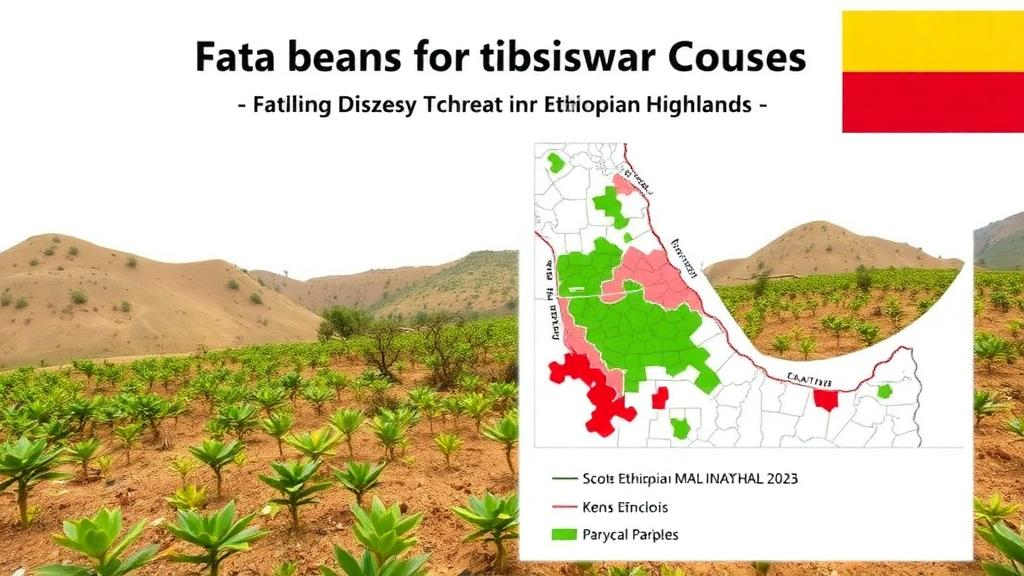
The results reveal a steep geographic and seasonal gradient. Legambo recorded the highest disease burden, with 97.60 percent prevalence, mean incidence of 82.26 percent and severity of 71.92 percent, followed by Tenta at 95.60 percent prevalence, 70.85 percent incidence and 57.14 percent severity. Kelala showed the lowest incidence and severity, at 59.41 percent and 41.45 percent respectively, with Woreilu slightly higher at 66.99 percent and 54.56 percent. Season mattered as well: the 2022 season saw mean incidence of 74.81 percent and severity of 64.01 percent, compared with 64.17 percent and 47.21 percent in 2023, a difference the authors attribute to increased rainfall, humidity and prolonged cloud cover during the wetter year.
Altitude emerged as a dominant factor. Disease incidence and severity rose with elevation, peaking in fields above roughly 2844 metres above sea level, and the highest values of all were recorded at 3069 to 3230 metres, where prevalence reached 97.60 percent, incidence 85.50 percent and severity 72.93 percent. Higher prevalence and severity were generally observed between 2426 and 3230 metres. Micro-environmental conditions amplified these patterns: shaded areas, waterlogged zones and sites near furrows or trees supported more severe infections, likely because of increased moisture retention and reduced air circulation. Soil type also contributed, with Vertisols showing the highest prevalence, incidence and severity, followed by Nitisols, while freer-draining Arenosols recorded the lowest levels, consistent with the pathogen’s apparent preference for moist, poorly aerated conditions.
To disentangle these influences, the researchers used ordinal logistic regression, categorising field-level incidence and severity into ordered classes and evaluating variables through single-variable, full and reduced multivariable models validated with likelihood ratio tests. District, year and altitude consistently emerged as the strongest independent predictors of both incidence and severity. Including these three factors in Type III models reduced residual deviance by 112.6, 47.3 and 38.9 units respectively for incidence, and by 98.4, 41.7 and 36.5 units for severity, indicating that they accounted for a substantial share of field-level variability. Secondary but significant influences on incidence came from variety, previous crop, fungicide application and field drainage, while soil type, planting method, field size and growth stage lost significance once the dominant environmental factors were accounted for.
Management practices clearly modified disease outcomes, even if they could not override the environmental drivers. Fields planted with the improved Wolkie variety showed lower mean incidence, 62.23 percent versus 73.57 percent, and lower severity, 48.31 percent versus 63.52 percent, than fields with local landraces, although the authors caution that the limited number of Wolkie plots means further evaluation is needed and that no variety displayed complete resistance. Unweeded fields had higher incidence and severity than those weeded twice, and broadcast sowing promoted more disease than row planting, which was associated with reductions in incidence of 62.68 percent and in severity of 48.64 percent. NPS fertiliser at sowing and fungicide application were each associated with lower disease levels than untreated fields, and previous rotation with cereals was linked to lower incidence and severity than rotation with legumes, suggesting cereal rotations may suppress pathogen build-up. The authors emphasise that these associations are correlative rather than causal, given variability in farmers’ knowledge of proper fungicide rates and timing.
The disease’s dependence on humid, cool conditions helps explain the seasonal and altitudinal patterns. Prior work cited by the authors indicates that Physoderma viciae thrives under high relative humidity of 80 to 100 percent, moderate temperatures of 10 to 20 degrees Celsius and prolonged leaf wetness, while temperatures above 20 degrees Celsius tend to inhibit its development. The 2022 season’s heavier rainfall, prolonged cloud cover and higher humidity during vegetative and flowering stages likely favoured leaf wetness, zoospore release, dispersal and infection, whereas drier, warmer conditions during podding in 2023 probably suppressed disease. The authors note, however, that the satellite-based NASA POWER climate data used in the study may not fully capture local microclimatic variation, a limitation worth bearing in mind when interpreting the weather-disease links.
The survey’s broader message is sobering for Ethiopian highland farming. The disease has already been reported across several major faba bean regions, including North Shewa, the Selale highlands and the Wollo highlands, and in some districts elsewhere, such as parts of South Gondar, Quarit and Sekela, farmers have abandoned faba bean cultivation entirely because of repeated outbreaks. Because growth stage did not retain independent significance in the reduced models, the apparent peak of disease at flowering appears largely mediated by seasonal and agro-ecological conditions rather than being an intrinsic susceptibility of that stage alone. The authors argue that the multifactorial nature of faba bean gall epidemics demands integrated, location-specific management: developing and promoting resistant or tolerant varieties, improving field drainage, rotating with cereals or other non-legumes, applying fungicides judiciously, adopting row planting, timely weeding and balanced fertilisation, alongside further research into the biology, epidemiology and survival mechanisms of the pathogen and stronger seed systems and farmer training. Without such coordinated action, they warn, the disease will continue to spread through the highlands where Ethiopia’s faba bean, and the food security it underpins, is most at risk.
Subject of Research: Distribution and epidemiology of the faba bean gall disease Physoderma viciae in South Wollo, Ethiopia
Article Title: Survey on the distribution and epidemiology of faba bean gall (Physoderma viciae) in South Wollo, North-Eastern Ethiopia: an emerging threat to faba bean production
Article References: Hussen, S., Abera, M., Bekele, B., & Alemu, T. (2026). Survey on the distribution and epidemiology of faba bean gall (Physoderma viciae) in South Wollo, North-Eastern Ethiopia: an emerging threat to faba bean production. Agriculture & Food Security, 15(1), Article 33. https://doi.org/10.1186/s40066-026-00626-8
Image Credits: AI Generated
DOI: 10.1186/s40066-026-00626-8
Keywords: faba bean gall, Physoderma viciae, Ethiopia, South Wollo, plant disease survey, faba bean, altitude, crop disease epidemiology, integrated disease management, ordinal logistic regression, highland agriculture, Amhara Region
News Source: Alan Morgan. (October 29, 2026). Faba Bean Gall Survey Maps Emerging Disease Threat in Ethiopian Highlands. Scienmag.