


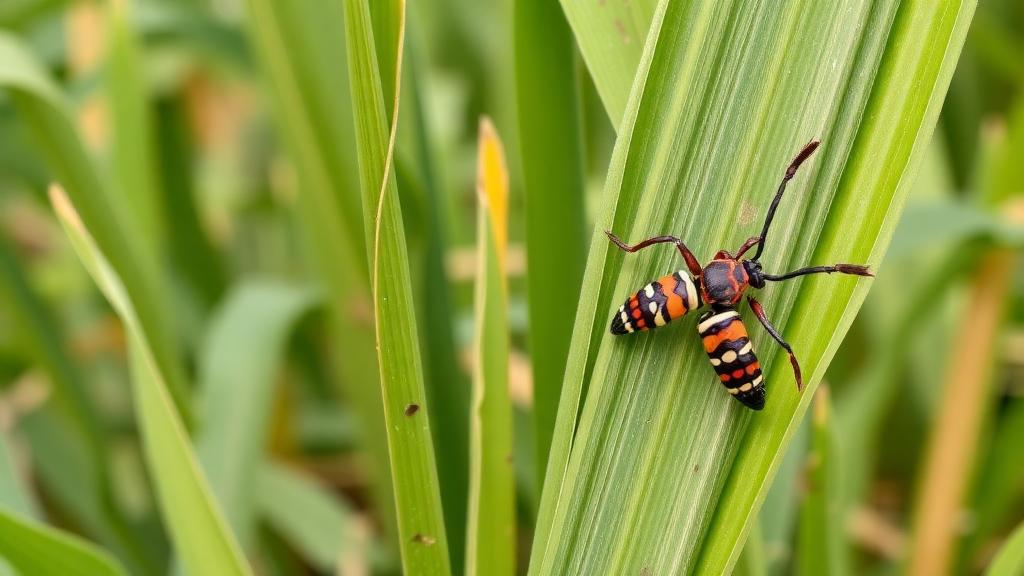
Fall armyworm, the invasive caterpillar scientifically known as Spodoptera frugiperda, has been one of the most damaging pests of maize since its arrival in India in 2018. A new three-year study from the erstwhile Warangal district of Telangana reports that an integrated pest management package kept the pest far more tightly in check than the conventional insecticide-heavy approach that many farmers rely on, and did so while delivering higher yields and better economic returns. The work, published in the Egyptian Journal of Biological Pest Control, compared the two systems side by side across 20 farmer-managed fields over three consecutive Rabi seasons from 2022 to 2025.
The evaluation was carried out by researchers from Krishi Vigyan Kendra programmes operating under the Indian Council of Agricultural Research’s Agricultural Technology Application Research Institute, using frontline demonstration plots. Each integrated pest management demonstration occupied a 0.2 hectare plot chosen for uniform soil type, a history of fall armyworm infestation and the participating farmer’s willingness to take part. The design followed ICAR-ATARI annual zonal action plan guidelines, and replication across 20 independent sites provided the statistical basis for comparison. All other agronomic practices were standardized across treatments so that the pest management package remained the main difference between plots.
The integrated package combined preventive and curative tactics: summer deep ploughing, four border rows of sorghum, seed treatment with a cyantraniliprole plus thiamethoxam mixture at 4 millilitres per kilogram of seed, intercropping with redgram in a 6:1 row ratio, four pheromone traps per acre, mechanical removal of egg masses, and need-based sprays of azadirachtin at 10,000 ppm, Beauveria bassiana at 1 × 10⁸ CFU per gram, and chlorantraniliprole 18.5% SC. By contrast, the farmer practice plots were characterized by indiscriminate chemical pesticide use, only occasional use of azadirachtin and Beauveria bassiana, and rarely any summer deep ploughing. Pest monitoring took place biweekly using standard damage rating scales, with larval counts from 50 randomly selected plants per demonstration at each site.
The headline results were stark. Pooled across the three seasons, mean fall armyworm incidence was 6.8 percent under integrated pest management versus 30.8 percent under farmer practice, and mean larval density was 0.7 larvae per plant versus 2.5. Paired t-tests and two-way ANOVA confirmed significant differences between treatments at p < 0.001, with very large effect sizes (Cohen’s d > 11), and mixed-effects models validated consistency across years and locations. Multivariate analysis of variance showed clear separation of the two systems (Wilks’ Lambda = 0.10, p < 0.0001), and pest incidence correlated strongly with larval density, with correlation coefficients above 0.98. Across all years, integrated management reduced pest incidence by 75.8 to 80.0 percent and larval numbers by 69.0 to 73.9 percent relative to farmer practice.
Seasonal monitoring revealed a characteristic pattern. Peak fall armyworm activity occurred in November and December, declining by February, a window the authors link to the cooler temperatures and higher humidity early in the Rabi season that favour pest proliferation. In farmer practice plots during 2022, incidence climbed to 36 percent in December before easing to 34.5 percent by February, while integrated plots stayed stable, moving only from 8.6 to 8.1 percent. Notably, infestation declined under both systems over the three years, but integrated plots remained below the economic threshold level throughout, ranging from 8.5 percent down to 5.5 percent, whereas farmer practice plots stayed far above it.
The economic comparison favoured the ecological package as well. Integrated plots yielded an average of 28.77 quintals per acre, rising from 27.5 q/acre in 2022–2023 to 30.0 q/acre in 2024–2025, against 20.0 q/acre under farmer practice, an advantage of 8.77 q/acre attributed largely to reduced pest damage. Cultivation costs were modestly higher under integrated management, at ₹23,167 per acre versus ₹21,167, but gross returns were substantially greater at ₹46,027 versus ₹32,667 per acre. Net returns reached ₹22,860 per acre under integrated management against ₹11,500 under farmer practice, producing a benefit-cost ratio of 2.0 versus 1.5. Technology dissemination indicators also improved over time: the technology gap fell from 4.5 to 2.0 q/acre, the technology index improved from 14.06 to 6.25 percent, and the extension gap averaged 8.77 q/acre.
Weather emerged as a powerful driver of pest dynamics. Relative humidity showed the strongest positive correlation with larval populations (r = 0.982 under integrated management; r = 1.00 under farmer practice), and rainfall also correlated positively (r = 0.963 and 0.997 respectively). Temperature and sunshine hours were negatively correlated with both incidence and larval density. Regression models quantified these relationships: a 1 °C rise in temperature reduced larval numbers by 0.25 under integrated management and 0.536 under farmer practice, a 1 percent humidity increase raised counts by 0.075 and 0.150 respectively, and each millimetre of rainfall added 0.042 and 0.085 larvae. Model R² values ranged from 0.93 to 0.997, indicating strong predictive accuracy within this dataset.
Classification and regression tree analysis identified specific outbreak-prone conditions: humidity above 97.5 percent, rainfall above 95.3 millimetres, and sunshine below 5 hours per day. The authors argue that such thresholds could feed into climate-based early warning systems tailored to local agro-ecological conditions, allowing farmers and extension services to anticipate high-risk windows rather than react to damage after it appears. Bi-plot analysis reinforced the treatment separation, with integrated observations aligning negatively along pest incidence and larval density vectors and positively with the yield vector, while farmer practice observations clustered toward high infestation and lower yield. Spider plots of technology adoption showed the largest divergences for pheromone trap deployment, sorghum border cropping, seed treatment, redgram intercropping and early egg mass removal, all components with substantially higher adherence on integrated plots.
The authors are careful to frame the findings appropriately. The study is described as a multi-location observational comparison rather than a fully controlled experiment, and the conclusions note that causal inference is limited by the non-experimental design and variability in initial farm conditions. Site-specific environmental factors, seasonal variation and differential farmer adherence could influence adoption levels and pest suppression, while confounders such as soil fertility, natural enemy presence and local agronomic practices may also have affected results. The study covered only fall armyworm in Rabi maize, so effectiveness against other pests or crops, and long-term sustainability under a changing climate, remain open questions. Practical barriers to scaling up include farmer awareness, bio-pesticide availability and initial adoption costs.
Even with those caveats, the consistency of the pattern across three seasons and 20 locations, supported by large effect sizes and multiple independent analytical approaches, gives the results considerable weight for the semi-arid tropics where the study was conducted. The findings align with earlier reports of 70 to 80 percent fall armyworm reductions under integrated strategies in similar Indian agro-climatic conditions and with economic studies from Southeast Asia and West Africa showing improved returns under ecological management. For maize farmers in Telangana and comparable regions, the study suggests that combining cultural practices, biological controls and targeted, need-based chemical use with weather-based monitoring can suppress one of the world’s most destructive maize pests while improving the bottom line, offering extension programmes a concrete, field-tested template for climate-resilient pest management.
Subject of Research: Comparative evaluation of integrated pest management versus farmer practice for fall armyworm control in Rabi maize
Article Title: Eco-epidemiological and economic evaluation of climate-responsive Spodoptera frugiperda (J. E. Smith) (noctuidae: lepidoptera) management in Rabi maize: a comparative study of IPM and conventional systems
Article References: Agurla, R., Rohidas, A. J., Chilumula, S., Gugulothu, G., & Jettaboina, S. K. (2026). Eco-epidemiological and economic evaluation of climate-responsive Spodoptera frugiperda (J. E. Smith) (noctuidae: lepidoptera) management in Rabi maize: a comparative study of IPM and conventional systems. Egyptian Journal of Biological Pest Control, 36(1), Article 19. https://doi.org/10.1186/s41938-026-00894-3
Image Credits: AI Generated
DOI: 10.1186/s41938-026-00894-3
Keywords: fall armyworm, Spodoptera frugiperda, integrated pest management, maize, Telangana, India, weather regression, yield economics, pheromone traps, biopesticides, frontline demonstrations, semi-arid tropics
News Source: Alan Morgan. (October 29, 2026). Integrated Pest Management Slashes Fall Armyworm Damage in Indian Rabi Maize. Scienmag.



