


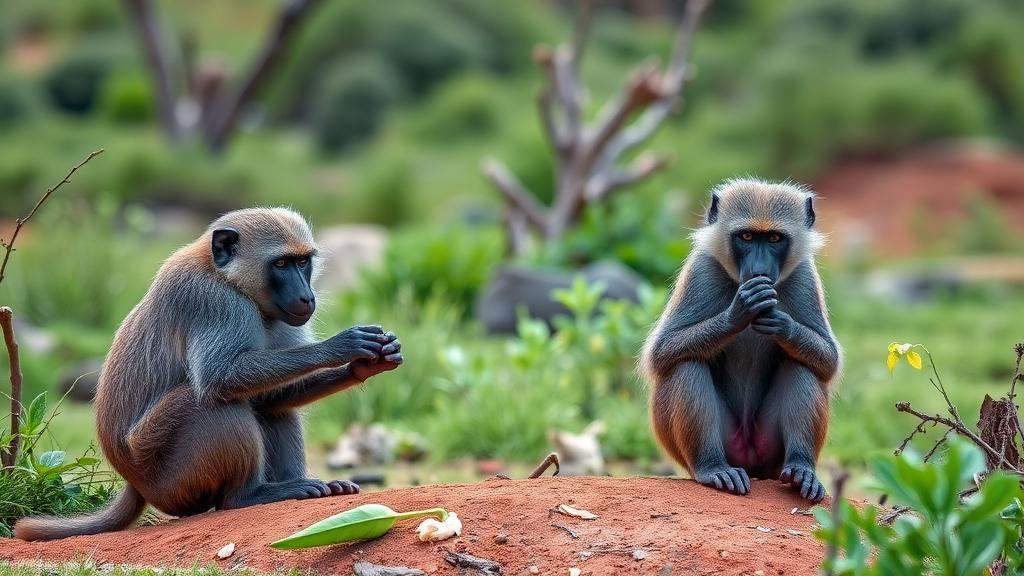
Households living around Borena-Sayint National Park in northern Ethiopia lose nearly four animals each to hamadryas baboons over a five-year period, according to a new questionnaire survey published in BMC Zoology. The study, led by Hussein Ibrahim with colleagues including Afework Bekele, Dereje Yazezew, Amera Moges, Meseret Chane and Addisu Mekonnen, interviewed 300 households bordering the park and found that livestock depredation, not drought, disease or theft, was the challenge residents cited most often in rearing their animals.
The research team worked in and around Borena-Sayint National Park, a protected area of 4,375 hectares in the South Wollo Zone of Amhara Regional State. The park sits on a mountain ridge between roughly 2,188 and 3,732 meters above sea level, within the Eastern Afromontane Biodiversity Hotspot, and its slopes carry natural forests and high-altitude grasslands. The Denkoro River bisects the park, splitting it between two districts with strikingly different conditions: the Borena District side retains relatively continuous vegetation and experiences lower human disturbance, while the Mehal-Sayint District side is more fragmented and more heavily encroached. Around the park, approximately 8,290 people in 1,190 households across 35 village clusters make their living from agriculture, traditional livestock husbandry, honey production and rain-fed farming on degraded hillsides, with sheep as the dominant livestock species.
Between February and July 2018, following a pilot survey in January, the researchers administered a semi-structured questionnaire, translated into Amharic, to households selected by a spatial systematic random sampling method. Because official household registries were unavailable at village level, the team divided the estimated 1,190 households by their target sample of 300 to arrive at a sampling interval of four, interviewing every fourth household. Respondents were allocated proportionally between the districts, yielding 220 participants from Borena and 80 from Mehal-Sayint. Of the 300 respondents, 239 were men and 61 were women, a skew the authors attribute to the traditional structure of rural Ethiopian households, where men typically head households and manage livestock. Two focus group discussions with community members, elders, scouts and park administrators complemented the survey and were used to triangulate the quantitative findings.
The questionnaire asked respondents to recall livestock losses attributed to hamadryas baboons over the previous five years, covering January 2013 to December 2017. The authors deliberately chose this multiannual recall window to capture infrequent and seasonal attack events that a twelve-month period might miss. Respondents were instructed to report only events from their own direct experience and observation, but the team acknowledges that no formal recall-bias reduction techniques, such as temporal anchoring or independent verification, were employed. The results therefore reflect perceived rather than independently verified depredation, a limitation the authors weigh explicitly throughout the paper.
The headline numbers are stark. Respondents estimated that hamadryas baboons damaged an average of 3.84 animals per household over the five-year recall period. Sheep suffered the highest average reported losses at 1.3 animals per household, followed by lambs at 1.12, goat kids at 0.7 and goats at 0.59. Multiple response analysis showed that 74.55 percent of respondents identified depredation by predators from the park as their main problem in livestock rearing, well ahead of drought at 18.4 percent, theft at 3.5 percent and disease at 2.5 percent. Overall, 82 percent of respondents reported experiencing livestock depredation by wild animals in and around the park, and among those who lost animals, more than 93 percent in both districts said losses had increased in recent years.
The two districts told noticeably different stories, and not in the direction the researchers had predicted. Depredation was significantly higher in Borena District, where 85 percent of respondents reported incidents, than in Mehal-Sayint District, where 59 percent did. Reported losses of lambs, goat kids and sheep were all higher in Borena, and Mann-Whitney U tests confirmed that the district differences in lamb and sheep losses were statistically significant, while losses of goat kids and goats were not. Borena households also kept larger sheep flocks, averaging 5.21 animals against 3.66 in Mehal-Sayint. The authors had hypothesized that the more fragmented Mehal-Sayint landscape would see more attacks; instead, local respondents attributed the heavier Borena losses to a greater abundance of hamadryas baboons along the Borena section of the park, a result that ran counter to the study’s initial expectation.
Seasonality emerged as a powerful pattern in the reported attacks. Monthly frequencies varied significantly, with peaks in January, December, February and March and the fewest incidents in June and October. When pooled across both districts, dry-season attacks significantly outnumbered wet-season attacks, and seasonal losses were also significantly associated with district location. The authors suggest two converging explanations: during the harvest period, domestic animals were often kept in Kuren, storage areas for harvested crops, with limited protection while households focused on harvesting, and preferred natural foods such as fruits are scarcer in the park during the dry season, possibly pushing baboons toward alternative food sources outside their natural habitat. Adult male baboons were reported as the perpetrators in 95.2 percent of losses, with sub-adult males, adult females and young individuals accounting for small shares of the remainder.
Retaliation, remarkably, was rare. The vast majority of respondents, 93.9 percent, reported that they had not killed hamadryas baboons in retaliation for livestock losses, and 98.4 percent said they had never injured one. When attacks did occur, the most common response, reported by 80.5 percent of respondents, was to inform the park’s scouts, while 11.8 percent did nothing and about 6 percent made noise to scare the animals away. None of the respondents reported using fire, building fences or hiring labor as preventive measures. Yet attitudes toward the species were far from warm: 82.3 percent of respondents viewed hamadryas baboons as a threat to their long-term livelihoods, 54.3 percent favored reducing the local population and 28 percent preferred the species to disappear from their locality entirely. A binary logistic regression found that geographic location was the only significant predictor of threat perception, with Borena residents less likely to view the baboons as a threat than those in Mehal-Sayint.
The most intriguing finding, however, may be what did not erode. Nearly all respondents, 98.3 percent, knew that catching, trapping or hunting hamadryas baboons is prohibited under national law, and 89.2 percent agreed that the animals have a natural right to exist in the area, with agreement significantly higher in Mehal-Sayint and among male respondents. Moreover, 91.3 percent did not perceive local communities as a threat to the species’ long-term survival. The authors read this combination as evidence that while resource competition generates negative attitudes and a preference for fewer baboons, it does not translate into support for indiscriminate lethal control or eradication, leaving room for community-based mitigation. They recommend improved livestock husbandry, better protection during high-risk dry-season periods, physical barriers, collaborative monitoring with park authorities and habitat management that enhances natural food availability inside the park. Because the reported losses rest on perception and memory rather than verified observations, and because ecological variables such as food availability and baboon density were not directly measured, the authors caution that the patterns should be read as descriptive associations. Future work combining ecological monitoring, GPS telemetry and direct behavioral observation, they argue, will be needed to pin down the true drivers of conflict in this fragmented highland landscape.
Subject of Research: Livestock depredation by hamadryas baboons and local community attitudes around Borena-Sayint National Park, northern Ethiopia
Article Title: Assessment of livestock depredation by hamadryas baboons (Papio hamadryas) in and around Borena-Sayint National Park, northern Ethiopia
Article References: Ibrahim, H., Bekele, A., Yazezew, D., Moges, A., Chane, M., & Mekonnen, A. (2026). Assessment of livestock depredation by hamadryas baboons (Papio hamadryas) in and around Borena-Sayint National Park, northern Ethiopia. BMC Zoology, 11(1), Article 26. https://doi.org/10.1186/s40850-026-00283-1
Image Credits: AI Generated
DOI: 10.1186/s40850-026-00283-1
Keywords: hamadryas baboons, human-wildlife conflict, livestock depredation, Borena-Sayint National Park, Ethiopia, sheep, questionnaire survey, protected areas, community attitudes, conservation, seasonality, retaliation
News Source: William Thompson. (October 29, 2026). Hamadryas Baboons Blamed for Heavy Livestock Losses Around Ethiopian National Park. Scienmag.



