


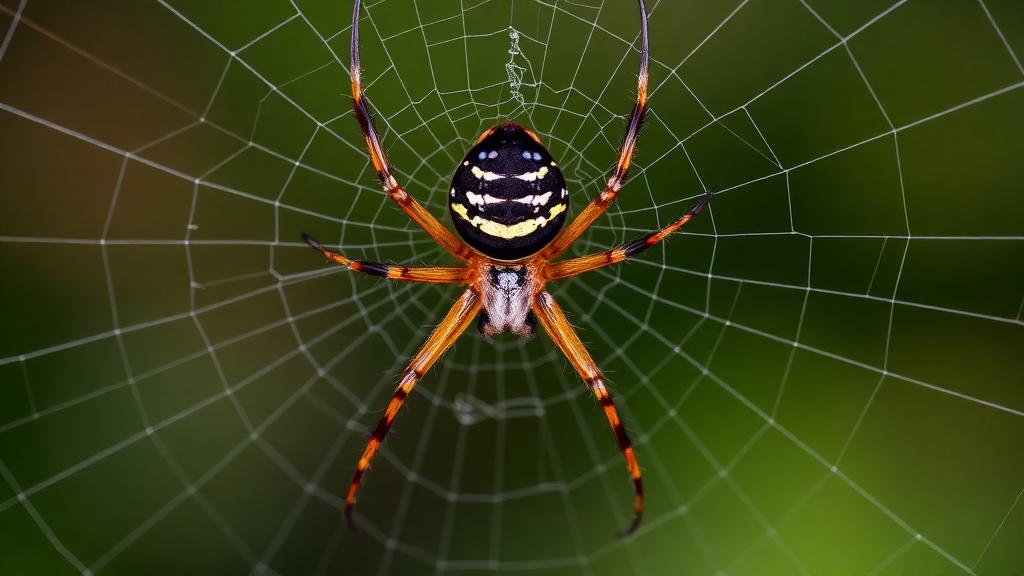
A new species of orb-weaver spider has been formally described from the mountains of central China, extending a genus previously known only from the country’s far west into an entirely different region. The species, named Zangaraneus zhishengi, is the fifth member of the orb-weaver genus Zangaraneus, which was established only recently by Mi and colleagues in 2026 to accommodate four species, all of which were known from Xizang, China.
The holotype, an adult male carrying the specimen identifier TRU-Araneidae-793, was collected on 21 September 2023 in the Shennongjia Forestry District, at Hongping Township, Yazikou, in Hubei province, at an elevation of 1780 metres. A female paratype from the same site and date completes the type series from that locality. Further paratypes broaden the picture considerably: a male from Lanying Township, Xi’an Village, in Yintiaoling National Nature Reserve, Wuxi county, Chongqing, collected on 24 September 2022 at 1637 metres; a female from Zhuanping in the same reserve, taken on 18 August 2022 at 2178 metres; a male from Duheyuan National Nature Reserve in Zhushan county, Hubei, collected on 19 September 2023 at 1802 metres; and a final male and female pair from Dajiuhu National Wet Park, also in the Shennongjia Forestry District, from the same September 2023 date. All told, the species is recorded from both Hubei and Chongqing, the two provinces that share the Shennongjia mountain borderlands.
That setting matters to the story. The Shennongjia Mountains, lying on the border between Chongqing and Hubei, are home to one of the most biodiverse regions in central China and boast one of the best-preserved primary forest ecosystems in the country. Although several spider families in the area have been studied over the past five years, the araneid fauna, the orb-weaving family Araneidae to which the new species belongs, remains unclear. It was amongst araneid specimens collected from this region that the authors recognised something that did not match any described species, prompting the formal description that now establishes Zangaraneus zhishengi as a name-bearing species.
The genus itself is a recent creation. Zangaraneus was established in 2026 by Mi and colleagues specifically to accommodate four species from Xizang, and its members are characterised by a combination of reproductive anatomy: an epigyne, the external female genital structure, bearing a pair of atria, and a male pedipalp bearing an almost triangular median apophysis together with a slender terminal apophysis appendix.
The male of the new species is a small spider. The holotype has a total body length of 4.30 millimetres, with a carapace 2.10 millimetres long and 1.80 wide, and an abdomen 2.50 millimetres long and 1.80 wide. The eye arrangement is recorded in detail: the anterior median eyes measure 0.10 millimetres, the anterior laterals 0.08, the posterior medians 0.13 and the posterior laterals 0.08, with the median ocular area 0.38 millimetres long. The legs are long and slender relative to the body, with the first leg the longest at 8.20 millimetres in total, followed by the second at 7.70, the fourth at 6.30 and the third at 4.60. In colour and form, the carapace is pear-shaped and yellow with a longitudinal fovea, the groove that marks the internal muscle attachments; the chelicerae are yellow and bear four promarginal and three retromarginal teeth; the sternum is cordiform, or heart-shaped, yellow and dressed with brown setae; and the legs are yellow without annuli, with the first femur carrying ten prolateral macrosetae at its middle. The abdomen is elliptical, about 1.19 times longer than wide, whitish-yellow with inverted branch-like markings, while the underside is white with two pairs of white spots around the spinnerets.
In the new species it bears two patellar bristles; the median apophysis is wide and somewhat triangular, with a slender spur at each end; the embolus is tapered and curves anti-clockwise through about 90 degrees near the base of the median apophysis; the conductor is membranous and rounded distally, with a large, heavily sclerotised spur at its base; the terminal apophysis is heavily sclerotised, thick, and armed with denticles at its base; and the terminal apophysis appendix is long, flattened and weakly sclerotised.
Those comparisons yield the formal diagnosis. The male of the new species resembles Z. zhui in pedipalp structure but can be distinguished in three ways: its embolus lacks the long embolic lamella that is visible in prolateral view in Z. zhui; the spur at the base of its conductor is large and heavily sclerotised rather than small and weakly sclerotised; and its abdomen lacks the dark patches that give Z. zhui five pairs of dark markings posteriorly. The female tells a parallel story. The female paratype has a total length of 6.30 millimetres, with a carapace 2.50 millimetres long and 2.00 wide and an abdomen 4.70 millimetres long and 4.40 wide, making her markedly larger than the male, and her habitus shape and colouration are similar to the male’s. Her epigyne, however, most closely resembles that of another Xizang species, Z. liui, and differs from it in three characters: the outline of the atrium is almost round rather than ear-shaped; the anterior surface of the epigynal plate is procurved in ventral view rather than recurved; and the copulatory ducts are almost straight in posterior view rather than spiral. In the new species the epigynal plate is about twice as wide as long in ventral view, the posterior plate is constricted at its middle and fused with the lateral sclerites, the scape carries many fine ridges and grooves and is spoon-shaped distally and sinuous in lateral view, the copulatory ducts are heavily sclerotised and thickened to a spherical shape at their origin before narrowing toward the end, and the rounded spermathecae are separated by less than their own radius.
The species name itself carries a human story: zhishengi is a patronym honouring the arachnologist Professor Zhisheng Zhang of Southwest University in Chongqing, formed as a noun in the genitive case. With the description in place, Zangaraneus now numbers five species, four of them from Xizang and one, the new arrival, from the mountains of central China. The methods follow those of Mi and colleagues from 2024, all measurements are given in millimetres, and leg lengths are recorded as totals broken down by segment, femur, patella plus tibia, metatarsus and tarsus, following the conventions that allow future workers to make direct comparisons. For now, the species is known only from the type series, which was collected in Hubei and Chongqing and is deposited in the Museum of Tongren University, China.
Subject of Research: Taxonomic description of a new orb-weaver spider species, Zangaraneus zhishengi, from central China
Article Title: Description of a new species of the orb-weaver spider genus Zangaraneus Mi, Wang & Feng, 2026 ( Araneae , Araneidae ) from China
Article References: Wang, Z., Wang, C., & Mi, X. (2026). Description of a new species of the orb-weaver spider genus Zangaraneus Mi, Wang & Feng, 2026 (Araneae, Araneidae) from China. Biodiversity Data Journal, 14, Article e199306. https://doi.org/10.3897/bdj.14.e199306
Image Credits: AI Generated
Keywords: Zangaraneus, Araneidae, orb-weaver spiders, new species, taxonomy, Shennongjia, Hubei, Chongqing, China, arachnology, biodiversity, Description
News Source: Drew Townsend. (October 29, 2026). New orb-weaver spider species Zangaraneus zhishengi described from central China. Scienmag.



