


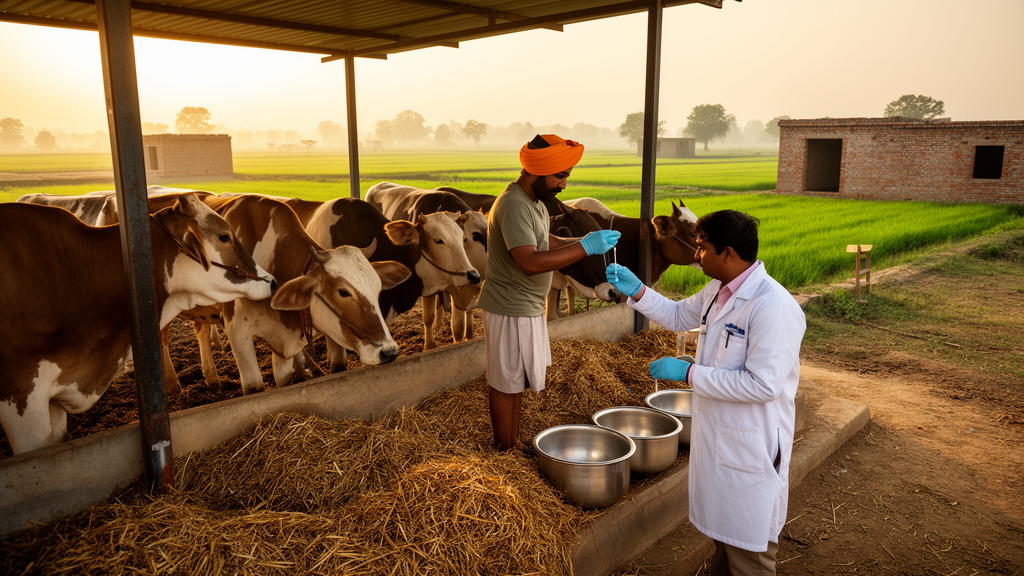
Scientists surveying cattle farms in Punjab, India, have recovered multidrug-resistant Klebsiella pneumoniae from more than one in ten samples tested, including two isolates with an extended-spectrum beta-lactamase (ESBL)-like phenotype whose whole genomes were sequenced in detail. The study, published in Current Genetics, examined 288 samples collected between November 2021 and March 2023 from 23 cattle farms across ten tehsils, including Jagraon, Khanna, Ludhiana East and West, Payal, Raikot, Samrala, Tarn Taran, Bathinda and Mansa. Klebsiella pneumoniae, which the World Health Organization classifies as a critical priority pathogen, was detected in 10.06 percent of all samples (29 of 288), and 65.51 percent of the isolates (19 of 29) proved multidrug-resistant.
The sampling design combined animal and human screening on the same farms. Researchers collected 239 cattle fecal samples, 34 hand swabs from cattle handlers and 15 stool samples from handlers. The bacterium turned up in 11.29 percent of cattle fecal samples (27 of 239) and 5.88 percent of handler hand swabs (2 of 34), but in none of the handler stool samples. Farms were recruited through local veterinarians, and only farmers who voluntarily consented participated, meaning the study relied on convenience sampling rather than a randomized strategy, a limitation the authors acknowledge.
Antimicrobial susceptibility testing by disk diffusion, following Clinical and Laboratory Standards Institute 2020 breakpoints, revealed striking resistance patterns. Every one of the 29 isolates was resistant to ampicillin. Resistance to cefotaxime reached 48.2 percent, cefazolin and ceftriaxone 37.9 percent each, tobramycin 34.4 percent, gentamicin 31.0 percent, and ceftazidime 27.5 percent. Lower rates were recorded for trimethoprim (24.1 percent), co-trimoxazole and amoxicillin-clavulanic acid (17.2 percent each), ciprofloxacin (10.3 percent), chloramphenicol (6.89 percent), and tetracycline and amikacin (3.44 percent each). Notably, no isolate was resistant to levofloxacin or meropenem. Among cattle fecal isolates, 70.37 percent (19 of 27) were multidrug-resistant, defined as resistance to at least one antibiotic in three or more classes, while none of the hand swab isolates were.
Phenotypic testing for specific resistance mechanisms produced a nuanced picture. Using a modified CLSI combined disk diffusion confirmatory test, 7.40 percent of cattle fecal isolates (2 of 27) were phenotypically positive for ESBL production, while none of the handler swab isolates were. However, none of the isolates tested positive for AmpC beta-lactamase, carbapenemase, KPC, MBL, or co-production of KPC and MBL enzymes. Screening by conventional PCR identified several resistance genes across the 29 isolates: blaTEM in 62.06 percent, blaSHV in 51.72 percent, blaAmpC in 51.72 percent, qnrS in 13.79 percent and tetA in 10.34 percent.
Whole-genome sequencing was performed on the two isolates that met both criteria of phenotypic ESBL production and multidrug resistance, a choice the authors attribute partly to funding constraints that limited sequencing to just two genomes. The analysis revealed multiple antimicrobial resistance genes conferring resistance to quinolones, cephalosporins, carbapenems, tetracyclines, macrolides and other classes. Chromosomal genes associated with resistance included marA, hns, adeF, emrR, kpnG, kpnH, rsmA, crp, ompK37, kpnE, kpnF, blaSHV-11, fosA6 and vanG, among others, with the authors noting that blaSHV-11 on the chromosome is likely responsible for resistance to third-generation cephalosporins. Plasmid-borne genes included aph(3′)-Ia, aadA2 and aadA for aminoglycosides, qnrS1 for quinolones, tetA for tetracyclines, cmlA1 for phenicols and sul3 for sulfonamides.
A particularly intriguing finding concerns the ESBL-like phenotype itself. Although both sequenced isolates were phenotypically classified as ESBL producers, classical ESBL genes were not detected in either PCR or whole-genome sequencing data. Instead, both isolates harbored multiple efflux pump-associated genes, acrA and acrB, along with the global transcriptional activator marA and mutations in marR, which normally represses the marRAB operon. The authors propose that marR mutations may cause constitutive marA overexpression, upregulating the AcrAB-TolC efflux pump and reducing intracellular concentrations of beta-lactam antibiotics such as cefotaxime. This efflux-mediated mechanism can mimic ESBL activity phenotypically without enzymatic inactivation of the drug, highlighting a limitation of phenotypic ESBL detection methods when alternative resistance mechanisms are at play.
The genomic analysis also mapped the mobile genetic elements that could spread resistance between bacteria. Plasmid sequences fell into four replicon types: IncFIB, Col440I, IncFIB(K) and IncFII(K). A complete integron was identified on the plasmid of one isolate (16C9, accession CP120219), carrying genes including aad2, cmlA1, aadA and qacL, which confer resistance to aminoglycosides, phenicols, disinfecting agents and antiseptics. The other isolate (12C9, CP120218) lacked complete integron sequences. Insertion sequences ISKpn24 and ISKpn1 were found on the chromosomes, while ISKpn24, ISKpn19 and IS26 were present on plasmids. No transposon sequences were detected, which the authors attribute to short-read sequencing being unable to reliably resolve these repetitive elements. Virulence factors detected included type 1 and type 3 fimbriae, the AcrAB efflux pump, iron uptake systems such as aerobactin, enterobactin and salmochelin, the regulatory factor RcsAB, and type 6 secretion system machinery (T6SS-I, T6SS-II and T6SS-III).
Multilocus sequence typing assigned the two sequenced isolates to ST-160 and ST-4232, with core-genome MLST identifying corresponding types ST-14,733 and ST-13,365. The authors report that no epidemiological data or distribution patterns for these sequence types were available in the PubMLST database, and neither was associated with known clinical cases. Phylogenetic analysis based on a core genome of 3,577 genes, comparing the two new genomes with 14 publicly available genomes and using a K. quasipneumoniae outgroup, placed both study isolates within a single clade that shared common ancestry with strains from human rectal swabs in the United States and poultry fecal samples from China. The authors interpret this clustering as highlighting the possibility of cross-species transmission and the interconnectedness of resistance threats across sectors and borders, while comparative whole-genome alignment against the reference strain HS11286 showed largely conserved synteny with some rearrangements and sequence-level variation.
Farm-level survey data added context but no statistical answers. Antibiotics were reportedly stored for future use on 60.86 percent of farms, with quinolones (60.86 percent), third-generation cephalosporins (45 percent), penicillins (39.13 percent), aminoglycosides (35 percent), tetracyclines (34.78 percent) and polymyxins (5 percent) among the stored classes. Some 56.52 percent of farmers relied on non-veterinarians for animal treatment, and 43.47 percent consulted licensed veterinarians. However, chi-square analysis found that none of the surveyed variables, including farmer education level, antibiotic storage or veterinary consultation, were significantly associated with the occurrence of K. pneumoniae (p greater than 0.05). The authors suggest the observed resistance trends may still reflect indirect influences of these practices on selection pressure.
The study’s limitations are explicitly stated and shape how the findings should be read. Whole-genome sequencing covered only two isolates due to financial constraints, restricting the generalizability of the genomic findings regarding the diversity of resistance genes, virulence factors, plasmid types and mobile elements. Convenience sampling introduces potential bias, and short-read sequencing limited resolution of complex genomic structures such as transposons and resistance gene cassettes. The authors call for future research with broader and more diverse isolate sets, systematic sampling strategies and long-read sequencing. From a One Health perspective, they argue the detection of K. pneumoniae with an ESBL-like phenotype, resistance genes and virulence determinants on cattle farms underscores the need for integrated surveillance across human, animal and environmental sectors, regulation of antimicrobial use in livestock, stronger veterinary support for farmers, and education about prudent antibiotic use to contain the spread of antimicrobial resistance.
Subject of Research: Antimicrobial resistance and genomic characterization of Klebsiella pneumoniae isolated from cattle farms in Punjab, India
Article Title: Antimicrobial resistance profiles and genomic insights of phenotypically extended spectrum β-lactamase-positive Klebsiella pneumoniae from cattle farms
Article References: Parmar, N., Singh, R., Tyagi, A., & Kaur, S. (2025). Antimicrobial resistance profiles and genomic insights of phenotypically extended spectrum β-lactamase-positive Klebsiella pneumoniae from cattle farms. Current Genetics, 71(1), Article 23. https://doi.org/10.1007/s00294-025-01326-9
Image Credits: AI Generated
DOI: 10.1007/s00294-025-01326-9
Keywords: Klebsiella pneumoniae, antimicrobial resistance, ESBL, cattle farms, whole-genome sequencing, One Health, Punjab India, multidrug resistance, plasmids, virulence factors, MLST, livestock
News Source: William Thompson. (October 29, 2026). Drug-Resistant Klebsiella pneumoniae Found on Cattle Farms in Punjab, India. Scienmag.



