


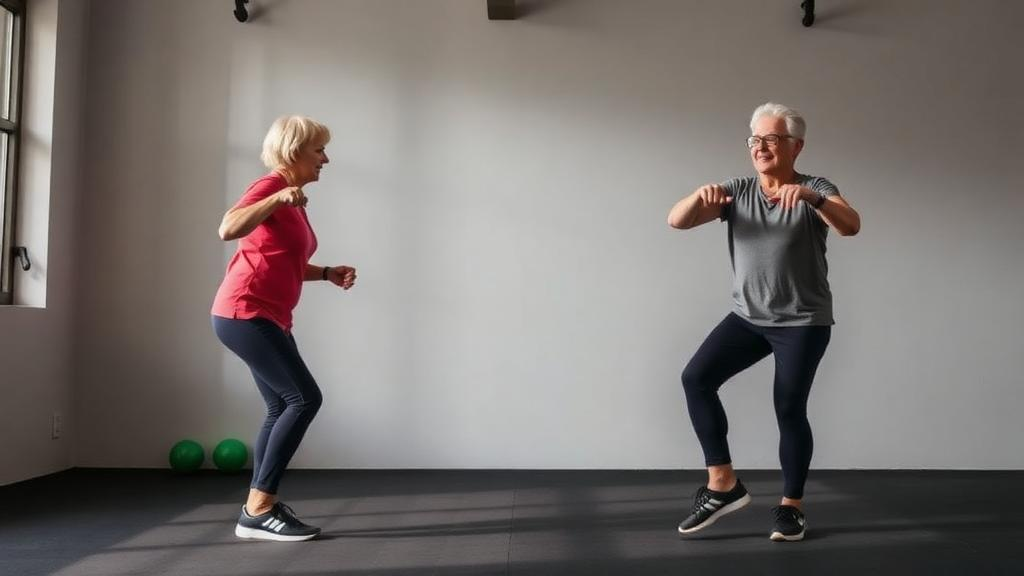
Unstable resistance training reduced muscle co-activation and improved balance more effectively than stable resistance training in older adults, while stable training produced broader gains in muscle-tendon stiffness, according to a randomized controlled trial published in the European Review of Aging and Physical Activity. Both twelve-week programs lowered knee pain, but the unstable version delivered a larger pain reduction, suggesting the two training styles may serve different goals rather than one being universally superior.
The trial, led by Ping Liu, Lele Chang, Yueyue Shi and Yaru Hao, enrolled fifty adults aged 65 to 75 and randomly assigned twenty-five to each arm. Forty-six participants, twenty-three per group, completed the intervention. Both groups performed the same seven lower-limb exercises with matched volume and intensity: squats, forward and lateral lunges, isometric wall sits, single-leg Romanian deadlifts, glute bridges and standing hip extensions. The stable group trained on firm ground with free weights, machines and elastic bands, while the unstable group performed identical movements on a BOSU ball, a balance disc and a physioball, progressing through a predetermined sequence of instability levels as tolerated.
Training was dose-matched. Both arms completed three sixty-minute sessions per week for twelve weeks, each consisting of a ten-minute warm-up, forty minutes of training and a ten-minute cool-down. Intensity was guided by the Borg rating of perceived exertion at a target of 6 to 7, with participants performing three sets of ten to fifteen repetitions per exercise. Loads were increased by 5 to 10 percent when participants consistently exceeded the upper end of the target range. Because the two programs visibly differed, participant blinding was not feasible, but the outcome assessors remained blinded to group allocation throughout data collection.
The researchers imaged the rectus femoris, vastus medialis and vastus lateralis of the quadriceps, the biceps femoris and semimembranosus of the hamstrings, plus the quadriceps and hamstring tendons. Secondary outcomes included muscle co-activation during squat-down, stand-up and transition phases of squatting, recorded with surface electromyography and analyzed with a time-varying multi-muscle co-activation function. Dynamic balance was tested with the Y-Balance Test, static balance with the Balance Error Scoring System, and pain with a ten-centimeter visual analogue scale.
After Holm adjustment for multiple comparisons, the unstable group showed greater reductions in co-activation than the stable group during all three movement phases: the transition phase at an adjusted p-value of 0.003, stand-up at 0.006 and squat-down at 0.035. Within the unstable group, co-activation fell significantly in all phases, while the stable group improved significantly only during stand-up. Co-activation, the simultaneous contraction of opposing muscle groups around a joint, is a stabilizing strategy that becomes excessive in many older adults, and the authors interpret its reduction as a sign of improved neuromuscular efficiency rather than weakness.
The stiffness findings were strikingly asymmetric. Unstable training increased stiffness only in the vastus medialis, the quadriceps tendon and the hamstring tendon, whereas stable training raised stiffness across essentially the full measured set of quadriceps and hamstring muscles and tendons. After adjustment, only the rectus femoris, vastus lateralis and vastus medialis comparisons remained statistically significant between groups. The authors propose that unstable training builds stiffness in key knee stabilizers through neural adaptations driven by balance demands, whereas stable training relies on heavier mechanical loading to thicken and stiffen a broader range of muscle-tendon units.
Balance outcomes favored the unstable group as well. Baseline-adjusted between-group comparisons showed larger improvements in the Balance Error Scoring System at an adjusted p-value of 0.016, in the right-leg Y-Balance composite score at 0.016, and in the left-leg score at 0.003. Within-group analysis showed that the unstable group improved significantly on all three measures while the stable group showed no meaningful change on any of them. The authors note that dynamic balance gains were numerically larger than static balance gains, which they attribute to the continuous sensorimotor demands of training on a non-fixed platform with progressively increasing instability.
Pain declined in both groups over the twelve weeks, but the reduction was larger after unstable training, with a between-group difference of p equal to 0.009 that remained significant after Holm adjustment. The authors caution that pain was a secondary, exploratory outcome in this trial and that the study was not primarily designed or powered around it, although the shared sample-size calculation was based on muscle stiffness and assumed a twenty percent dropout rate.
The trial has important limitations that the authors themselves highlight. There was no non-training control group, so the study cannot separate modality effects from the simple effect of doing resistance exercise. The registry entry was retrospective, the actual falls were never assessed, and the authors explicitly state that the balance improvements should not be interpreted as evidence of reduced fall risk. Minimal clinically important difference thresholds for the pain and balance outcomes were not prespecified, which limits judgments about clinical relevance. The eligibility criteria were narrow, restricted to independently mobile adults aged 65 to 75 without recent lower-limb pain, surgery or trauma, so generalization to frailer or clinical populations remains untested. The authors call for larger trials, longer follow-up of six to twelve months, and studies determining whether these laboratory gains translate into real-world functional independence. In the meantime, their practical conclusion is pragmatic: older adults and their trainers should choose unstable training when the priority is coordination and balance, and stable training when the priority is broader increases in muscle-tendon stiffness, with both options appearing to relieve knee pain.
Subject of Research: A randomized controlled trial comparing unstable versus stable resistance training effects on muscle stiffness, co-activation, balance and knee pain in older adults.
Article Title: Effect of 12-week unstable surfaces resistance training on muscle stiffness, muscle co-activation, and balance in older individuals
Article References: Liu, P., Chang, L., Shi, Y., & Hao, Y. (2026). Effect of 12-week unstable surfaces resistance training on muscle stiffness, muscle co-activation, and balance in older individuals. European Review of Aging and Physical Activity, 23(1), Article 39. https://doi.org/10.1186/s11556-026-00430-0
Image Credits: AI Generated
DOI: 10.1186/s11556-026-00430-0
Keywords: resistance training, unstable surfaces, older adults, muscle stiffness, co-activation, balance, randomized controlled trial, shear-wave elastography, knee pain, fall risk, BOSU ball, aging
News Source: Ophelia Keating. (October 29, 2026). Unstable Resistance Training Outperforms Stable Training for Balance and Coordination in Older Adults. Scienmag.



