Mud crabs farmed in floating cages spend their lives at the warmest layer of the pond, and that constant heat takes a measurable toll. A new study from India’s ICAR-Central Institute of Brackishwater Aquaculture reports that a simple, pump-operated submersible cage system, which sinks crabs to the cooler bottom water during the day, produced dramatically better growth, survival and feed efficiency than conventional floating cages over a 90-day grow-out trial. Crabs in the submerged units gained roughly 199 grams on average, compared with about 123 grams for crabs in floating cages, and every single submerged crab survived the full three-month experiment, while nearly a quarter of the floating-cage crabs died.
The research, published in the journal Aquaculture Science and Management, was conducted at the Muttukadu Experimental Station of ICAR-CIBA in a 200-square-metre HDPE-lined pond about 1.5 metres deep. Juvenile giant mud crabs, Scylla serrata, were collected from the wild by local fishermen and held in 600-litre tanks before the trial. Only crabs in the intermoult stage, with fully hardened exoskeletons, were selected, ensuring that all animals started from a comparable physiological condition. The chosen crabs averaged 109.65 grams in body weight and 81.56 millimetres in carapace width, and the initial weights did not differ significantly between the two treatment groups.
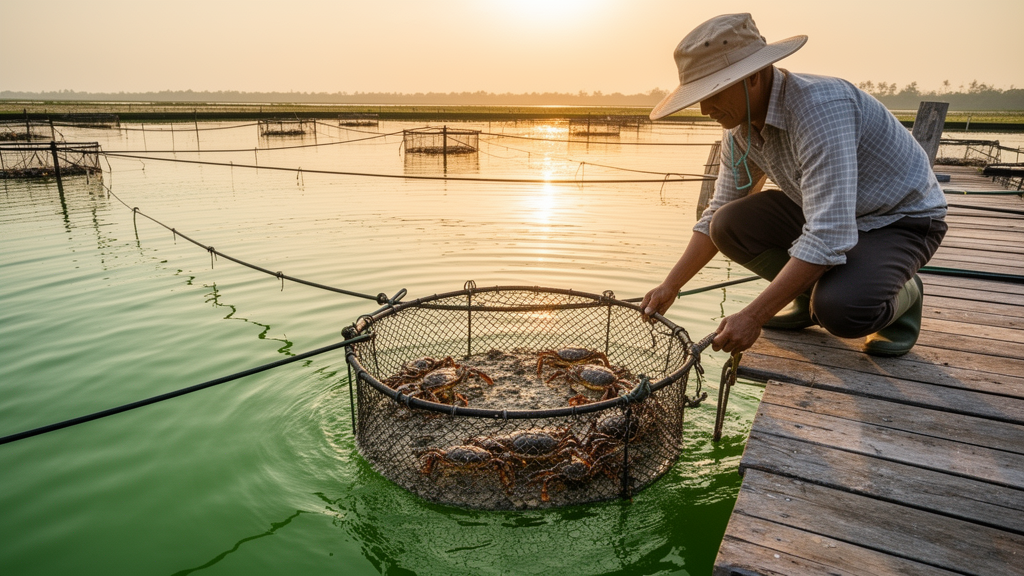
The experimental setup was deliberately simple. Each culture system consisted of a cylindrical PVC frame, 6.10 metres long and 0.91 metres wide, holding 24 blue HDPE boxes of 25-litre capacity, with one crab per box. Each box had holes at the base, sides and top for water exchange, a cut window for placing, feeding and removing the crab, and a copper-wire tie to prevent escapes. The frames were supported at the bottom by a handwoven coir net with a large mesh. The floating unit stayed at the pond surface around the clock, as commercial units do. The submersible unit, by contrast, was fitted with a bottom inlet and top outlet connected to a 0.5-horsepower self-priming motor pump on the pond dyke. Opening a pair of valves flooded the frame with pond water in about two minutes, sinking it to the pond bottom; reversing the valves emptied it in roughly a minute and a half, bringing it back up.
The daily routine gave the submerged crabs the best of both thermal worlds. The submersible unit sat on the pond bottom during the day, when surface heating is most intense, and was raised to the surface once daily at 9 a.m. for feeding. It then remained at the surface from 6 p.m. until the next morning’s feeding, giving a total surfacing duration of 15 hours per day. Crabs in both systems were fed chopped tilapia flesh twice daily, at 9 a.m. and 4 p.m., at a rate of 10 percent of body weight, and unconsumed fish was removed each morning. The pond’s salinity was kept below 30 grams per litre, and a paddle wheel aerator ran 15 hours a day to keep dissolved oxygen above 6 milligrams per litre.
Water quality monitoring at 15-day intervals confirmed that the two depth zones really did offer different thermal environments. Salinity ranged from 23 to 27 grams per litre, pH from 8.26 to 8.45, dissolved oxygen from 6.35 to 6.63 milligrams per litre, and turbidity from 14.64 to 15.50 NTU, all stable and within suitable ranges for mud crab culture. The key finding was thermal: at every sampling interval, surface water was significantly warmer than bottom water, with a steady difference of about 4 degrees Celsius maintained between the surface and the bottom throughout the experiment. Bottom water stayed in a cooler range of roughly 26 to 30 degrees Celsius, while surface water reached 31 to 34 degrees Celsius. Temperature readings were taken directly at the locations of the two culture units, so the contrast reflects the conditions the crabs actually experienced.
The biological results favoured the submerged crabs across every measured parameter. The specific growth rate averaged 1.13 percent per day in the submersible system versus 0.85 percent per day in the floating system, a statistically significant difference. Weight gain averaged 199.17 grams in the submerged units against 122.8 grams in the floating cages, corresponding to roughly 200 percent versus 125 percent relative weight gain. Size increment was also significantly higher underwater, at 40.07 percent compared with 28.43 percent. Survival told perhaps the starkest story: the submersible system maintained 100 percent survival across the entire culture period, while the floating system recorded 87.50 percent at 30 days, 85.71 percent at 60 days and 76.19 percent at 90 days.
Feed conversion efficiency moved in the same direction. The feed conversion ratio, calculated as feed given divided by body weight gain, was significantly lower in the submersible system at 4.61, compared with 6.54 in the floating system. In practical terms, the submerged crabs converted a larger share of their ration into body mass, wasting less feed on stress-driven metabolism. The authors attribute this to the cooler, more stable thermal regime, which likely reduced physiological stress and allowed more energy to be channelled into somatic growth rather than heat adaptation. They note, however, that the precise mechanism behind the improved feed utilization remains unclear, and earlier work has shown that temperatures above the optimum for mud crabs reduce survival, moulting success and growth, with optimal performance reported around 28 to 30 degrees Celsius.
The economic analysis, based on the trial’s costs and production, strengthened the case further. The submersible system required a higher fixed capital investment of 321.52 dollars versus 206.90 dollars for the floating system, but its crabs reached an average harvest weight of 415 grams with full survival, against 198 grams and 76.19 percent survival in the floating units. Despite higher feed and operating costs per cycle of 22.29 dollars and 46.87 dollars respectively, the submersible system generated a gross profit of 55.14 dollars per cycle for the 24-box unit, compared with just 2.08 dollars for the floating system. The benefit-cost ratio was 2.18 versus 1.06, and the cycle return on investment was 17.15 percent versus 1.00 percent. The submersible system paid back its capital in 5.83 cycles, roughly 18 months, while the floating system emerged as economically unviable under the trial conditions.
The study’s authors are careful to frame these results within their scope. The work was a pond-based comparison under tropical enclosed conditions at a single research station, with 24 individually reared crabs per treatment, and it measured growth performance, feed utilization, survival and selected economic indicators. The conclusions state that crab health status, internal physiology, nutritional status and behavioural responses to the different rearing systems were not assessed, and that the economic feasibility, operational challenges and scalability of submersible cages under commercial farming conditions were not comprehensively addressed. The authors suggest these gaps as priorities for further research, alongside the potential integration of sensor-based monitoring, machine learning and artificial intelligence to optimize environmental control and feeding in submerged systems.
Even with those caveats, the findings point to an appealingly low-tech solution to a growing problem. Mud crab farming began in India in the early 1980s and expanded rapidly in Andhra Pradesh and Kerala, and interest in the species has surged as marine crab landings declined during 2020 and 2021, driven by strong export demand for live crabs in Southeast Asian markets. Because mud crabs are aggressive and cannibalistic, individual boxes or cages outperform conventional group stocking in earthen ponds, but surface-based platforms expose the animals to temperature swings and heat stress, epiphytic algal fouling and mortality. By exploiting the natural temperature gradient of a shallow tropical pond, letting crabs retreat to cooler water during the hottest part of the day, the submersible design turns an existing physical feature of the pond into a thermal refuge. For farmers in tropical environments facing warming conditions, the study suggests that a PVC frame, a modest pump and a daily flooding routine may be enough to keep crabs cooler, growing faster and surviving longer.
Subject of Research: A submersible cage system for mud crab grow-out culture that improves growth, survival and profitability compared with floating cages
Article Title: Development of a submersible cage system for mud crab (Scylla serrata) grow-out operations: an efficient and sustainable method for enhancing growth and survival
Article References: Sarkar, S., Balasubramanian, C. P., Rekha, P. N., Sivagnanam, S., Ghoshal, T. K., Datta, J., Raja, R. N., & Vijayan, K. K. (2026). Development of a submersible cage system for mud crab (Scylla serrata) grow-out operations: an efficient and sustainable method for enhancing growth and survival. Aquaculture Science and Management, 3(1), Article 7. https://doi.org/10.1186/s44365-026-00036-8
Image Credits: AI Generated
DOI: 10.1186/s44365-026-00036-8
Keywords: mud crab, Scylla serrata, aquaculture, submersible cage, floating cage, water temperature, growth performance, survival, feed conversion ratio, brackishwater pond, economic analysis, India
News Source: Alan Morgan. (October 29, 2026). Submersible Cages Keep Mud Crabs Cooler and Boost Growth and Survival. Scienmag.