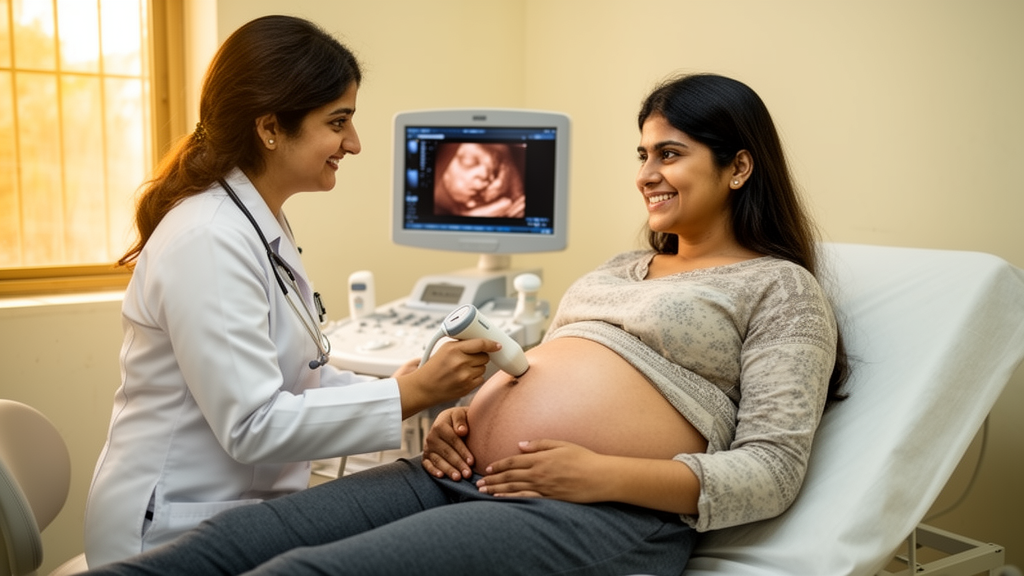
A small qualitative study in a peri-urban community of Karachi, Pakistan, has found that both pregnant women and the healthcare providers who scan them view handheld point-of-care ultrasound, or POCUS, as an acceptable and practical addition to antenatal care. The research, published in BMC Digital Health, interviewed six pregnant women and three healthcare providers at a primary health center in Bhains Colony and identified five shared themes: the role of ultrasound, the perceived utility of POCUS, its limitations and areas for improvement, myths and misconceptions surrounding ultrasound, and recommendations for future use.
The study was conducted between June and September 2025 at a Primary Health Center in Bhains Colony, a densely populated neighborhood of roughly 140,000 people in Bin Qasim Town along Karachi’s coastal belt. The participants were drawn from an ongoing parent study called the Fetal Age Machine Learning Initiative, a prospective cohort in which pregnant women are enrolled during antenatal care and followed through delivery. In that study, POCUS scans are performed alongside conventional ultrasound at each visit to support the development and validation of models that estimate gestational age and assess fetal lie, placental location, and amniotic fluid volume.
The researchers used purposive sampling and in-depth interviews lasting 30 to 45 minutes, conducted in Urdu in a private room at the health center. Eligible women were aged 15 to 49, able to communicate in Urdu, and had received at least one POCUS scan in the preceding three months to ensure reliable recall. Interviews continued until thematic saturation was reached, meaning no new themes emerged from successive interviews; for the women, this occurred after six interviews. The three providers interviewed represented a complete census of the POCUS-trained staff at the site: one expert sonologist and two community-based health workers who had completed a one-time eight-hour training covering device handling, probe placement, and identification of key anatomical positions, with competency assessed through direct observation before independent scanning.
Analysis followed Braun and Clarke’s six-step thematic framework, with transcripts transcribed verbatim in Romanized Urdu, translated into English, coded in Dedoose, and refined through consensus meetings. The interview guides were built around constructs of the Technology Acceptance Model, a framework describing how perceived usefulness and perceived ease of use shape acceptance of a technology. The authors report that the findings aligned with these constructs: both groups saw POCUS as useful for rapid fetal assessment, and providers highlighted its portability and user-friendly interface.
The accounts from the two groups diverged in a revealing way. Women’s confidence in the device was driven largely by the reassurance of seeing the fetus directly during brief scans, which the authors say helped build trust in the care received. One participant described the scan in vivid terms: “Ultrasound is important because we can see everything about the baby…how the brain is, how the hands are, how the kidneys are, how the legs are.” Providers, by contrast, held a more cautious view of what the device could diagnose, emphasizing accurate gestational dating, evaluation of fetal growth, and early detection of complications rather than the emotional reassurance that dominated women’s accounts.
Practical advantages featured prominently on both sides. Women valued the device’s small size, speed, and the reduced need to travel to facilities for imaging; one noted that the handheld device “gets done quickly,” whereas the conventional machine required traveling to the center. Providers appreciated the simple interface and envisioned home-based scanning for women who could not reach the facility. “If a patient has an emergency, we can quickly go to her home and scan her,” one provider said, describing checks of the fetal heartbeat and movements. Some women initially felt anxious on first encountering the unfamiliar device but reported feeling comfortable once staff explained the procedure and its purpose.
The study also documented meaningful limitations. Providers acknowledged that handheld devices have lower resolution than conventional machines and are less suitable for detecting complex abnormalities or providing detailed imaging, a perception the authors note is supported by comparative evidence showing conventional ultrasound produces higher image quality, particularly in obstetric scanning. Some women preferred conventional ultrasound, shaped by prior experience and the belief that a full formal scan offers greater diagnostic assurance. “The big machine seems better,” one participant said. Providers further identified ongoing training and reliable technical support as prerequisites for sustained use, with one stating that proper implementation would require organized training programs.
Misconceptions emerged as a distinct barrier. Women described community beliefs that repeated scans expose the baby to radiation and could harm its eyes, concerns the authors note are not directly related to POCUS itself but to ultrasound more broadly. Providers reported that some patients feared the handheld device was a “different” ultrasound that might harm them or the baby. In response, providers recommended community education sessions to explain the purpose, safety, and benefits of POCUS and to build trust. Both groups nonetheless expressed strong support for continued and expanded use of POCUS in community-based antenatal care.
The authors situate their findings in a wider literature. A community-based study in the Philippines reported that handheld ultrasound performed by trained providers identified abnormalities in 31.7% of pregnancies and estimated that timely referral enabled by its use could avert up to 6.3% of maternal and 14.6% of neonatal deaths. In rural Zambia, 21 midwives performed 441 scans over six months, with 17% of cases leading to changes in clinical decision-making, and Kenyan studies have linked POCUS in rural clinics to improved timely referral for high-risk pregnancies. Qualitative work from rural Nepal reported that trained birth attendants viewed decentralized ultrasound services as beneficial for earlier identification of high-risk cases, and a mixed-methods study of providers in Africa found that more than 75% believed POCUS would improve antenatal attendance and clinical decision-making, provided strong referral pathways existed.
The authors are careful about the study’s scope. It was conducted at a single peri-urban site, included only three providers whose views may have been disproportionately shaped by the expert sonographer among them, and recruited women already enrolled in the parent POCUS study at the same institution conducting the interviews, raising the possibility of social desirability and selection bias. Women with negative views may have been less likely to volunteer, and the findings reflect the perceptions of women already exposed to the device rather than POCUS-naïve women, whose acceptability may differ. Within these limits, the study suggests that obstetric POCUS is acceptable and feasible when integrated into existing antenatal services in this setting, and that scale-up will require structured training, ongoing technical support, community engagement to address misconceptions, and strong referral linkages. The authors conclude that prospective outcome studies are needed to confirm any impact on maternal and neonatal outcomes.
Subject of Research: Perceptions of obstetric point-of-care ultrasound among pregnant women and healthcare providers in peri-urban Karachi, Pakistan
Article Title: Providers’ and pregnant women’s perspectives on obstetric point-of-care ultrasound use in peri-urban Karachi, Pakistan: a qualitative study
Article References: Hussain, L., Yazdani, N. S., Khalid, A., Ahmed, F., Javed, H., Fatima, I., Nisar, I., Jehan, F., Rittenhouse, K., Freeman, B. L., Stringer, J., & Hoodbhoy, Z. (2026). Providers’ and pregnant women’s perspectives on obstetric point-of-care ultrasound use in peri-urban Karachi, Pakistan: a qualitative study. BMC Digital Health, 4(1), Article 64. https://doi.org/10.1186/s44247-026-00295-4
Image Credits: AI Generated
DOI: 10.1186/s44247-026-00295-4
Keywords: point-of-care ultrasound, antenatal care, Pakistan, qualitative research, pregnancy, healthcare providers, Technology Acceptance Model, LMICs, maternal health, community health, portable ultrasound, misconceptions
News Source: Harold Sullivan. (October 29, 2026). Handheld ultrasound wins trust of pregnant women and providers in Karachi. Scienmag.