


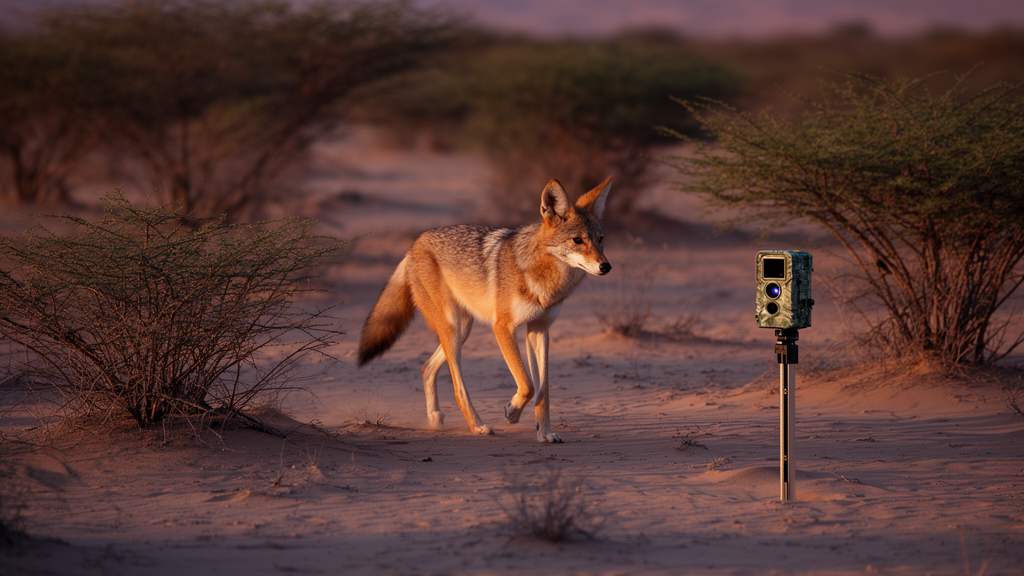
Camera traps in King Abdulaziz Royal Reserve have photographed two golden jackals (Canis aureus) in Riyadh Province, Saudi Arabia, marking the first confirmed record of the species in this part of the country. The images, captured on 2 October 2025 at Rawdat At-Tanhat within the reserve, extend the documented range of a canid that has historically been recorded only sparsely and patchily across the Arabian Peninsula. The finding, published in Discover Life, is significant less because the golden jackal is rare globally—it is classified as Least Concern on the Arabian Peninsula—and more because it fills a conspicuous gap in the species’ known distribution in east-central Arabia.
The detection came from a systematic camera-trapping program rather than an incidental sighting. Researchers deployed a network of 103 remote-sensing infrared cameras across the reserve, comprising 70 Bushnell Trophy Cam HD E3 units and 33 GardePro A3S models. The reserve was divided into equal-sized grid cells of 10 by 10 kilometers, with traps placed systematically at suitable locations within these cells—a standard sampling design in wildlife monitoring. Cameras were mounted on stands at a height of 40 centimeters to target large and medium-sized mammals. Data collection ran from late January to the end of October 2025, accumulating 304 trap-nights of effort, with monthly maintenance visits to replace batteries and retrieve images.
The two golden jackal photographs were taken by a single GardePro A3S camera positioned at Wahet At-Tanhat, an artificial lake created in 2025 in the northwestern part of Rawdat At-Tanhat. The images were recorded at 05:24:50 and 05:31:39 in the morning, and they show two adult animals. The authors matched the animals’ appearance against published descriptions of the species to confirm the identification. The golden jackal is a medium-sized canid whose coat is fundamentally golden but varies seasonally from light creamy yellow to deep tawny, with the pelage on the back often a mixture of black, brown, and white hairs that creates the appearance of a dark saddle. The underparts are pale ginger to cream, and the bushy tail carries a black tip.
The wider sampling results underline just how scarce the species is at this location. Across the full survey period, the camera network registered 4,343 independent detection events corresponding to 12 mammalian species within the reserve. Only two images of golden jackals were captured among those thousands of records, a relative abundance of 0.046 percent. Against this backdrop of intensive, sustained effort, a single pair of detections stands out as an unusually thin signal.
The authors weigh several explanations for this extremely low detection rate. One possibility is that golden jackals occur at very low density within the reserve, perhaps reflecting marginal habitat suitability or limited resource availability in parts of the study area. Another is that the species behaves cryptically and moves over wide areas, reducing the probability of capture even under intensive camera trapping. A third interpretation is that the animals use the landscape in a spatially restricted way, concentrating around specific resource-rich spots such as artificial wetlands, which limits their encounters with systematically distributed cameras. Taken together, the mismatch between high sampling effort and very low detection probability suggests that the golden jackal’s presence in the reserve is likely localized rather than widespread, and that the species may not yet be fully established across the area but instead occurs sporadically or in low numbers.
King Abdulaziz Royal Reserve itself is a striking setting for the record. Founded in 2018 and included on the IUCN Green List in 2025, the reserve lies roughly 70 kilometers north of Riyadh and encompasses 28,345 square kilometers spanning the Riyadh and Eastern Provinces. The climate is hot desert under the Koppen-Geiger classification: summers from June to September are arid and oppressive, winters from November to April are humid with intermittent substantial rainfall, and temperatures range from 6.7 degrees Celsius in winter to 42.8 degrees in summer, with unusual peaks above 50 degrees. Annual precipitation averages just 66 millimeters.
Within this harsh matrix, Rawdat At-Tanhat is the reserve’s most extensive rawdah, or vegetated lowland plain, covering approximately 32 square kilometers and bordered by the Al-Dahna sand dunes to the east and north. Its soils are predominantly sand and loamy sand, and its topography includes water channels, water accumulation areas, depressions, and sandy plains. Wadis such as Wadi Al Ataq, Wadi Al Shouky, and Wadi Al Tairy channel accumulated water from the west and south into the low-lying area, improving soil quality and supporting richer vegetation than surrounding terrain. More than eighty plant species grow there, dominated by Vachellia gerrardii and Ziziphus nummularia trees alongside perennial subshrubs and herbs, with seasonal wildflowers flourishing in spring. In 2025, the artificial Wahet At-Tanhat lake was created in the northwestern part of the plain, replenished with fresh water and surrounded by indigenous flora to function as an attractive habitat for mammals and birds.
Until now, the golden jackal’s documented presence in Saudi Arabia rested on a handful of scattered records. Early studies reported a single record south of Al Jouf and no presence in Harrat al-Harrah Protected Area, while later assessments suggested the species was largely restricted to the eastern regions around Hofuf and Al Asfah. More recent evidence has broadened but not filled the picture: a juvenile was photographed near Jubail in the Eastern Province in 2017, and camera traps detected the species near Qa’ Sharorah pools in Tabuk and on Abu Ali Island within Al Jubail Marine Wildlife Sanctuary. Two occurrences were also documented in the Prince Mohammed bin Salman Royal Reserve in the Tabuk region, suggesting an extension of the species’ western distribution within the country. The new Riyadh Province record therefore connects a previously empty space between these fragmented points on the map.
Whether the record reflects a genuine range expansion or simply better detection is a question the authors treat with caution. They note that the observed extension may be attributable to insufficient survey coverage in underexplored or inaccessible areas before the reserve’s establishment, which created knowledge gaps, and that the creation of KARR has enabled more comprehensive surveys. Indeed, they argue the detection is best interpreted as a response to localized resource availability rather than a true expansion: individuals were likely already present in the surrounding desert matrix but became more detectable after the creation of artificial water resources such as Wahet At-Tanhat, which can increase wildlife activity and aggregation without necessarily changing underlying distribution patterns. Distinguishing between genuine range expansion and previously undocumented presence will require long-term monitoring.
The finding also raises ecological questions about how the species fits into the reserve’s carnivore community. In KARR, the golden jackal coexists with the Arabian wolf (Canis lupus arabs), the Arabian red fox (Vulpes vulpes arabica), and the wildcat (Felis lybica), and significant dietary niche overlap has been documented between the golden jackal and both the Arabian wolf and the red fox, so native species may be affected as the jackal begins competing for habitat and resources. On the Arabian Peninsula more broadly, the species is classified as Least Concern owing to its broad distribution and an estimated steady population exceeding 1,000 adult individuals, and unlike the darker C. aureus subsp. syriacus of the Levant, Arabian golden jackals of the nominate subspecies often display lighter fur. Conservation context matters here too: the species has been assessed as warranting high priority within Saudi Arabian nature reserves, with indiscriminate killing of canids implicated in its restricted distribution. For now, the two photographs from Rawdat At-Tanhat serve as a foundation—confirmation that the golden jackal has reached Riyadh Province, and a prompt for the biological, ecological, and population studies needed to understand what its presence means for the reserve and its native fauna.
Subject of Research: First camera-trap record of the golden jackal in Riyadh Province, Saudi Arabia
Article Title: First record of golden jackal, Canis aureus, Linnaeus 1758, in Riyadh Province, Saudi Arabia
Article References: Alzahrani, A. S., Younes, M. I., Eisa, A. M., Alrefae, A. S., Riad, S. A., Alqahtani, A. M., Alkhamis, H. H., Alowaifeer, A. M., & Alrefaei, A. F. (2026). First record of golden jackal, Canis aureus, Linnaeus 1758, in Riyadh Province, Saudi Arabia. Discover Life, 56(1), Article 34. https://doi.org/10.1007/s11084-026-09754-4
Image Credits: AI Generated
DOI: 10.1007/s11084-026-09754-4
Keywords: golden jackal, Canis aureus, Riyadh Province, Saudi Arabia, camera trapping, King Abdulaziz Royal Reserve, wildlife distribution, range expansion, conservation, mammal survey, arid habitat, Rawdat At-Tanhat
News Source: Margaret Porter. (October 29, 2026). Camera Traps Photograph Golden Jackals in Riyadh Province for the First Time. Scienmag.



