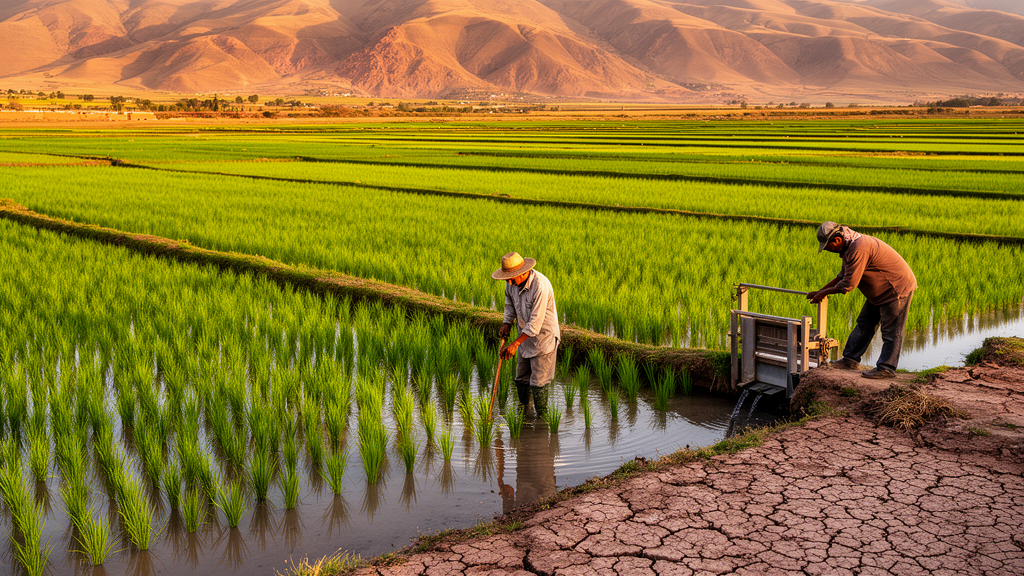
Rice farmers in one of Peru’s most productive irrigation valleys may be able to cut their water use substantially without sacrificing harvests, according to a new field study conducted in the Chira Valley of Piura, Peru. Researchers from Peru’s National Institute of Agricultural Innovation (INIA) tested four seasonal irrigation allocations on the locally important cultivar INIA 515-CAPOTEÑA and found that reducing water inputs by up to 23.5% significantly increased irrigation water productivity while producing no statistically significant differences in grain yield. The findings, published in Frontiers in Agronomy, come at a time when water scarcity and climate change are placing mounting pressure on irrigated rice systems worldwide.
The experiment was carried out during 2025 at three locations within the Chira Valley: the El Chira Agricultural Experimental Station in the district of Marcavelica, the village of Cerro Mocho in the district of Ignacio Escudero, and the town of Viviate in the district of La Huaca. El Chira was evaluated during the 2025-I growing season, with sowing in February, while Viviate and Ignacio Escudero were evaluated during the 2025-II season, with sowing in August. Because location and growing season were not evaluated independently, the researchers analyzed them jointly as site-season environments. The study used a randomized complete block design with six blocks at El Chira and three blocks at each of the two producer fields, totaling 48 experimental subplots across the three environments.
Four irrigation treatments were compared: a conventional control of 17,000 cubic meters per hectare (T0), representing the reference allocation established by the Chira Valley Water Users Association and traditionally applied by local farmers, and three reduced allocations of 15,000 (T1), 14,000 (T2), and 13,000 cubic meters per hectare (T3). These corresponded to target reductions of approximately 11.8%, 17.6%, and 23.5% relative to the conventional volume. Irrigation frequency was identical across all treatments; only the target seasonal allocation differed. Water delivery was measured precisely using sharp-crested rectangular weirs fitted with galvanized steel gates, and the actual cumulative volumes applied showed only minor deviations from the predefined targets. The researchers note that soil moisture and field water-balance components were not monitored, so the treatments should not be interpreted as quantified levels of crop water deficit.
The results were striking in their consistency. Grain yield ranged from 11.19 to 11.81 tonnes per hectare across treatments, with the reduced-irrigation treatment T2 actually producing the highest average yield at 11.8 tonnes per hectare and T1 the lowest at 11.2 tonnes per hectare. Analysis of variance and Tukey’s multiple comparison test placed all treatments in the same statistical group, meaning no significant yield differences were detected. Grain yield was also unaffected by site-season environment or the treatment-by-environment interaction. The cultivar’s yield potential of up to 12 tonnes per hectare, reported in earlier work, was consistent with the yields achieved under all four water regimes.
Irrigation water productivity, calculated as grain yield per unit of irrigation water applied, told a very different story. Mean values rose progressively as irrigation volumes fell, from 0.68 kilograms per cubic meter under the conventional treatment to 0.74, 0.84, and 0.87 kilograms per cubic meter under T1, T2, and T3, respectively. Compared with the conventional allocation, the two lowest irrigation volumes increased irrigation water productivity by approximately 24% and 28%. Tukey’s test confirmed that treatments receiving the lowest irrigation volumes had significantly higher water productivity than the conventional treatment. The authors caution, however, that because the study did not directly quantify crop water requirements or losses through evaporation, runoff, or deep percolation, the mechanisms underlying this increase cannot be directly determined.
Most agronomic traits also showed no significant response to irrigation volume. Plant height ranged from 87.42 to 89.74 centimeters, tillers per hill from 29.75 to 32.0, and panicles per square meter from 29.28 to 31.33 across treatments, with only small numerical differences. The single exception was grain width, which showed a statistically significant treatment effect (p = 0.0489), though the differences were modest, with mean widths ranging from 2.34 to 2.40 millimeters. Grain quality was similarly resilient: head rice, broken rice percentages, chalky grains, and the numbers of filled, unfilled, and black grains per panicle were all unaffected by irrigation treatment within the range evaluated. Head rice ranged from 59.19% to 61.18%, broken rice from 8.17% to 9.71%, and chalky grains from 12.67% to 15.83% across treatments, with no consistent pattern associated with water volume.
Where the crop did respond strongly was to environment rather than irrigation. Site-season environment significantly affected grain length, tillers per hill, panicles per square meter, broken rice, chalky grains, and the number of unfilled grains per panicle. The El Chira Agricultural Experimental Station, which had a sandy clay loam soil with the lowest organic matter and available phosphorus and the most alkaline pH of the three sites, generally showed the lowest values for the agromorphological traits evaluated. Ignacio Escudero, with a clay loam soil, the highest clay content at 37.1%, and a near-neutral pH of 6.5, and Viviate, with a loam soil, differed in ways the authors attribute to the combined influence of soil properties and growing-season conditions. Because location and season were confounded in the design, these effects cannot be fully separated, and the authors stress that the observed differences should be interpreted as combined site and seasonal responses rather than being attributed exclusively to soil properties.
The study’s authors are careful to frame their findings within their limitations. Only one cultivar was evaluated, and rice responses to reduced water availability are known to vary considerably with genotype, as previous studies have documented significant genotype-by-irrigation interactions for yield components, water-use efficiency, and physiological traits. Physiological variables such as leaf water potential, stomatal conductance, and root biomass were not measured, and soil moisture dynamics were not monitored. The authors also note that the land-leveling method, based on traditional puddling practices, may have caused slight variations in water distribution among plots, and they suggest future work should consider laser land leveling, additional cultivars, multiple growing seasons, and complementary strategies such as alternate wetting and drying.
From a physiological perspective, the authors propose that the absence of yield differences under moderate irrigation reductions could involve mechanisms regulating root water uptake and transpirational water loss, including aquaporin-mediated adjustments and abscisic acid-regulated stomatal closure, but they emphasize these remain plausible explanations rather than experimentally demonstrated responses, since none of these processes were measured. They also point to earlier research showing that water-saving strategies maintain yield only up to a threshold beyond which further savings become agronomically detrimental, and they caution that maximum allowable depletion percentages in other studies should not be directly equated with the percentage reductions in irrigation applied here.
For the Chira Valley, where rice production depends heavily on irrigation and Piura contributes roughly 14% of Peru’s national paddy rice production, the practical implications are considerable. The authors suggest the findings could inform more efficient scheduling of irrigation duration and frequency, better matching of irrigation volumes to crop demand, and improved estimation of irrigation water demand in annual water-resource planning, including decisions about how much area can be supplied under available water allocations. They note that the results refer to water productivity at the field level and do not directly quantify the operational efficiency of the irrigation distribution system, so implementation would require coordination among farmers, water-user organizations, and water management institutions, along with technical assistance for irrigation scheduling and flow measurement. Within the range of irrigation volumes evaluated, the reduced irrigation strategies may offer a practical approach to improving the sustainability of rice production in the valley by lowering water inputs without producing statistically significant reductions in crop productivity, though the authors emphasize that broader applicability across cultivars and growing seasons still requires further assessment with direct measurements of soil and crop water status.
Subject of Research: Reduced irrigation volumes and their effects on rice yield, grain quality, and irrigation water productivity in the Chira Valley, Peru
Article Title: Grain yield, milling quality, and irrigation water productivity of rice under reduced irrigation in the Chira Valley, Peru
Article References: Alberca, L., Casas-Niño, S., Palomino, M., Ramirez Rojas, M., & Vilela Pingo, J. L. (2026). Grain yield, milling quality, and irrigation water productivity of rice under reduced irrigation in the Chira Valley, Peru. Frontiers in Agronomy, 8, Article 1939924. https://doi.org/10.3389/fagro.2026.1939924
Image Credits: AI Generated
DOI: 10.3389/fagro.2026.1939924
Keywords: rice, irrigation water productivity, water scarcity, Chira Valley, Peru, grain yield, grain quality, INIA 515-CAPOTEÑA, field experiment, water management, Oryza sativa, sustainable agriculture
News Source: Alan Morgan. (October 29, 2026). Cutting Irrigation by Up to 23.5% Boosted Rice Water Productivity Without Yield Loss in Peru. Scienmag.