


Plant conservation has long been framed as a technical, ecological problem: count the species, map the habitats, manage the reserves. But a new bibliometric analysis suggests that the research literature itself reflects a persistent biological bias, even within the disciplines that are supposed to bring human perspectives into the picture. The study, published in Neotropical Biology and Conservation, examined three decades of publications on plant conservation indexed in the social sciences and humanities, and found that ecological and technical themes still dominate the conversation while sociocultural dimensions are increasingly pushed to the margins.
The research team searched the Scopus database on 13 September 2025 using the exact phrases “plant conservation” or “plants conservation” in article titles, abstracts and keywords, restricted to documents published between 1995 and September 2025. The initial search retrieved 1,917 records, most of them indexed in Agricultural and Biological Sciences and Environmental Science. When the search was narrowed to publications indexed in the Social Sciences and Arts and Humanities subject areas, only 119 records remained. Of those, 111 were articles, seven were book chapters, six were reviews, and one each was a data paper and a note. Nearly all were in English, with a handful in Portuguese, Spanish, Chinese, Italian, Indonesian and German. All 119 records were indexed in Social Sciences, and 19 were also indexed in Arts and Humanities.
To map the intellectual structure of this small but revealing body of literature, the researchers used VOSviewer, a software package for constructing and visualizing bibliometric networks. They performed a co-occurrence analysis of authors’ keywords, applying fractional counting so that documents generating many keyword links would not disproportionately shape the network. A minimum occurrence threshold of three produced a preliminary list of 73 keywords, which the team then screened manually. Thirty-two terms were excluded according to predefined criteria: broad concepts inherent to the search scope, redundant plural or alternative forms, ten geographical terms such as China, India and Europe that would have reflected study locations rather than research topics, and generic demographic or contextual descriptors. That left 41 keywords for the final network.
The co-occurrence network grouped these keywords into five clusters, four of which were large enough to be interpreted as major thematic areas. “Biodiversity” was the most frequent keyword of all, appearing in 32 publications and sitting at the center of the network as a connecting axis between clusters. The next most frequent terms were “ethnobotany,” “medicinal plant,” “environmental protection,” “conservation management,” “conservation of natural resources” and “sustainability.”
The largest group, the red cluster, contained 11 keywords and was named Plant Conservation Biology. Its most frequent terms, in descending order, were “biodiversity,” “conservation management,” “species richness,” “species conservation” and “conservation planning.” This cluster represents a classic line of ecological research focused on species richness and diversity, the spatial distribution of biodiversity, and the planning and management of protected areas. In other words, even within the social sciences and humanities subset of the literature, the biophysical core of plant conservation research remains firmly ecological and technical.
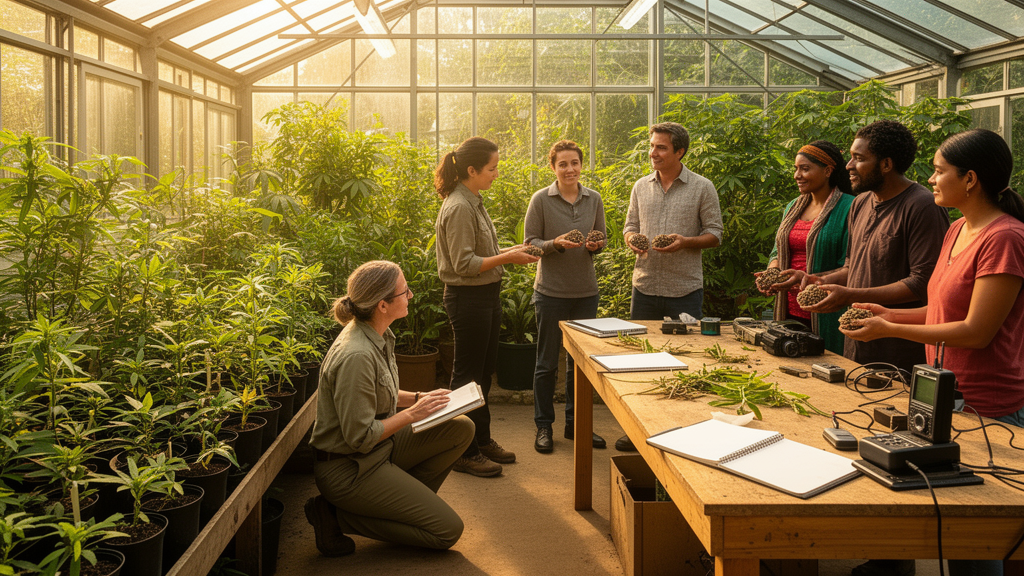
The second-largest group, the green cluster, comprised 10 keywords and was labeled Ethnobotany and Medicinal Plants. Its leading terms were “ethnobotany,” “medicinal plant,” “environmental protection,” “conservation of natural resources” and “knowledge.” This area covers the traditional use of plants, traditional and modern plant-based medicine, cultural harvesting practices, and environmental protection linked to the use of natural resources. The co-occurrence of terms such as ethnobotany, medicinal plants, traditional medicine and knowledge points to an important role for local and traditional knowledge, including its intergenerational transmission, in supporting biocultural conservation.
Two further clusters of nine keywords each rounded out the picture. The blue cluster, named Sociocultural Dimensions of the Conservation of Useful Plants, grouped terms such as “sustainability,” “traditional knowledge,” “useful plants,” “environmental education,” “agroforestry” and “livelihood,” linking conservation to community well-being, rural economies and the cultural and religious values of rural communities. The yellow cluster, Plant Biodiversity, included “conservation status,” “plant community,” “vegetation,” “species diversity” and “introduced species,” and was characterized predominantly by ecological terms related to floristics and plant communities, particularly in grasslands and national parks, though it also incorporated local participation in sustainable management. A fifth, purple cluster contained only two keywords, “ecosystem” and “botanical garden,” and was too small to count as a separate thematic area.
The temporal analysis revealed a striking pattern in research output. From 1995 to 2017, fewer than five documents on plant conservation were published annually within the social sciences and arts and humanities. From 2018 onward, annual counts generally rose, exceeding seven publications per year except in 2023, and the highest annual count was recorded in 2024, with 15 publications. Scientific output in this niche has therefore grown notably in recent years, even though it remains a small fraction of the overall plant conservation literature.
An overlay visualization, which colors keywords according to the average publication year of the documents in which they occur, showed that keywords with different average publication years coexist within all four thematic areas. Terms such as “agroforestry,” “harvesting,” “protected area,” “religion” and “rural economy” were associated with earlier average publication years, appearing in cooler colors. In contrast, “conservation planning,” “conservation status,” “ecosystem service,” “grassland,” “native plants,” “spatial distribution,” “spatiotemporal analysis,” “species richness” and “vascular plant” were associated with more recent average publication years, appearing in warmer tones. Notably, this pattern was particularly evident in the red cluster, meaning that the ecological and technical vocabulary of plant conservation biology is the most strongly represented among the most recent publications.
The study’s conclusions carry a warning as well as a roadmap. The analysis shows a strong representation of ecological perspectives in plant conservation research alongside a more limited representation of local knowledge and community participation, even within disciplines dedicated to the human dimensions of science. The authors argue that this matters because plant conservation is particularly vulnerable to “plant awareness disparity,” the tendency to overlook plants in the environment and undervalue their importance to the biosphere and society. When plant species lose cultural relevance, community motivation to transmit intergenerational knowledge about them declines, weakening the social base that underpins conservation. Local and traditional knowledge also remains poorly integrated into public conservation policies, which can cause locally developed sustainable management practices to be overlooked or displaced by formal approaches, while technocratic approaches that prioritize biological or economic criteria over social considerations can lead to socio-environmental conflicts. As remedies, the authors recommend strengthening biocultural approaches that integrate ecological metrics with traditional knowledge, giving priority to livelihoods, sustainability and traditional knowledge in future research, and designing collaborative projects that actively involve local communities from project design through implementation. Institutional and communication barriers, they note, continue to hinder the incorporation of the social sciences into conservation planning, and overcoming them will require genuine epistemic co-production rather than the superficial incorporation of concepts such as participation or culture into conservation policies.
Subject of Research: A bibliometric analysis of plant conservation topics in social sciences and humanities literature from 1995 to 2025
Article Title: An overview of plant conservation from the perspective of the social sciences and humanities
Article References: Carrió, E., & Barona, E. (2026). An overview of plant conservation from the perspective of the social sciences and humanities. Neotropical Biology and Conservation, 21(4), 339-353. https://doi.org/10.3897/neotropical.21.e204690
Image Credits: AI Generated
DOI: 10.3897/neotropical.21.e204690
Keywords: plant conservation, bibliometrics, ethnobotany, traditional knowledge, biodiversity, conservation social science, VOSviewer, keyword co-occurrence, biocultural approaches, Scopus, medicinal plants, community participation
News Source: Margaret Porter. (October 29, 2026). Plant Conservation Research Still Overlooks the Social Sciences, Study Finds. Scienmag.



