


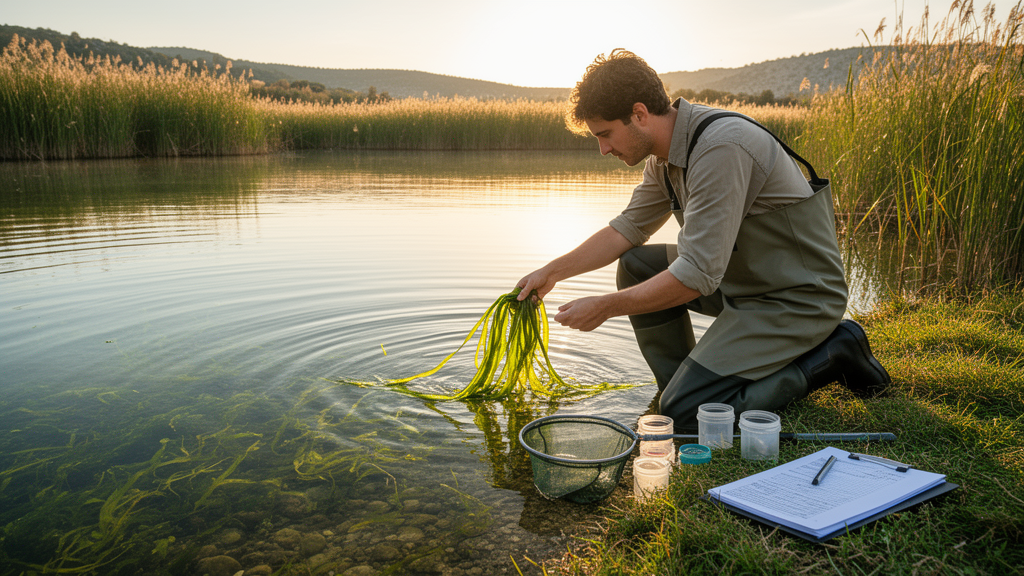
A nine-year sweep of Croatia’s rivers and lakes has produced the first comprehensive picture of where the country’s pondweeds grow. Drawing on national surface water monitoring conducted from 2016 to 2024, researchers recorded ten species of Potamogeton, one species of Stuckenia and one hybrid, Potamogeton × cooperi, across 646 running water sites and 42 standing waterbodies spanning both the Pannonian and Dinaric Ecoregions. The survey, published in the Biodiversity Data Journal, analysed distribution patterns in relation to ecoregion, catchment size, hydromorphological alteration, reference vegetation type and the company each species keeps.
Pondweeds are far more than botanical curiosities. As rooted, submerged or floating aquatic plants, they act as ecosystem engineers: they modify physical and chemical conditions in the water, influence hydrology and sediment dynamics, contribute as primary producers, regulate nutrient cycling and provide structural habitat and shelter for other organisms. Because different taxa have different ecological optima and tolerances, their presence or absence can signal the health of a waterbody, including its level of degradation or trophic status. That makes a systematic national inventory a practical tool for water management, not just an academic exercise.
The standout finding is the ecological versatility of Potamogeton nodosus, the long-leaved pondweed with floating as well as submerged leaves. It was the most frequent taxon by a clear margin, occurring in 179 of all investigated watercourse sampling sites, or 27.7 percent. Although most of those sites sit in the Pannonian Ecoregion, P. nodosus was also the most frequent species in both Dinaric subecoregions, with records in the Continental–Dinaric and Mediterranean–Dinaric zones. It appeared in watercourses of every catchment size class and every reference vegetation type, and most of its localities were natural, unaltered watercourses.
The authors attribute this dominance to wide ecological tolerance, a conclusion supported by a previous Croatian study showing that P. nodosus ranks among the most tolerant pondweeds with respect to total phosphorus and nitrogen, electrical conductivity, pH and temperature. Its heterophyllous morphology may also help: floating leaves can access atmospheric carbon dioxide and intercept light directly, while submerged leaves take up nutrients from the water column, an advantage over purely submerged competitors. Notably, P. nodosus was the only pondweed appearing among the most frequent accompanying species of every other taxon in the study.
The second and third most frequent species tell a more troubling story. Potamogeton crispus was recorded in 15.8 percent of watercourse sites and Stuckenia pectinata in 11.3 percent, both concentrated in the Pannonian Ecoregion. Both are indicators of eutrophication and ecological degradation. P. crispus thrives in highly conductive water even at low dissolved oxygen, and its early-season growth, fuelled by autumn-produced turions, gives it a competitive head start while other submerged plants are still dormant. S. pectinata, a cosmopolitan species with an extremely wide ecological amplitude, flourishes in turbid, nutrient-rich watercourses and was the only pondweed with fewer than half of its records from natural watercourses.
A third group of species paints a healthier picture. Potamogeton perfoliatus, P. berchtoldii and P. natans were mostly recorded in the Continental–Dinaric Subecoregion, where mountainous carbonate terrain and lower population density leave rivers comparatively less disturbed. P. berchtoldii, P. natans and P. lucens were among the species found predominantly in natural watercourses, with more than 70 percent of occurrences in unaltered sites for the first two. P. lucens stood out as the species most frequent in the Mediterranean–Dinaric Subecoregion, where permeable carbonate bedrock creates chemically favourable conditions for this calciphilous species, which can use bicarbonate as an alternative carbon source in alkaline, carbon-rich waters.
At the rare end of the spectrum, the survey documented Potamogeton coloratus from a single artificial watercourse, Milanovići Canal in the Mediterranean–Dinaric Subecoregion, and P. × cooperi from just two close localities on the significantly modified River Dobra, downstream of a hydropower plant. The hybrid, a cross between P. perfoliatus and P. crispus, is the first molecularly confirmed pondweed hybrid from Croatia and was found repeatedly at the same site between 2016 and 2025 alongside both parental species, suggesting stable populations. Potamogeton gramineus was recorded only in two lakes, Vlaćine and Prološko Blato, where its tolerance of water level fluctuations, including terrestrial forms growing in areas that nearly dry out, matched the periodic drawdowns of those waterbodies.
The study also confronts the limits of its own method. European Union Water Framework Directive monitoring targets watercourses with catchment areas above 10 square kilometres and lakes above 0.5 square kilometres, so smaller ponds, ditches, pools and intermittent streams remain under-represented. Very large rivers such as the Danube, Drava and Sava are excluded from macrophyte monitoring entirely due to severe anthropogenic degradation, which explains why the Potamogeton reference vegetation type typical of large lowland rivers was barely sampled. The authors suggest that targeted surveys of these overlooked habitats would substantially enrich understanding of pondweed diversity in Croatia.
Historical context adds a cautionary note. Herbarium records document three further Data Deficient species in Croatia, P. alpinus, P. compressus and P. polygonifolius, each known only from single late nineteenth-century specimens. Given the ecological requirements of these boreal and sub-Atlantic taxa, which favour cool, oligotrophic, neutral to acidic waters, the authors consider their continued persistence in Croatia unlikely amid ongoing climatic warming. Two additional taxa reported in the literature without vouchers or precise localities, P. filiformis and P. × fluitans, are considered doubtful records.
The dataset compiled here now serves as a baseline for long-term monitoring, macrophyte-based ecological status assessment and conservation planning in Croatia and the wider south-eastern European region. For a family of plants that quietly underpins freshwater food webs, knowing exactly which species grow where, and which are slipping away, is the first step toward keeping them there.
Subject of Research: Diversity and distribution of pondweed taxa in Croatian freshwaters based on national water monitoring
Article Title: The diversity and distribution of pondweeds ( Potamogeton and Stuckenia ) in Croatia (South-Eastern Europe) – Insights from national water monitoring
Article References: Bučar, M., Rimac, A., Šegota, V., Vuković, N., & Alegro, A. (2026). The diversity and distribution of pondweeds (Potamogeton and Stuckenia) in Croatia (South-Eastern Europe) – Insights from national water monitoring. Biodiversity Data Journal, 14, Article e208115. https://doi.org/10.3897/bdj.14.e208115
Image Credits: AI Generated
Keywords: Potamogeton, Stuckenia, pondweeds, Croatia, freshwater macrophytes, water monitoring, biodiversity, ecoregions, eutrophication, aquatic plants, Water Framework Directive, conservation
News Source: Margaret Porter. (October 29, 2026). Croatia’s Pondweeds Mapped: Nine Years of National Water Monitoring Reveal 12 Taxa. Scienmag.



