


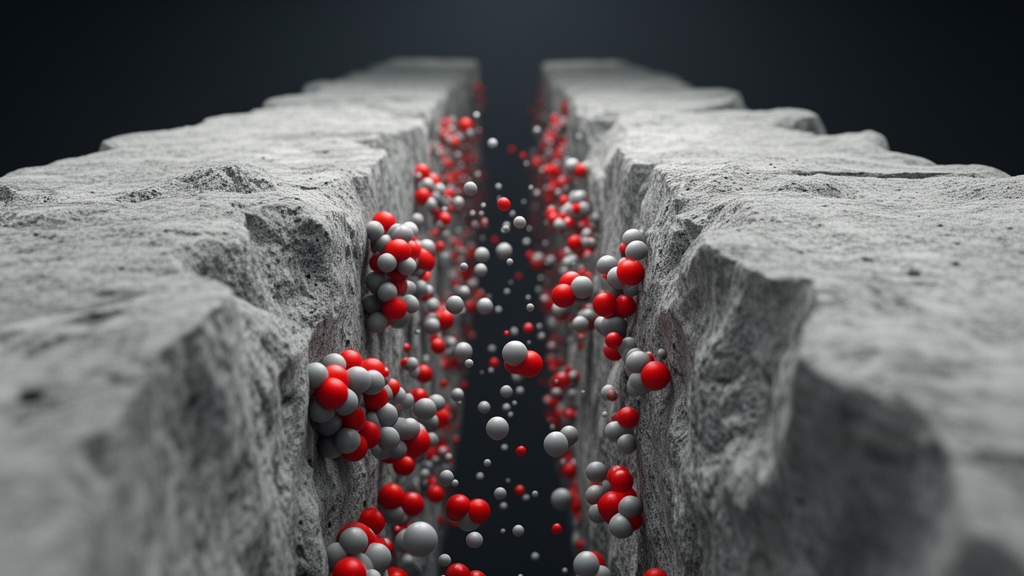
Carbon dioxide moving through the nanoscale pores of cement-based materials sits at the heart of two opposing concerns: the degradation of concrete durability and the promise of locking carbon away in mineral form. A new computational study published in the Journal of Materials Science examines, at the molecular scale, how the physical phase of CO2 and the chemical state of calcium–silicate–hydrate (C–S–H) surfaces jointly govern how the gas adsorbs and migrates within these confined pores.
The work, led by Manli Chen and Qi Luo, combines molecular dynamics simulations with density functional theory calculations. Rather than treating CO2 transport and interfacial reactivity separately, as most earlier studies have done, the team modeled three distinct phase states of CO2 inside model C–S–H nanopores: a gaseous state, an aqueous state, and a water-bearing supercritical environment. They also varied the surface chemistry, comparing hydroxylated surfaces that mimic realistic pore-solution conditions with an idealized, fully non-hydroxylated surface.
The simulations revealed a strongly phase-dependent picture of molecular mobility. In the aqueous system, individual CO2 molecules showed the highest per-molecule mobility of the three cases. The water-bearing supercritical-density system combined dense pore filling with substantial molecular mobility at a much higher prescribed CO2 loading, making it an interesting intermediate case. Gaseous CO2, by contrast, became strongly confined near the pore surfaces and showed negligible long-range mobility, effectively pinned at the interfaces it would need to leave in order to penetrate deeper into the material.
Surface chemistry proved equally consequential, though its influence depended on the phase state. Across both the aqueous and supercritical systems, hydroxylation changed the interfacial coordination strength in a consistent way, but its effect on overall transport differed between the two phases, shifting the balance between transport and adsorption.
The starkest contrast emerged between the two idealized surface types. The fully non-hydroxylated surface, which the authors explicitly treat as a reactive upper bound rather than a typical hydrated interface, promoted strong CO2 adsorption and pronounced distortion of the molecule. The computed adsorption energy reached −1.46 electronvolts, with a Bader charge transfer of roughly 0.52 electrons, and CO2 mobility in the aqueous system was suppressed. On the hydroxylated surface, adsorption weakened dramatically to −0.18 electronvolts and charge transfer fell to about 0.06 electrons, conditions under which CO2 could migrate more freely through the nanopore.
Electronic-structure analysis offered a mechanistic explanation for this difference. The distortion of CO2 adsorbed on the non-hydroxylated surface was associated with electron transfer from high-energy surface states into the antibonding orbitals of CO2, accompanied by molecular bending and orbital hybridization. In other words, the reactive surface does not merely hold the molecule in place; it chemically activates it, bending the normally linear molecule and weakening its internal bonds.
Extending the comparison beyond C–S–H, the team performed density functional theory calculations on hydroxylated forms of C3S and C3A, two other minerals abundant in cement. The intrinsic propensity for CO2 adsorption and activation followed the order C3A greater than or equal to C3S greater than C–S–H, a ranking that correlated with the electron-donation capability of each mineral surface. This suggests that the mineralogical composition of cement paste could influence where and how strongly CO2 is captured at the molecular level.
The authors are careful to frame the scope of their findings. The simulations model CO2 adsorption and transport only; the carbonation reaction itself was not simulated. None of the results have been experimentally validated in this study, and the model systems involve specific combinations of CO2 loading, density, temperature, and water content, so the transport behavior observed is specific to those prescribed conditions. The paper presents its conclusions as mechanistic hypotheses intended to guide the design and further study of cement-based materials for CO2 sequestration, not as demonstrated performance claims.
Even with those caveats, the study offers a useful conceptual framework: early-stage carbonation may be governed by a competition between phase-dependent transport, which determines how quickly CO2 reaches reactive sites, and surface-controlled adsorption, which determines how strongly and in what activated form the molecule is held once it arrives. Understanding that competition at the molecular scale could eventually inform strategies for both protecting concrete infrastructure from carbonation-induced degradation and engineering cementitious materials that sequester carbon more effectively.
Subject of Research: Computational study of CO2 adsorption and transport in calcium–silicate–hydrate nanopores under different phase states and surface chemistries
Article Title: Effects of CO2 phase state and surface chemistry on the transport and adsorption of CO2 in confined C–S–H nanopores
Article References: Chen, M., & Luo, Q. (2026). Effects of CO2 phase state and surface chemistry on the transport and adsorption of CO2 in confined C–S–H nanopores. Journal of Materials Science. https://doi.org/10.1007/s10853-026-13985-1
Image Credits: AI Generated
DOI: 10.1007/s10853-026-13985-1
Keywords: CO2 sequestration, cement carbonation, C–S–H, molecular dynamics, density functional theory, nanopores, adsorption, surface chemistry, supercritical CO2, transport, C3A, C3S
News Source: Bethany Barker. (October 29, 2026). Simulations Reveal How CO2 Phase and Surface Chemistry Shape Transport in Cement Nanopores. Scienmag.



