


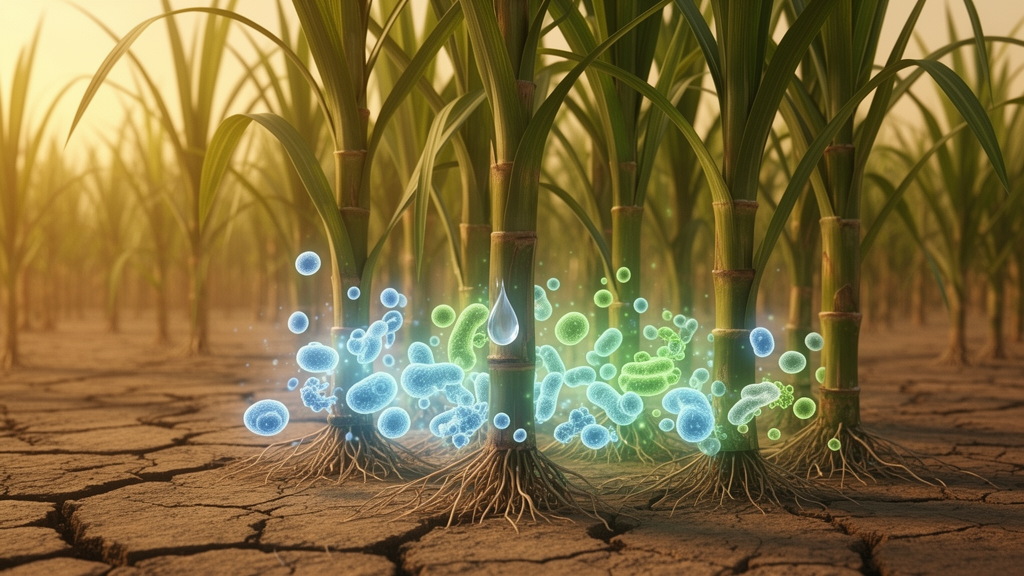
Drought is a mounting threat to sugarcane, a crop that demands substantial water to reach its productivity potential, and researchers are increasingly looking to the plant microbiome for solutions. A new study published in Plant Molecular Biology reports that inoculating sugarcane with engineered bacterial communities, known as synthetic communities or SynComs, measurably changes how the crop’s genes respond to drought stress.
The research team evaluated five candidate synthetic communities and selected one, designated SC3, for detailed gene expression analysis. The choice was based on two criteria: SC3 showed relatively higher microbial diversity and community evenness, as measured by the Shannon diversity and Pielou’s evenness indices, and it promoted sugarcane growth and physiological processes more effectively than the other communities tested.
SC3-inoculated plants were associated with increased plant height, greater phosphorus uptake, and higher osmoprotectant content compared with plants receiving the other SynComs.
The transcriptomic analysis revealed a striking difference in how drought signals were processed. In plants inoculated with SC3, mitogen-activated protein kinase, or MAPK, signaling was prominent. In contrast, uninoculated control plants relied more heavily on plant hormone signaling to mount their drought response. This suggests that the bacterial community does not simply reinforce the plant’s native stress program but redirects it through a different signaling architecture.
The study also documented differences in energy allocation and the production of secondary metabolites as defense responses to drought. Plants treated with SC3 directed their resources toward maintaining lipid membrane integrity and toward lignification, the deposition of lignin that reinforces cell walls. Control plants, by comparison, focused their defensive metabolism on antioxidant activity mediated by flavonoids.
These findings indicate that bacterial synthetic community inoculants can modulate drought stress responses in sugarcane, rather than merely improving growth indirectly. By shifting both signaling pathways and downstream metabolic priorities, the microbial community appears to reorganize the plant’s overall strategy for coping with water scarcity.
The work is significant because sugarcane is a major global crop whose water requirements make it particularly vulnerable to drought intensification driven by climate change. However, the mechanisms by which defined communities of bacteria act on their host have remained unclear, particularly in sugarcane, which is precisely the gap this study set out to address.
By using transcriptomics, the researchers were able to observe the plant’s molecular response at the level of gene expression rather than relying solely on visible traits. This allowed them to link the growth and physiological benefits associated with SC3, such as increased height and phosphorus uptake, to specific shifts in signaling and metabolic gene activity.
The authors conclude that the findings highlight the potential of synthetic communities as a sustainable microbial strategy for enhancing crop performance under drought stress. As with any controlled study, the results describe the behavior of specific defined communities under the experimental conditions tested, and the selected community SC3 was chosen on the basis of its diversity, evenness, and growth-promoting performance among the five candidates evaluated.
Subject of Research: How bacterial synthetic communities modulate transcriptomic drought responses in sugarcane
Article Title: Transcriptomic responses of sugarcane to drought stress are modulated by bacterial synthetic communities
Article References: Sulastri, S., Rahmawati, R. S., Herliana, L., Roswanjaya, Y. P., Sukmadi, R. B., Asiani, N., Irawati, A. F. C., Saryanah, N. A., & Sedijani, P. (2026). Transcriptomic responses of sugarcane to drought stress are modulated by bacterial synthetic communities. Plant Molecular Biology, 116(6), Article 108. https://doi.org/10.1007/s11103-026-01773-z
Image Credits: AI Generated
DOI: 10.1007/s11103-026-01773-z
Keywords: sugarcane, drought stress, synthetic communities, transcriptomics, MAPK signaling, plant microbiome, osmoprotectants, lignification, flavonoids, plant molecular biology, Transcriptomic, responses
News Source: Drew Townsend. (October 29, 2026). Bacterial synthetic communities reshape how sugarcane responds to drought stress. Scienmag.



