

• HOME
  • NEWS
  • EXPLORE
    • CAREER
      • Companies
      • Jobs
    • EVENTS
    • iGEM
      • News
      • Team
    • PHOTOS
    • VIDEO
    • WIKI
  • BLOG
  • COMMUNITY
    • FACEBOOK
    • INSTAGRAM
    • TWITTER
Friday, October 30, 2026
BIOENGINEER.ORG
No Result
View All Result
  • Login
  • HOME
  • NEWS
  • EXPLORE
    • CAREER
      • Companies
      • Jobs
        • Lecturer
        • PhD Studentship
        • Postdoc
        • Research Assistant
    • EVENTS
    • iGEM
      • News
      • Team
    • PHOTOS
    • VIDEO
    • WIKI
  • BLOG
  • COMMUNITY
    • FACEBOOK
    • INSTAGRAM
    • TWITTER
No Result
View All Result
Bioengineer.org
No Result
View All Result
Home NEWS Science News Technology

Solid-state route delivers sodium iron phosphate cathode with 91% capacity retention over 200 cycles

by
October 29, 2026
in Technology
Reading Time: 2 mins read
0
Solid-state route delivers sodium iron phosphate cathode with 91% capacity retention over 200 cycles

Solid-state route delivers sodium iron phosphate cathode with 91% capacity retention over 200 cycles

Share on FacebookShare on TwitterShare on LinkedinShare on RedditShare on Telegram

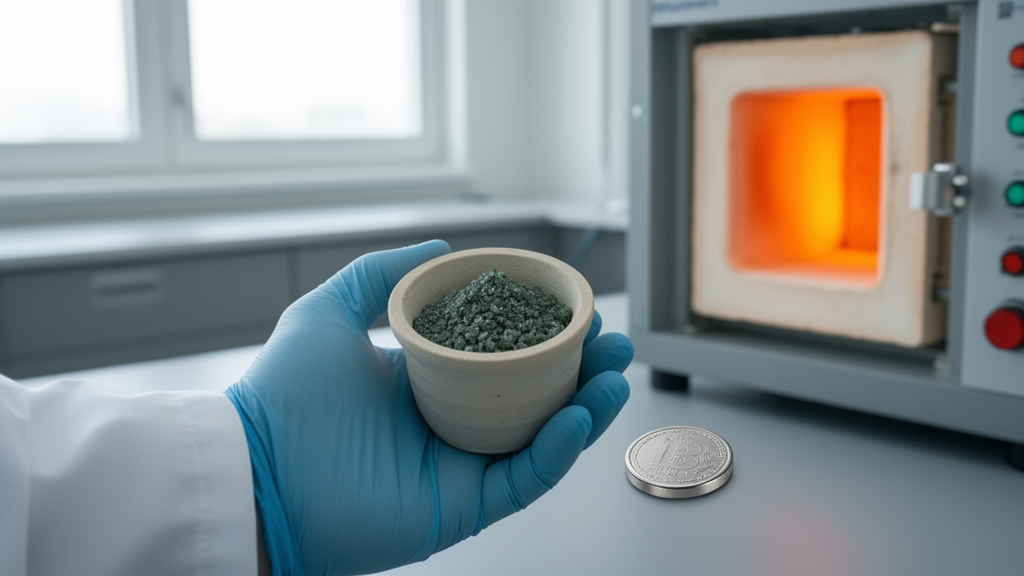
Researchers report a solid-phase synthesis route for Na4Fe3(PO4)2P2O7 (NFPP), an iron-based mixed phosphate cathode material for sodium-ion batteries, and show that the resulting powder delivers an initial discharge capacity of 110 mAh·g−1 at 0.1 C, a reversible capacity of about 84 mAh·g−1 even at a 20 C rate, and 91% capacity retention after 200 cycles at 1 C. The work, published in the Journal of Materials Science, focuses on a preparation method the authors describe as significant for large-scale production of the material.

NFPP is described as a promising cathode material for sodium-ion batteries because it combines a stable structure, high operating voltage and high specific capacity. The synthesis used in the study relies on widely available starting compounds: NaH2PO4·2H2O and FeC2O4·2H2O served as the main raw materials, while citric acid monohydrate (C6H8O7·H2O) was added as the carbon source. A two-step ball-milling process was used to prepare the reaction mixture before heat treatment.

A central element of the study was the investigation of how reaction temperature affects the structure and performance of the product. By varying the temperature during synthesis, the team could link processing conditions to the electrochemical behaviour of the resulting cathode material, an approach relevant to optimising the route for practical manufacturing.

The rate capability results indicate that the material retains useful capacity under demanding conditions: at a 20 C current rate, corresponding to very fast charging and discharging, the reversible specific capacity remains around 84 mAh·g−1. Cycling stability was assessed at 1 C, where the material kept 91% of its capacity after 200 cycles, suggesting that the solid-phase route produces a cathode with durable electrochemical performance.

The findings are limited to the laboratory-scale samples and test conditions reported in the abstract; the reported capacities and retention figures apply to the prepared NFPP material under those specific current rates and cycle counts. The authors position the work as a step toward establishing preparation methods suitable for large-scale production of this iron-based mixed phosphate cathode for sodium-ion batteries.

Subject of Research: Solid-phase synthesis and electrochemical performance of the Na4Fe3(PO4)2P2O7 cathode material for sodium-ion batteries

Article Title: Study on the synthesis and the electrochemical properties of Na4Fe3(PO4)2P2O7 material

Article References: Liu, G., Wan, H., Chen, L., Chen, Z., & Zhao, M. (2026). Study on the synthesis and the electrochemical properties of Na4Fe3(PO4)2P2O7 material. Journal of Materials Science. https://doi.org/10.1007/s10853-026-14005-y

Image Credits: AI Generated

DOI: 10.1007/s10853-026-14005-y

Keywords: sodium-ion batteries, cathode material, Na4Fe3(PO4)2P2O7, solid-phase synthesis, mixed phosphate, iron phosphate, ball milling, carbon source, capacity retention, rate capability, energy materials, synthesis

News Source: Denise Maddox. (October 29, 2026). Solid-state route delivers sodium iron phosphate cathode with 91% capacity retention over 200 cycles. Scienmag.


Tags: ball millingcapacity retentioncarbon sourcecathode materialenergy materialsiron phosphatemixed phosphateNa4Fe3(PO4)2P2O7rate capabilitySodium-ion batteriessolid-phase synthesissynthesis
Share12Tweet7Share2ShareShareShare1

Related Posts

Systematic review maps sustainability tensions in offshore wind development

Systematic review maps sustainability tensions in offshore wind development

October 30, 2026
Amateur maps and sketches helped put Hong Kong's wartime pillboxes on official charts

Amateur maps and sketches helped put Hong Kong’s wartime pillboxes on official charts

October 30, 2026

Heavier logging trucks only pay off when the road network lets them work

October 30, 2026

Supersulfated cement outperforms Portland cement in curbing concrete’s alkali-silica reaction

October 30, 2026

POPULAR NEWS

  • Microbial Sources and Stress Shape the Hidden Endophytes of an Invasive Plant

    Microbial Sources and Stress Shape the Hidden Endophytes of an Invasive Plant

    29 shares
    Share 12 Tweet 7
  • Firebreaks Leave Lasting Scars in Grasslands While Wildfire Heals Fast

    29 shares
    Share 12 Tweet 7
  • ZNF207 shields glutamine transporter ASCT2 from degradation to fuel liver cancer growth

    29 shares
    Share 12 Tweet 7
  • Systematic review maps sustainability tensions in offshore wind development

    29 shares
    Share 12 Tweet 7

About

We bring you the latest biotechnology news from best research centers and universities around the world. Check our website.

Follow us

Recent News

Microbial Sources and Stress Shape the Hidden Endophytes of an Invasive Plant

Firebreaks Leave Lasting Scars in Grasslands While Wildfire Heals Fast

ZNF207 shields glutamine transporter ASCT2 from degradation to fuel liver cancer growth

Subscribe to Blog via Email

Enter your email address to subscribe to this blog and receive notifications of new posts by email.

Join 86 other subscribers
  • Contact Us

Bioengineer.org © Copyright 2023 All Rights Reserved.

Welcome Back!

Login to your account below

Forgotten Password?

Retrieve your password

Please enter your username or email address to reset your password.

Log In
No Result
View All Result
  • Homepages
    • Home Page 1
    • Home Page 2
  • News
  • National
  • Business
  • Health
  • Lifestyle
  • Science

Bioengineer.org © Copyright 2023 All Rights Reserved.
