


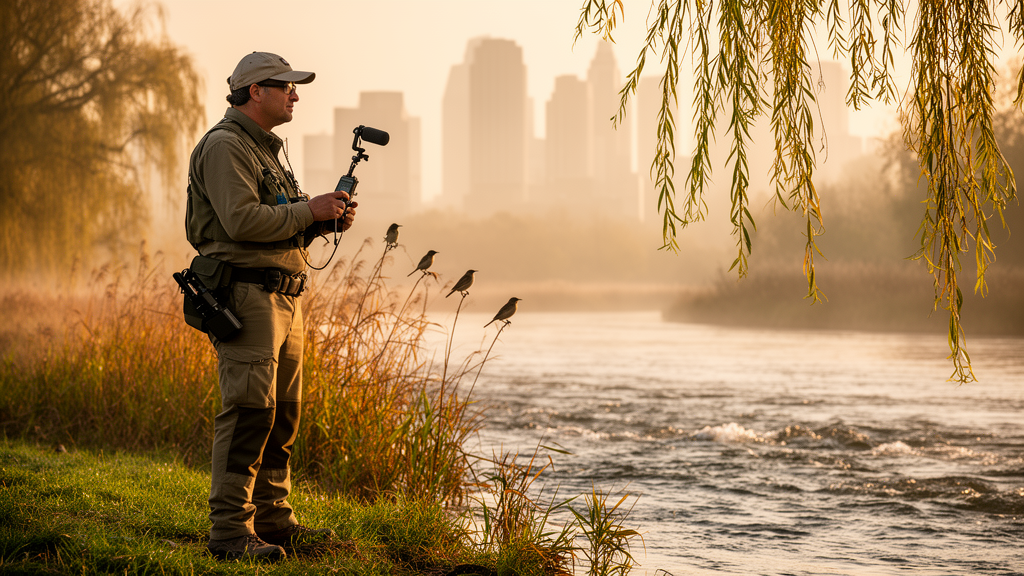
Researchers deployed passive acoustic loggers along the riparian corridor and analysed the recordings with three standard soundscape indices, revealing how urbanisation alters both where and when birds are vocally active.
The study, published in BMC Ecology and Evolution, focused on three measures: the Acoustic Complexity Index (ACI), the Normalised Difference Soundscape Index (NDSI) and the Bioacoustic Index (BIO). Each index summarises different features of a recording, and the team ground-truthed them by manually identifying the contents of a subsample of audio files to check which indices actually tracked biological sound.
The validation produced a clear verdict. ACI showed only a positive correlation with geophony diversity and duration, and was therefore excluded from further analysis because of its lack of correlation with ecologically relevant biophony or anthrophony measurements. NDSI was positively correlated with biophony duration, while BIO showed the strongest relationship with both measures of biophony and was unrelated to anthropogenic or geophysical sound, making the two the most ecologically meaningful of the three.
Using these validated indices, the researchers found that lower streetlight densities were associated with a more natural acoustic environment as measured by NDSI, suggesting that light pollution shapes the soundscape alongside more obvious urban pressures. BIO increased moderately with closer proximity to the river, reflecting greater avian acoustic activity near the water and toward the centre of the green corridor.
Temporal patterns proved just as revealing as spatial ones. The dawn chorus, one of the most celebrated phenomena in acoustic ecology, was reduced at more urbanised locations along the corridor. Greater diurnal fluctuation in avian acoustic activity occurred where urban land cover was lower, indicating that daily rhythms of bird vocal behaviour are flattened or compressed in heavily built-up sections of the landscape.
The recorders also captured a weekly rhythm: acoustic activity was lower at weekends than during weekdays.
Across the seasons, avian acoustic activity peaked in early spring, coinciding with the onset of the avian breeding season.
The authors conclude that soundscape indices can successfully be used for biodiversity monitoring within an urban environment. Because the indices captured both spatial and temporal patterns in avian acoustic activity and were associated with anthropogenic drivers, the authors suggest they can be used to assess how city planning decisions echo through ecological communities.
The findings also carry a practical message for urban design. Avian acoustic activity increased with proximity to the centre of the riparian corridor, highlighting the role of green corridors in reducing some ecological impacts of urbanisation. The researchers recommend similar bioacoustic recording approaches to inform the planning and management of habitats in cities.
Caveats remain. The study examined a single riparian corridor in one Scottish city, and the indices were validated against manual identification of a subsample of recordings rather than exhaustive annotation. Even so, the work demonstrates that continuous acoustic logging, paired with careful ground-truthing, can turn an urban river’s daily chorus into a quantifiable record of how biodiversity responds to the pressures of city life.
Subject of Research: Using soundscape indices to monitor how urbanisation affects avian acoustic activity along a riparian corridor in Glasgow
Article Title: Using soundscapes to examine the impacts of urbanisation on spatial and temporal patterns of avian acoustic activity along a riparian corridor
Article References: Guthrie, J., Bracken, A. M., Vovides, A. G., Balke, T., McCafferty, D. J., & Dominoni, D. M. (2026). Using soundscapes to examine the impacts of urbanisation on spatial and temporal patterns of avian acoustic activity along a riparian corridor. BMC Ecology and Evolution. https://doi.org/10.1186/s12862-026-02588-8
Image Credits: AI Generated
DOI: 10.1186/s12862-026-02588-8
Keywords: soundscapes, urbanisation, birds, acoustic indices, dawn chorus, light pollution, riparian corridor, biodiversity monitoring, Glasgow, bioacoustics, green corridors, examine
News Source: Drew Townsend. (October 29, 2026). Research report: Using soundscapes to examine the impacts of urbanisation on spatial and temporal patterns of avian acoustic activity along a riparian corridor. Scienmag.



