


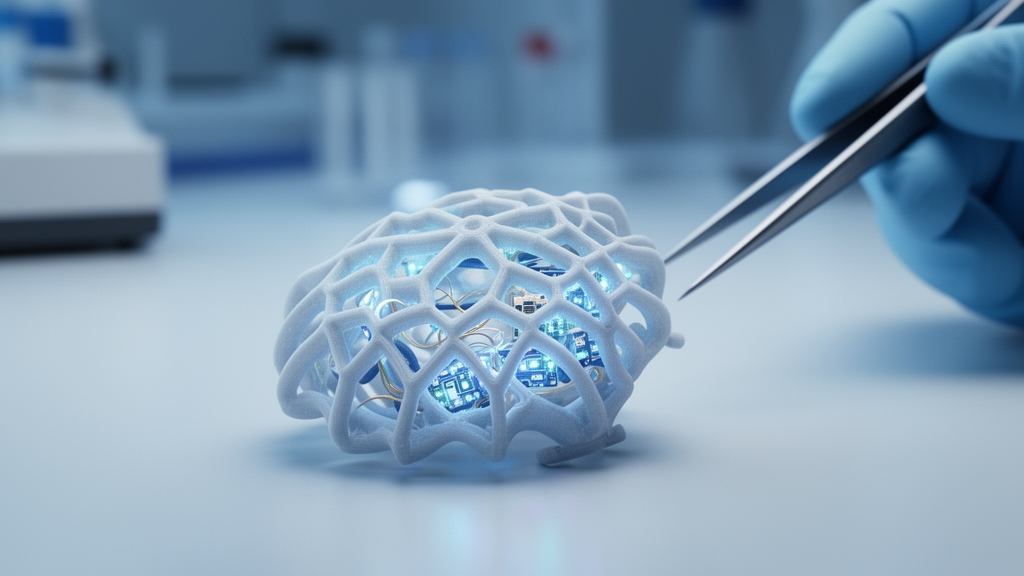
Additive manufacturing, the layer-by-layer fabrication technique better known as 3D printing, has emerged as a foundational technology for a new generation of intelligent medical devices, according to a comprehensive review published in Discover Mechanical Engineering. The review, authored by Gurbhej Singh, Gaurav Tejpal, Hitesh Vasudev, Manoj Kumar and Jagriti Singh, systematically examines how additive manufacturing combined with smart materials, embedded sensors and artificial intelligence is transforming implants, wearable health monitors, prosthetics and orthotic devices from passive structures into systems capable of real-time monitoring, adaptive response and data-driven clinical decision support.
The core advantage of additive manufacturing in healthcare lies in its departure from traditional subtractive manufacturing and molding processes. Conventional medical devices are highly standardized and often fail to account for anatomical, biomechanical and physiological differences between patients. Because additive manufacturing builds objects directly from computer models one layer at a time, it allows complex geometries, customization to individual patient needs and optimized use of materials. The review argues that this design freedom, combined with recent developments in shape memory alloys, conductive polymer composites, piezoelectric polymers and bioresorbable materials, has expanded the functional possibilities of additively manufactured healthcare devices well beyond what earlier reviews, which treated medical devices as largely passive, had envisioned.
The authors organize the field around four device categories. Smart implants, including orthopedic joint replacements, spinal cages, dental implants, cardiovascular stents and neural interfaces, are placed permanently or semi-permanently in the body and carry sensing components that measure strain, temperature, pressure, pH and corrosion activity, enabling real-time evaluation of implant performance and tissue reaction. Powder bed fusion techniques such as selective laser melting and electron beam melting are the most common methods for producing titanium-based implants with customized porosity designed to encourage implantation and minimize stress shifts. Studies cited in the review indicate that additively manufactured porous titanium implants are more readily integrated by the body and show a lower elastic modulus mismatch than traditionally made implants.
Smart wearables, the second category, are externally worn systems that continuously or semi-periodically monitor physiological and biomechanical parameters, including smart watches, biosensing patches, smart clothing and rehabilitation tools. Their principal goals are real-time health analysis, timely identification of abnormal situations and remote patient management. Material extrusion and direct ink writing allow flexible polymers and conductive processing routes to be incorporated, producing lightweight, comfortable and mechanically compliant wearables that fit the morphology of an individual body. The integration of additive manufacturing with flexible electronics has, according to the review, greatly increased the clinical usefulness of wearable healthcare technology.
Smart prosthetics and orthotics complete the classification. Unlike traditional passive mechanical prosthetics, smart prosthetics use sensors, actuators and control algorithms to deliver adaptive motion and identify user intent, relying on real-time feedback from muscle signals, pressure sensors and inertial measurement units. Additive manufacturing contributes lightweight and modular designs, with lattice-based structures reducing weight without compromising strength, while digital workflows accelerate iteration and user-specific design. Orthotic devices such as ankle-foot orthoses, spinal braces, cervical collars and corrective insoles can incorporate sensors that track usage patterns, weight distribution and therapeutic efficacy, allowing treatment plans to be adjusted based on data. Compared with traditionally made orthoses, the review reports that additively manufactured versions offer better comfort, shorter fabrication times and improved clinical results.
The review details the manufacturing technologies underpinning these devices, following the ASTM and ISO categorization of additive manufacturing processes. Powder bed fusion methods, including selective laser melting and electron beam melting, dominate the production of load-bearing metallic implants, using high-energy heat sources to selectively melt metal powder layers into dense or deliberately porous structures with high dimensional accuracy. Titanium alloys such as Ti-6Al-4V are particularly well suited to these processes. Material extrusion methods, including fused deposition modelling, largely govern polymer-based wearables, prosthetics and orthotics because they are inexpensive, offer diverse material selection and are easily customized, although the anisotropic mechanical properties arising from layer deposition remain problematic for high-stress applications. Vat photopolymerization and stereolithography provide superior resolution and surface finish, making them ideal for dental applications, hearing aids and other miniature biomedical components, while direct ink writing with composite inks allows electrically conductive materials, biological components and stimuli-responsive polymers to be integrated in a single process.
Material selection emerges as a decisive factor in device performance, safety and lifespan. Titanium alloys are favored for load-bearing implants for their mechanical properties, corrosion resistance, fatigue strength and biocompatibility, while cobalt-chromium alloys are common where superior wear resistance is needed, though their high stiffness and density limit some applications. However, the review highlights a persistent biomechanical problem: the elastic modulus of titanium alloys, roughly 110 gigapascals, is significantly higher than that of cortical bone, which ranges from 10 to 30 gigapascals, a mismatch that can lead to stress shielding and bone resorption. Additive manufacturing addresses this by enabling controlled porous and lattice structures that lower the effective elastic modulus and promote osseointegration and vascularization. Polymers such as polylactic acid, polycaprolactone, thermoplastic polyurethane and polyethylene terephthalate glycol dominate wearables, prosthetics and orthotics, though they remain prone to creep deformation, limited fatigue resistance and environmental degradation. Ceramics including alumina, zirconia and bioactive glasses serve dental implants and bone scaffolds, despite brittleness and sintering-induced shrinkage challenges.
Design strategies enabled by additive manufacturing are among the most transformative elements surveyed. Because the technique decouples geometric complexity from manufacturing cost, designers can engineer beam-based lattices, sheet-based architectures and triply periodic minimal surface structures with precisely tuned stiffness, strength and deformation behavior, matching implant stiffness to native bone to prevent stress shielding. Functionally graded designs, which vary porosity, topology or composition spatially, allow conflicting objectives to be resolved simultaneously, such as increased load-bearing capacity in a device core combined with greater osseointegration or sensing sensitivity at the surface, and can locally reinforce structures to protect embedded sensors without degrading structural integrity. Patient-specific design, combining medical imaging with computational design and additive manufacturing, has been shown in research studies to reduce surgeon operating time, improve device fit and increase patient satisfaction and comfort.
The intelligence layer of these devices rests on embedded sensing, Internet of Things connectivity and artificial intelligence analytics. Embedded sensors monitor strain, temperature, pressure and optical or ultra-thin e-skin signals, with strain sensors carrying particular relevance for load-bearing implants and prosthetic components where continuous mechanical load data informs analysis of device integrity, fatigue behavior and bone-implant interaction. Temperature sensors enable early detection of implant-associated infection and inflammation. Wireless modules transfer sensor data to smartphones and cloud platforms for remote monitoring, while machine learning methods, including support vector and random forest classifiers and deep learning neural networks, identify trends and abnormalities in time-series data. For prosthetics and orthotics, learning algorithms process pressure, inertial and electromyography data to adapt device control in real time, and for implants, predictive analytics can evaluate remaining useful life and failure risk, supporting proactive rather than reactive clinical decisions.
The review is candid about the barriers standing between laboratory prototypes and widespread clinical adoption. Embedded sensors face signal drift, biofouling, moisture ingress and mechanical fatigue from cyclic physiological loading, while integrating sensors and wireless modules into compact devices raises power consumption, electromagnetic interference, heat dissipation and miniaturization challenges. Additively manufactured metallic implants can exhibit anisotropy, unwanted residual stresses and porosity defects that act as stress concentration points and promote fatigue crack formation, requiring process optimization and post-processing such as surface finishing or hot isostatic pressing. AI models need high-quality, diverse, clinically validated datasets, and issues of algorithm transparency, cybersecurity, patient privacy and regulatory compliance remain unresolved. On sustainability, the authors note that additive manufacturing can reduce material waste compared with subtractive methods, but that full lifecycle assessment, particularly of use and disposal phases for devices containing embedded electronics and multifunctional materials, remains underdeveloped. The authors conclude that coordinated, interdisciplinary advances in materials engineering, process optimization, embedded electronics, computational intelligence and clinical validation will be required to bring next-generation intelligent medical devices from the laboratory to the clinic.
Subject of Research: A comprehensive review of additive manufacturing technologies, materials, embedded sensing and AI integration in smart medical devices including implants, wearables, prosthetics and orthotics.
Article Title: Additive manufacturing driven intelligent medical devices a comprehensive review
Article References: Singh, G., Tejpal, G., Vasudev, H., Kumar, M., & Singh, J. (2026). Additive manufacturing driven intelligent medical devices a comprehensive review. Discover Mechanical Engineering, 5(1), Article 194. https://doi.org/10.1007/s44245-026-00361-1
Image Credits: AI Generated
DOI: 10.1007/s44245-026-00361-1
Keywords: additive manufacturing, 3D printing, smart implants, wearable health devices, prosthetics, orthotics, embedded sensors, artificial intelligence, biomaterials, titanium alloys, lattice structures, Internet of Things
News Source: Denise Maddox. (October 29, 2026). 3D-Printed Smart Medical Devices Move From Passive Implants to Intelligent Systems. Scienmag.



