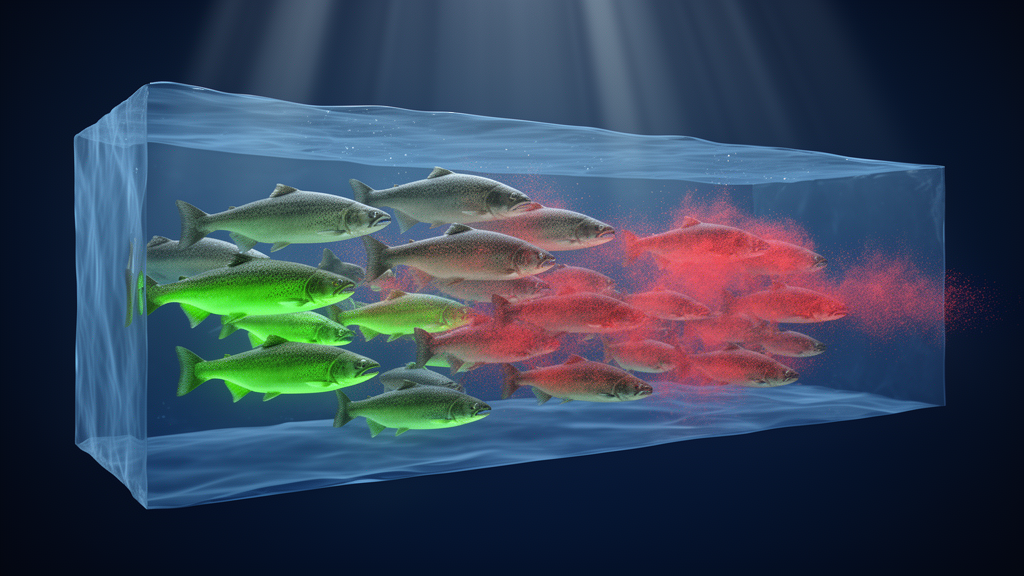
Infectious disease outbreaks are among the most serious threats facing aquaculture, where fish share tanks and cages and water flow can carry pathogens rapidly between animals. Selective breeding for disease resistance is widely used in species such as salmonids and shrimp, but breeding programs typically judge resistance by mortality records from challenge tests performed on relatives of the selection candidates.
The study, conducted by Silvia García-Ballesteros and colleagues, modeled a salmon population exposed to a fast-transmitting virus with epidemiological parameters modeled on the infectious salmon anemia virus. The researchers built their simulations around three underlying host traits that govern disease transmission and are potentially under genetic control: susceptibility, the propensity of an uninfected fish to become infected when exposed; infectivity, the ability of an infected fish to transmit the pathogen to others; and infection-induced mortality, the propensity of an infected fish to die. The basic reproductive ratio, R0, defined as the expected number of secondary infections caused by one infectious individual in an otherwise susceptible population, served as the measure of disease spread. When R0 falls below one, an epidemic is expected to die out.
The simulation framework used a stochastic compartmental Susceptible-Infected-Removed epidemiological model to generate mortality phenotypes. The simulated genome comprised 30 chromosomes of 1 Morgan each, mirroring the salmon genome, with 3,600,000 biallelic loci and 1,000 quantitative trait loci simultaneously affecting the three underlying traits. Each underlying trait had an initial heritability of 0.5, which translated to a heritability of roughly 0.2 for the observed mortality trait. The researchers explored seven scenarios differing in the genetic correlations among the three traits, ranging from uncorrelated to combinations classified as favorable or unfavorable for disease control. Importantly, favorable correlations were defined from an epidemic standpoint rather than an individual welfare standpoint: a fish that dies quickly after infection limits the time available for transmission, which benefits the population even though it harms the individual.
Mortality records were assumed to come from sibs of the selection candidates, since challenge tests are conducted at facilities physically separated from the breeding nucleus. Two cohabitation challenge test designs were compared. Design 1 used a few large groups, specifically two groups of 2,000 fish with all 200 families evenly mixed, reflecting the logistical constraints of tank space common in practice. Design 2 used many small groups, 20 groups of 200 fish each with ten families per group, a structure that theory suggests is needed for accurate estimation of genetic infectivity. In both designs, 2.5 percent of fish were seeded as infected index cases. Test durations varied by endpoint criteria: until cumulative mortality reached an asymptote at 60 days with roughly 80 percent dead, until 50 percent mortality at day 15, or until 25 percent mortality at day 7. Genomic selection using GBLUP was applied over 10 discrete generations, with results averaged over 50 replicates.
When selection was based on time to death recorded in challenge tests run until mortality naturally leveled off at 60 days, R0 consistently declined across all scenarios, often dropping below one within three to four generations, regardless of the genetic correlations among the underlying traits or the challenge test design. In contrast, selection based on dead/alive status, the binary outcome more commonly adopted in practice because it is simpler and cheaper, was highly sensitive to both trait correlations and test design. Under dead/alive selection, the epidemic was eradicated in only a subset of scenarios, and in several others R0 remained constant or even increased after the initial generations.
The reason lies in the different types of survivors each phenotype selects. Selection on time to death primarily produced fish with reduced susceptibility to infection. Selection on dead/alive status produced fish with both increased resistance and increased endurance, meaning infected fish survived longer without necessarily becoming less infectious. Reduced susceptibility benefits both the individual and epidemic control, but reduced infection-induced mortality, longer survival after infection, only benefits the individual and can hinder disease control by giving infected fish more time to transmit the pathogen. In the favorably correlated FCfr scenario under Design 1, selection for time to death with short test durations of 15 or 7 days actually drove R0 up to values of 7.0 and 9.8 respectively, even as survival rates improved, because infectivity increased as a correlated response.
The genetic correlations among the underlying traits proved decisive. In the least favorable scenario, UCgfr, selection on time to death decreased susceptibility and infection-induced mortality but increased infectivity in both designs, and R0 failed to decline sustainably. In unfavorable scenarios where R0 remained above one, survival rates still improved and the percentage of infected fish at day 60 decreased, yet the percentage of fish infected after day 60 rose, reaching up to 45 percent in Design 1 and up to 28 percent in Design 2. This pattern indicates that selection was delaying the onset of infection rather than reducing the total number of fish that became infected. Challenge Design 2, with its many small groups and varied family composition, generally outperformed Design 1, particularly for infectivity, because between-group variation in family-level infectivity allowed the genetic evaluation to capture differences that evenly mixed large groups concealed.
Direct selection on the true breeding values of the three underlying epidemiological traits was the most efficient strategy of all, reducing R0 below one in every scenario except selection for infectivity under the least favorable correlation scenario, with eradication occurring after one generation under favorable correlations, two generations when traits were uncorrelated, and three to seven generations under unfavorable correlations. The exception was selection for infectivity under the least favorable correlation scenario, where the epidemic was never eradicated. However, the authors caution that this approach remains largely theoretical: to their knowledge, no commercial breeding program currently estimates or directly selects for these underlying traits, and the simulations optimistically assumed breeding values for them could be predicted with perfect accuracy.
The study carries several important limitations. The simulations assumed an SIR epidemiological model, in which the pathogen replicates only within the host, so results may not extend to parasites with life stages outside the host, such as sea lice, or to diseases following a Susceptible-Infected-Susceptible model where recovery and reinfection occur. Identical phenotypic and genetic variances were assumed for all three traits due to limited empirical data. High transmission and mortality rates were assumed, matching conditions achieved with high challenge doses, and the simulations assumed pathogen transmissibility and virulence did not evolve over generations of selection, an assumption that could prove optimistic if genetic selection exerts pressure on pathogen populations. The authors also note that in commercial programs, disease resistance is typically one component of a multi-trait selection index alongside growth, so the number of generations needed to control transmission in practice would exceed those simulated here, where resistance received full priority.
Nevertheless, the practical message is concrete. Genomic selection against disease mortality, when mortality is measured as time to death in a cohabitation or bath challenge test run until mortality naturally levels off, reduced both mortality and disease transmission in these simulations, while selection on binary dead/alive status was generally ineffective at preventing disease spread. The authors conclude that breeding programs may benefit from challenge test designs with multiple epidemic groups and appropriate family structures, which improve the ability to capture genetic variation affecting transmission and would enable estimation of genetic parameters for the underlying traits that determine both survival and disease spread. Recent statistical-genetics developments, including methods for estimating genomic breeding values for R0 and tools providing simultaneous estimates of effects on all three epidemiological traits, suggest that such designs are becoming feasible, offering a route toward aquaculture populations that are not only more survivable but genuinely less transmissive.
Subject of Research: Simulation study of how genomic selection for disease mortality traits affects infection spread in aquaculture
Article Title: Impact of genomic selection for disease resistance on the spread of infection in a simulated aquaculture population
Article References: García-Ballesteros, S., Fernández, J., Doeschl-Wilson, A. B., & Villanueva, B. (2026). Impact of genomic selection for disease resistance on the spread of infection in a simulated aquaculture population. Genetics Selection Evolution, 58(1), Article 64. https://doi.org/10.1186/s12711-026-01072-7
Image Credits: AI Generated
DOI: 10.1186/s12711-026-01072-7
Keywords: genomic selection, aquaculture, disease resistance, salmon, R0, epidemiology, challenge tests, susceptibility, infectivity, simulation study, GBLUP, selective breeding
News Source: Kristina Jarvis. (October 29, 2026). Research report: Impact of genomic selection for disease resistance on the spread of infection in a simulated aquaculture population. Scienmag.