


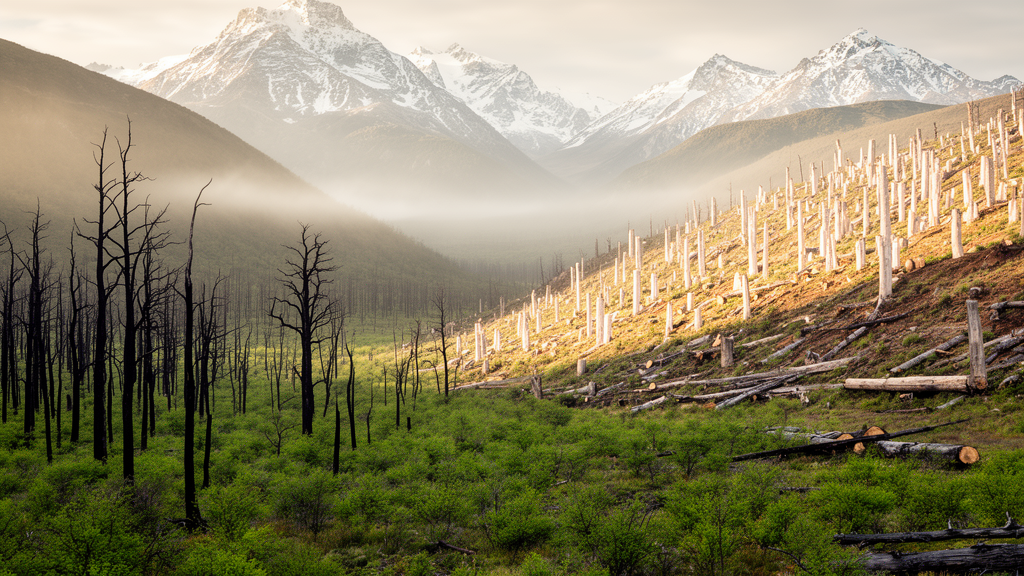
Sixty years after timber harvesting and wildfire swept through a forested landscape in Tierra del Fuego, Argentina, the scars are still written into the trees. A new field study reports that Nothofagus forests disturbed by humans have not returned to their original structure, and that the combination of logging and fire proved more damaging than either disturbance alone.
The study was led by Guillermo J. Martínez Pastur and colleagues, working at La Catalana ranch, a 10,339-hectare cattle operation about 15 kilometres from the seashore in the Argentine portion of Tierra del Fuego. Native forests there are dominated by two southern beeches: Nothofagus antarctica covers roughly 75 percent of the forested land and N. pumilio about 20 percent, with mixed stands of the two species making up the remainder. Between 1960 and 1966, part of the landscape was logged for timber and firewood, and a wildfire subsequently burned through the area. The paddocks were then grazed by sheep for about 50 years before being converted back to cattle breeding in the last decade, giving the researchers a well-documented disturbance history stretching back six decades.
To capture that history, the team laid out a systematic sampling grid of 150 by 150 metres across forestlands and openlands, measuring 130 plots in total. Forty-one plots fell on non-impacted environments: pure N. pumilio forests, mixed forests, closed and open N. antarctica forests, and grasslands dominated by Festuca gracillima. The remaining plots represented every combination of forest type and disturbance the landscape contained, from lightly and heavily harvested N. pumilio stands to stands hit by both harvesting and fire, harvested closed and open N. antarctica forests, and mixed forests affected by logging and burning together.
Each plot was sampled along a 25-metre transect. The researchers used the Bitterlich point-sampling method to estimate basal area of living and dead trees, laser rangefinders to record dominant height, and published allometric equations to convert those measurements into total wood volume. Hemispherical photographs taken with a fisheye lens yielded estimates of canopy cover and relative leaf area index. Along the same transects, a point-intercept method with 50 sampling points recorded the cover of coarse woody debris and tree regeneration, with debris diameters measured to calculate volumes per hectare. These variables, the authors argue, capture the biological legacies, the snags, fallen wood and seedlings, that determine whether a disturbed forest can rebuild itself.
The results were unambiguous on the central question: forest structure values significantly decreased in impacted stands compared to non-impacted ones. Among the undisturbed treatments, pure N. pumilio forests showed the greatest values for dominant height, canopy closure, leaf area index, basal area and volume, with mixed forests intermediate and N. antarctica forests lower, grading toward grasslands. After 60 years, harvested stands had not recovered these original values. Dominant height displayed a mixed pattern, rising in some lightly harvested and harvested N. antarctica stands, which the authors attribute to loggers preferring higher-quality sites, but falling in heavily harvested and burned N. pumilio and mixed stands, where harsh post-disturbance conditions and wind exposure appear to have degraded site quality.
The deadwood legacies told a more nuanced story. Some woody legacies increased after impacts while others declined. Snags, measured as basal area and volume of dead trees, tended to increase in harvested stands, because Nothofagus trees tolerate canopy changes poorly and crown dieback and mortality commonly follow cutting. Wildfires, by contrast, tended to reduce snag proportions, consistent with the general loss of woody biomass in burned forests. Coarse woody debris, meanwhile, mostly decreased in impacted stands, probably because timber and firewood extraction removed wood volume from the system. Firewood use was extensive in the region until around 1970, when natural gas pipelines reached the cities of Rio Grande and Ushuaia.
Regeneration, the seedling layer that represents a forest’s future, generally decreased after impacts, and the pattern depended on disturbance type. The authors found wildfire to be more aggressive than harvesting in this respect. In harvested N. pumilio stands, regeneration cover declined as the overstory resprouted and closed again, but failure of natural regeneration was detected in the most heavily impacted stands, those both heavily harvested and burned. Harvested closed N. antarctica forests also showed a striking drop in regeneration cover, which the researchers link to negative synergies with understory development after cutting and to the possible influence of livestock browsing and trampling. Notably, N. antarctica can regenerate both by seed and by root sprouting, an adaptation that appears to make it more resilient than N. pumilio, which relies on seeding and recruitment processes that are often limited in Southern Patagonia.
To synthesise these patterns, the team built two standardised indexes, one based on forest structure variables and another on dead trees, coarse woody debris and regeneration cover, and ran Principal Component Analyses on the plot-level data. The indexes revealed significant differences between non-impacted and impacted vegetation types and, crucially, allowed the authors to identify recovery thresholds, defined as points where an impacted treatment shows a significantly different dispersion from non-impacted treatments. The most extreme impact combination, heavy harvesting plus wildfire in N. pumilio forests, showed greater similarity to N. antarctica forests than to intact N. pumilio stands, indicating that a recovery threshold had been surpassed. Mixed forests told the same story: undisturbed mixed stands resembled N. pumilio forests, while heavily impacted mixed stands shifted toward the N. antarctica end of the gradient. N. antarctica forests themselves, by contrast, showed lower internal variation and no surpassed threshold, with all stands remaining closely related despite the impacts they had experienced.
The multivariate analyses also exposed negative synergies between the two disturbance types. Wildfire and harvesting together modified forest structure and legacies more severely than either alone, and the effect was stronger in N. pumilio forests than in stands dominated by N. antarctica. The authors explain the asymmetry ecologically: harvesting proposals in Nothofagus forests that emulate natural gap dynamics typically retain half the overstory as shelterwood for regeneration, whereas wildfires usually remove a greater portion of the overstory along with critical recovery components such as seed and seedling banks and the living roots needed for sprouting. Wildfire-affected areas therefore showed delayed recovery relative to areas that were only harvested, and the authors note that these ecosystems appear not to be prepared to recover after such impacts, promoting a shift from forestland to openlands.
The study’s authors are careful about scope. Their analysis covers a single 300-hectare landscape and a snapshot taken 60 years after the impacts; full recovery of forest structure values, they note, may take hundreds of years. They also emphasise that the indexes they developed, which rely on field measurements of structure, legacies and regeneration cover, could serve as practical resilience indicators for long-term monitoring and adaptive management, helping managers identify potential points of no return before degraded stands tip into grasslands and shrublands dominated by exotic species. Whether such monitoring can keep pace with the increasing frequency of wildfires and continued land-use pressure in Patagonia remains an open question, but this study provides a measured, six-decade baseline for judging what these forests can, and cannot, rebuild on their own.
Subject of Research: Long-term effects of timber harvesting and wildfire on the structure and resilience of Nothofagus forests in Tierra del Fuego
Article Title: Timber harvesting and wildfires drive long-term modification in forest structure of Nothofagus pumilio: resilience characterization based on disturbance legacies
Article References: Martínez Pastur, G. J., Chaves, J. E., Farías, A., Roberts, B., Lencinas, M. V., & Rodríguez-Souilla, J. (2026). Timber harvesting and wildfires drive long-term modification in forest structure of Nothofagus pumilio: resilience characterization based on disturbance legacies. Ecological Processes, 15(1), Article 90. https://doi.org/10.1186/s13717-026-00744-y
Image Credits: AI Generated
DOI: 10.1186/s13717-026-00744-y
Keywords: Nothofagus pumilio, Nothofagus antarctica, Tierra del Fuego, forest resilience, wildfire, timber harvesting, disturbance legacies, forest regeneration, coarse woody debris, recovery thresholds, Southern Patagonia, adaptive forest management
News Source: Drew Townsend. (October 29, 2026). Wildfires and Logging Leave Lasting Scars on Patagonia’s Southern Beech Forests. Scienmag.



