

• HOME
  • NEWS
  • EXPLORE
    • CAREER
      • Companies
      • Jobs
    • EVENTS
    • iGEM
      • News
      • Team
    • PHOTOS
    • VIDEO
    • WIKI
  • BLOG
  • COMMUNITY
    • FACEBOOK
    • INSTAGRAM
    • TWITTER
Friday, October 30, 2026
BIOENGINEER.ORG
No Result
View All Result
  • Login
  • HOME
  • NEWS
  • EXPLORE
    • CAREER
      • Companies
      • Jobs
        • Lecturer
        • PhD Studentship
        • Postdoc
        • Research Assistant
    • EVENTS
    • iGEM
      • News
      • Team
    • PHOTOS
    • VIDEO
    • WIKI
  • BLOG
  • COMMUNITY
    • FACEBOOK
    • INSTAGRAM
    • TWITTER
No Result
View All Result
Bioengineer.org
No Result
View All Result
Home NEWS Science News Health

Stroke Disrupts Brain Rhythms on Both Sides in Rat Motor Cortex

by
October 29, 2026
in Health
Reading Time: 2 mins read
0
Stroke Disrupts Brain Rhythms on Both Sides in Rat Motor Cortex

Stroke Disrupts Brain Rhythms on Both Sides in Rat Motor Cortex

Share on FacebookShare on TwitterShare on LinkedinShare on RedditShare on Telegram

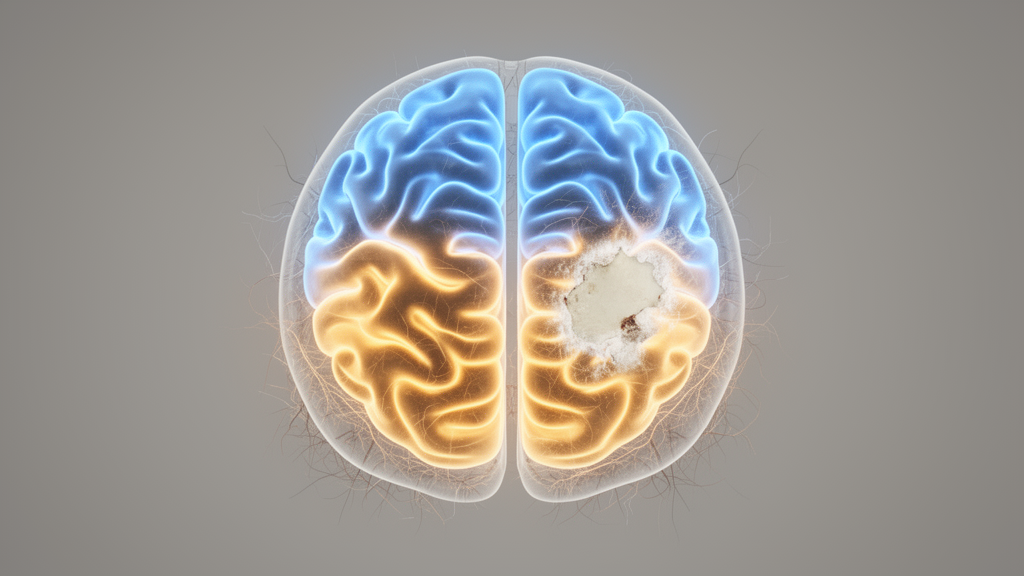
A unilateral ischemic stroke does not silence only the hemisphere it damages. In a rat study published in Behavioral and Brain Functions, researchers recorded neural activity from the caudal forelimb area on both sides of the brain and found widespread bilateral disruptions in oscillatory dynamics across delta, theta, alpha, beta, and gamma frequency bands after stroke.

The recordings combined several complementary analytical approaches. The researchers measured spectral power in canonical frequency bands, characterized the aperiodic 1/f slope of the local field potentials as an index of excitation–inhibition balance, and assessed cross-frequency coupling between the two hemispheres as a marker of interhemispheric coordination.

Two findings stand out. First, the aperiodic 1/f slope shifted after stroke, which the authors interpret as reflecting an altered balance between excitatory and inhibitory neural activity.

Second, cross-frequency coupling between hemispheres, particularly the coupling of low-frequency phase to gamma amplitude, was reorganized after the stroke. The team reports that this reorganization indicates impaired interhemispheric coordination and a bilateral imbalance in the motor network. In other words, the hemisphere that never experienced the infarct shows measurable changes in how its rhythms interact with those of the damaged side.

The authors conclude that post-stroke motor dysfunction arises from disrupted, state-dependent dynamics of distributed motor networks rather than from isolated changes confined to the lesioned hemisphere.

An important limitation deserves emphasis. The main experimental cohort did not include a sham-operated control group. However, a pilot experiment with three sham and three stroke animals, conducted using identical procedures, provided supportive evidence that the key measures remain stable under sham conditions. Readers should therefore treat the sham comparison as preliminary rather than definitive, and the anesthetized recordings add a further caveat about how the observed dynamics translate to awake behavior, even though task-based recordings were also collected.

Because the work was conducted in rats, the findings are preclinical and cannot be directly extended to human patients or to therapy. Still, the multiband, bilateral picture they paint offers a technically detailed map of how a focal lesion reverberates through a distributed motor circuit.

Subject of Research: Bilateral electrophysiological disruptions in the rat caudal forelimb area after ischemic stroke

Article Title: Bilateral cortical network disruptions in the rat caudal forelimb area after unilateral stroke

Article References: Cao, C., Chen, D., Gong, J., Gao, S., Huang, J., Jia, C., Liu, H., Li, Y., & Guo, Y. (2026). Bilateral cortical network disruptions in the rat caudal forelimb area after unilateral stroke. Behavioral and Brain Functions. https://doi.org/10.1186/s12993-026-00355-9

Image Credits: AI Generated

DOI: 10.1186/s12993-026-00355-9

Keywords: ischemic stroke, caudal forelimb area, local field potentials, oscillatory dynamics, excitation–inhibition balance, cross-frequency coupling, interhemispheric coordination, motor network, rat model, MCAO, single-pellet retrieval, aperiodic 1/f slope

News Source: Cassandra Pierce. (October 29, 2026). Stroke Disrupts Brain Rhythms on Both Sides in Rat Motor Cortex. Scienmag.


Tags: aperiodic 1/f slopecaudal forelimb areacross-frequency couplingexcitation-inhibition balanceinterhemispheric coordinationischemic strokeLocal field potentialsMCAOmotor networkoscillatory dynamicsrat modelsingle-pellet retrieval
Share12Tweet7Share2ShareShareShare1

Related Posts

ZNF207 shields glutamine transporter ASCT2 from degradation to fuel liver cancer growth

ZNF207 shields glutamine transporter ASCT2 from degradation to fuel liver cancer growth

October 30, 2026
Most Ethiopian HIV patients on dolutegravir therapy show good knowledge, survey finds

Most Ethiopian HIV patients on dolutegravir therapy show good knowledge, survey finds

October 30, 2026

Serum and urine protein biomarkers may sharpen prostate cancer detection beyond PSA

October 30, 2026

One gene locus flags atrial fibrillation risk after major surgery, UK Biobank study finds

October 30, 2026

POPULAR NEWS

  • Microbial Sources and Stress Shape the Hidden Endophytes of an Invasive Plant

    Microbial Sources and Stress Shape the Hidden Endophytes of an Invasive Plant

    29 shares
    Share 12 Tweet 7
  • Firebreaks Leave Lasting Scars in Grasslands While Wildfire Heals Fast

    29 shares
    Share 12 Tweet 7
  • ZNF207 shields glutamine transporter ASCT2 from degradation to fuel liver cancer growth

    29 shares
    Share 12 Tweet 7
  • Systematic review maps sustainability tensions in offshore wind development

    29 shares
    Share 12 Tweet 7

About

We bring you the latest biotechnology news from best research centers and universities around the world. Check our website.

Follow us

Recent News

Microbial Sources and Stress Shape the Hidden Endophytes of an Invasive Plant

Firebreaks Leave Lasting Scars in Grasslands While Wildfire Heals Fast

ZNF207 shields glutamine transporter ASCT2 from degradation to fuel liver cancer growth

Subscribe to Blog via Email

Enter your email address to subscribe to this blog and receive notifications of new posts by email.

Join 86 other subscribers
  • Contact Us

Bioengineer.org © Copyright 2023 All Rights Reserved.

Welcome Back!

Login to your account below

Forgotten Password?

Retrieve your password

Please enter your username or email address to reset your password.

Log In
No Result
View All Result
  • Homepages
    • Home Page 1
    • Home Page 2
  • News
  • National
  • Business
  • Health
  • Lifestyle
  • Science

Bioengineer.org © Copyright 2023 All Rights Reserved.
