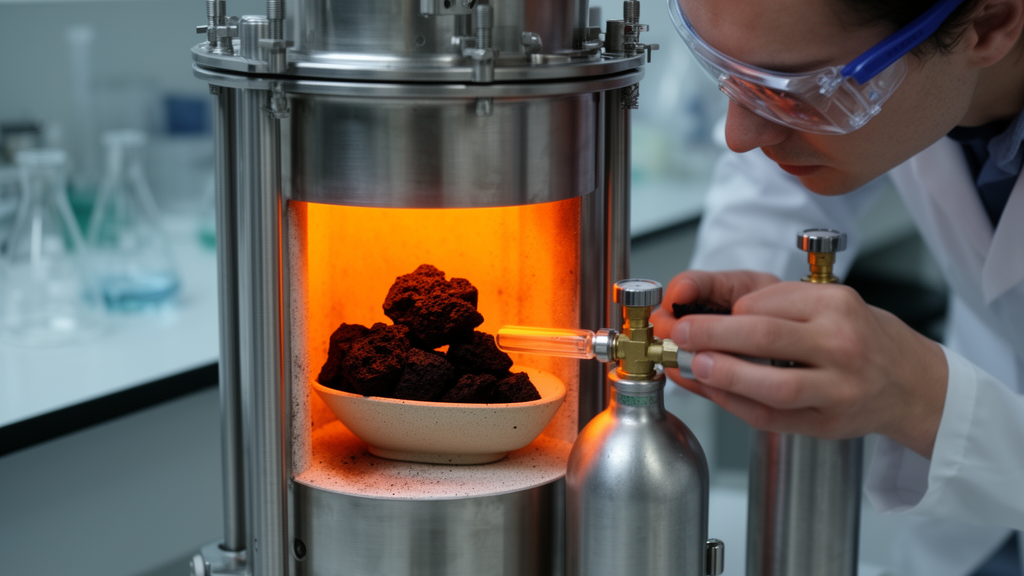
The gas swirling through a pyrolysis reactor does far more than carry vapours away. According to a new review published in Biochar, the atmosphere chosen for biomass pyrolysis—whether inert nitrogen, carbon dioxide, steam, sub-stoichiometric oxygen, ammonia, methane, or recycled flue gas—can decisively shift product yields, tar formation, and the porosity, surface chemistry and stability of the resulting biochar. Drawing on a semi-systematic search of Google Scholar supplemented by citation chaining, the authors compiled studies that explicitly varied the process atmosphere and reported product distributions or biochar properties, then compared them against the inert nitrogen or argon baseline that dominates the published literature.
Inert atmospheres remain the reference point for good reason. Because nitrogen and argon suppress oxidation and other side reactions, pyrolysis under these gases preserves a highly aromatic carbon framework and favours relatively high char and liquid yields. Interestingly, despite measurable differences in thermal conductivity and heat capacity between nitrogen and argon, previous work found no differences in product yields between the two, apparently because biomass decomposition reactions dominate over heat and mass transfer effects in small-scale reactors. Coal pyrolysis studies, however, showed a higher characteristic pyrolysis temperature under nitrogen and higher activation energy under argon, hinting that the two inert gases are not perfectly interchangeable.
Carbon dioxide is the most extensively studied reactive atmosphere, and its effects are strongly temperature-dependent. Below roughly 600 degrees Celsius, high CO2 partial pressure inside charring particles can constrain the diffusion of volatile fragments, promoting repolymerisation on particle surfaces and sometimes increasing biochar yield relative to nitrogen. Above about 700 degrees, the picture reverses: the Boudouard reaction, in which CO2 gasifies biochar carbon to carbon monoxide, accelerates devolatilisation and lowers char yields, a pattern documented for pepper stalks, swine manure, peat, tobacco waste and paper mill sludge, among others.
The clearest and most consistent CO2 effect is on tar and gas. Across feedstocks from seaweed to oak wood, CO2-assisted pyrolysis cracked volatile organic compounds and shifted carbon from condensable liquids into a carbon monoxide-rich gas stream. Tar reductions ranged from 23 percent for paper mill sludge to 70 percent for seaweed, and carbon monoxide concentrations in the pyrolysis gas reached roughly 17 times those under nitrogen at 660 degrees, rising further near 30-fold at 720 degrees. Surface area data reinforce the engineering appeal: biochar from fruit peel waste produced at 600 degrees under CO2 showed a BET surface area of 398 square metres per gram, compared with just 2.87 under nitrogen, while red pepper stalk char rose from 32 to 109 square metres per gram. High-ash feedstocks such as sewage sludge showed little or no such enhancement, and effects on carbon content and stability varied so much with feedstock, pelleting and temperature that the authors concluded they cannot be generalised.
Steam pyrolysis tells a different story. Below about 500 degrees, steam barely changes volatile yields, but at 700 degrees it participates directly in gasification reactions, converting char into hydrogen-rich gas. Compared with inert pyrolysis, steam atmospheres increase liquid product yields, cut organic acid content in the bio-oil, raise its hydrogen-to-carbon ratio and heating value, and strip tarry deposits from char surfaces, opening blocked pores. Oil palm frond biochar produced under steam reached BET surface areas above 450 square metres per gram. The trade-off is stark: lower biochar yield and, with it, reduced carbon sequestration potential. Evidence on the stability of steam-derived char is contradictory—fixed carbon fell for pine at 600 degrees but not at 500 degrees, and one study over 650 to 850 degrees found no change in thermal stability yet weakened chemical stability—so the review concludes that no clear verdict on long-term carbon persistence is yet possible.
Oxygen, even in tiny amounts, is the most aggressive lever. Because partial combustion of pyrolysis volatiles is exothermic, oxidative pyrolysis can partly heat itself, edging toward autothermal operation. But the carbon cost is severe: biochar yield dropped by up to 50 percent at 700 degrees as oxygen concentration increased, and rice straw char fell from 35.4 to 15.1 weight percent at 800 degrees when oxygen rose from zero to 21 percent. What survives is often more reactive rather than more abundant. Pinewood biochar produced with 21 percent oxygen at 500 degrees reached about 375 square metres per gram of surface area versus roughly 2 under inert conditions, and oxidative chars showed higher cation exchange capacity and more acidic surface groups. Mild oxidation also lowered hydrogen-to-carbon and oxygen-to-carbon ratios, proxies for greater recalcitrance, though the authors caution that wildfire charcoals formed under uncontrolled oxidative conditions show the opposite pattern, and field validation is lacking.
Ammonia occupies a narrower but distinctive niche. Molecular nitrogen is too unreactive to dope carbon, but ammonia decomposes above roughly 300 degrees into reactive species that etch the char while installing pyridinic, pyrrolic, quaternary and oxidised nitrogen functionalities—most effectively below 400 degrees, above which ammonia itself breaks down. Nitrogen-doping ratios as high as 8.1 percent have been reported. In one case, ammonia pyrolysis raised BET surface area from 158 to 521 square metres per gram and total pore volume more than threefold without changing char yield, and nitrogen-doped biochar removed 170 milligrams of phenol per gram from simulated wastewater versus about 105 for undoped material. These properties suit sorbents, catalysts and supercapacitor electrodes, though ammonia’s toxicity and corrosiveness add containment costs.
Methane and flue-gas atmospheres remain the weakest evidence base. Methane barely affected biochar yield in the few available studies, and a reported surface-area change during torrefaction fell within analytical uncertainty. At temperatures above 700 degrees, however, biochar can catalyse methane decomposition, depositing graphitic carbon nanofibers or nanospheres and potentially boosting conductivity—an intriguing route to engineered carbons that has so far been demonstrated mainly with pre-formed chars rather than during pyrolysis itself. Flue gas, though long used industrially in technologies such as the Lambiotte retort, which achieves 30 to 35 percent char yield with 80 to 90 percent fixed carbon, has attracted minimal systematic research. Its composition varies widely, contaminant risks from hydrogen chloride, hydrogen fluoride and heavy metals depend on the fuel source, and adding just 10 percent oxygen cut biochar yield from 83.1 to 76.4 percent in one spruce wood trial.
The review’s central message is that no atmosphere is universally superior. Inert pyrolysis remains the most reliable route when maximum retained solid carbon is the goal, while reactive atmospheres excel where engineered functionality, tar suppression, gas production or process heat integration matter more. The authors stress that stability proxies such as aromaticity and elemental ratios do not always move in the same direction as actual carbon retention, that most evidence comes from laboratory-scale fixed-bed reactors, and that field-scale validation, matched-condition comparisons and standardised reporting of gas compositions are urgently needed before alternative atmospheres can be deployed deliberately at scale.
Subject of Research: Effects of different pyrolysis atmospheres on biochar production and properties
Article Title: Biochar production under different atmospheres: an overview
Article References: Mašek, O., Buss, W., Wang, L., Sun, J., Wang, X., Wang, Y., & Skreiberg, Ø. (2026). Biochar production under different atmospheres: an overview. Biochar, 8(1), Article 129. https://doi.org/10.1007/s42773-026-00626-8
Image Credits: AI Generated
DOI: 10.1007/s42773-026-00626-8
Keywords: biochar, pyrolysis, CO2-assisted pyrolysis, steam pyrolysis, oxidative pyrolysis, ammonia atmosphere, carbon sequestration, surface area, tar reduction, flue gas, methane decomposition, production
News Source: Russell Cooper. (October 29, 2026). Pyrolysis Atmosphere Emerges as Key Lever to Engineer Biochar Yield and Function. Scienmag.