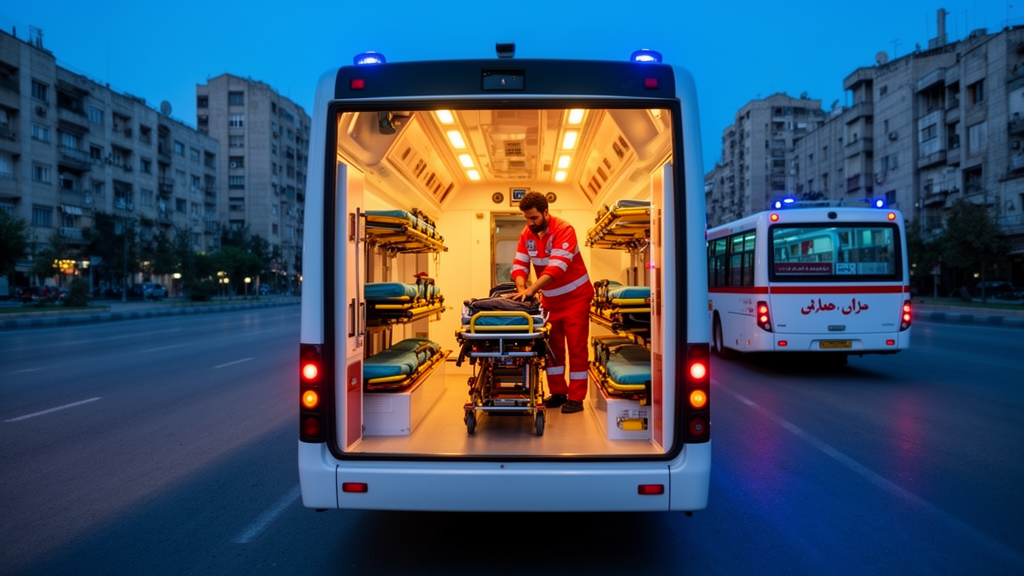
Iranian pre-hospital emergency medical services personnel see ambulance buses as a promising way to move large numbers of patients during mass-casualty incidents, but their hands-on experience reveals persistent problems with vehicle design, equipment, coordination and staff support, according to a qualitative study published in BMC Emergency Medicine.
Ambulance buses, often abbreviated AmBus, may provide additional transport capacity when the number of casualties exceeds what conventional ambulances can handle. The study’s authors note that the practical usefulness of these vehicles may depend not only on raw capacity but also on vehicle design, equipment availability, staffing, team coordination, operational protocols and personnel training.
To explore how frontline personnel actually experience these vehicles, researchers conducted a qualitative study using conventional content analysis. They recruited pre-hospital EMS staff, nurses and field supervisors who had taken part in missions involving ambulance buses in real-world deployments, simulation drills and group patient-transport operations, using purposeful sampling with maximum variation until data saturation was reached.
In total, 51 participants were interviewed through in-depth, semi-structured interviews. Because some participants were interviewed more than once to clarify and validate emerging interpretations, the team conducted 57 interviews overall. The conversations were audio-recorded, transcribed verbatim and analyzed using MAXQDA/10 software.
The analysis produced five main themes with ten subthemes: the ambulance bus as a capacity-enhancing tool for mass-casualty response; structural and equipment-related challenges of the vehicle; complexity of scene management and team coordination; psychological and physical burden on staff; and the need for training, drills and specific protocols.
Participants viewed the ambulance bus as both an opportunity and a challenge. On the opportunity side, they highlighted increased transport capacity and the ability to carry out simultaneous triage and care. On the challenge side, they pointed to limited space, insufficient equipment, role ambiguity and high stress.
The study’s conclusion reflects the perspective of the participating Iranian pre-hospital EMS personnel: ambulance buses may be a useful option for increasing transport capacity during selected mass-casualty and group patient-transport missions, but their practical use appears constrained by limitations in vehicle design, equipment, coordination, role clarity, staff support and specialized training.
As a qualitative study of 51 Iranian EMS personnel, the findings describe the experiences and perceptions of these participants rather than measuring clinical outcomes or vehicle performance. The authors note that limited qualitative evidence has previously been available on how pre-hospital EMS personnel in Iran experience ambulance bus use across actual missions, simulation exercises and group patient-transport operations, making this analysis a contribution to understanding where these vehicles fit within mass-casualty response systems.
Subject of Research: Qualitative study of Iranian pre-hospital EMS personnel's experiences with ambulance bus use in mass-casualty and group patient-transport missions.
Article Title: Challenges of applying bus ambulances in pre-hospital EMS in Iran: a qualitative study
Article References: Sheikhi, R. A., & Heidari, M. (2026). Challenges of applying bus ambulances in pre-hospital EMS in Iran: a qualitative study. BMC Emergency Medicine. https://doi.org/10.1186/s12873-026-01819-x
Image Credits: AI Generated
DOI: 10.1186/s12873-026-01819-x
Keywords: ambulance bus, mass-casualty incidents, pre-hospital EMS, Iran, qualitative study, emergency medical services, triage, patient transport, staff training, content analysis, Challenges, applying
News Source: Ophelia Keating. (October 29, 2026). Bus ambulances could boost mass-casualty response in Iran, but staff report major obstacles. Scienmag.