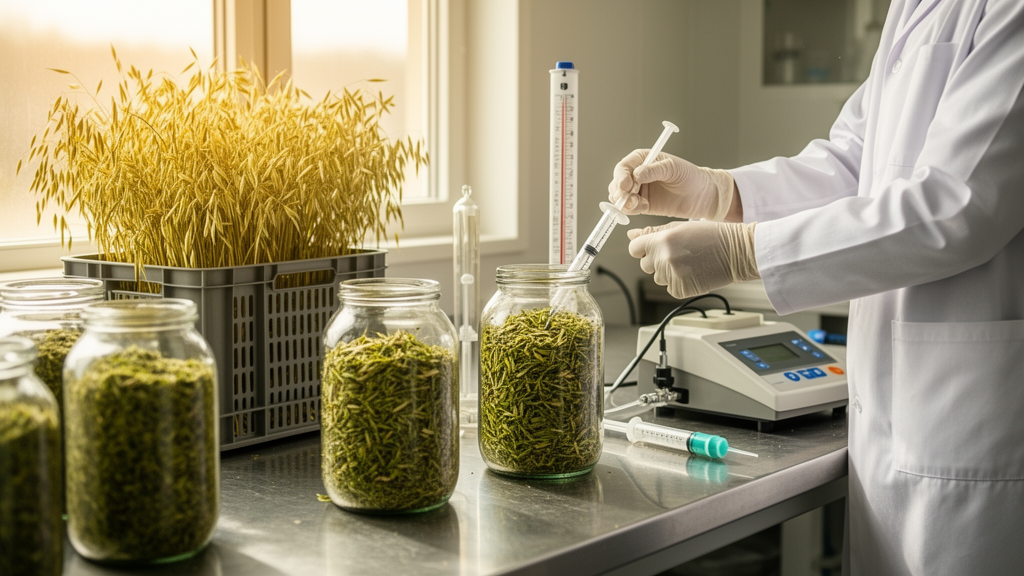
Carbon dioxide is the dominant greenhouse gas released during the fermentation of oat forage into silage, and the choice of lactic acid bacteria inoculant, together with ambient temperature, largely determines how much of that gas—and other emissions such as methane and nitrous oxide—escapes from the silo. That is the central conclusion of a new open-access study published in Chemical and Biological Technologies in Agriculture, which examined how homofermentative and heterofermentative bacterial additives perform under different temperature conditions.
The research team, led by Hao Guan and Xusheng Guo with colleagues, set out to address a gap in the literature. Although the global livestock sector produces enormous greenhouse gas emissions with substantial mitigation potential, the CO2, CH4, and N2O released during silage production through microbial fermentation—along with the associated losses of dry matter and energy—have remained insufficiently studied. Oat is an important forage crop on the Qinghai-Tibet Plateau, where silage fermentation is significantly influenced by ambient temperature and by the type of lactic acid bacteria used, yet the mechanisms by which different bacterial types regulate greenhouse gas emissions and their differential responses to temperature were poorly understood.
The experiment investigated the effects of different lactic acid bacteria inoculants and ambient temperatures on fermentation quality, aerobic stability, greenhouse gas emissions, and the bacterial community of oat forage silage. Two inoculants took center stage: Lactiplantibacillus plantarum 260, a homofermentative strain abbreviated LP, and Lentilactobacillus buchneri 40,788, a heterofermentative strain abbreviated LB, alongside an untreated control group.
Temperature and inoculant showed significant interactions on pH at days 7 and 60, and on acetic and propionic acid at day 19, with statistical significance at P < 0.05. Across the trial, LP consistently produced the lowest pH and the highest lactic acid content, indicating optimal fermentation quality. LB, by contrast, increased acetic acid but maintained a higher pH, a pattern consistent with typical heterofermentative metabolism, in which the bacteria generate a wider range of fermentation end products.
Temperature shifted the balance between the two strains in telling ways. Low temperature enhanced lactic acid production in silage treated with LP, whereas high temperature intensified heterofermentation in the LB-treated material. Aerobic stability—the silage’s resistance to heating and spoilage once exposed to air—was significantly improved by LB, as evidenced by the smallest rise in core temperature after 168 hours of aerobic exposure.
The greenhouse gas findings were equally differentiated. Methane was detected only in the high-temperature untreated control group during early fermentation, and it fell below the detection limit in all LAB-treated groups. Carbon dioxide was emitted throughout the ensiling process: LB led to higher initial CO2 emissions because of its heterofermentative metabolism, while LP resulted in the lowest CO2 emissions overall. LB may increase nitrous oxide during the early stage at low temperature and carbon dioxide at high temperature, whereas LP maintained relatively low N2O and CO2 under both temperature conditions.
Sequencing of the bacterial community helped explain these patterns. LP increased the relative abundance of L. plantarum from 40 to 55 percent, while LB raised L. buchneri abundance to nearly 95 percent. Low temperature favored the enrichment of L. plantarum, whereas high temperature increased spoilage-associated bacteria such as Clostridium and Bacillus. Correlation analysis revealed that L. plantarum was positively correlated with lactic acid and negatively correlated with pH and propionic acid, while L. buchneri was positively correlated with acetic acid. Methane, nitrous oxide, and carbon dioxide emissions were positively correlated with genera such as Leuconostoc and Enterobacteriaceae.
The authors conclude that LP rapidly acidifies the silage, improves fermentation quality, and reduces greenhouse gas emissions, whereas LB enhances aerobic stability but may increase CO2 and N2O emissions under high-temperature conditions.
As with any single-crop fermentation study, the findings are specific to oat forage silage under the tested conditions, and the authors note that the mechanisms by which different LAB types regulate greenhouse gas emissions remain an area for further work. The article was published on 13 October 2026 as peer-reviewed, accepted research shared early for faster access, citable under a permanent DOI and subject to further edits before the final Version of Record.
Subject of Research: Effects of lactic acid bacteria inoculants and ambient temperature on fermentation quality and greenhouse gas emissions in oat forage silage.
Article Title: Effects of lactic acid bacteria type and ambient temperature on fermentation quality and greenhouse gas emissions of oat forage silage
Article References: Guan, H., Li, H., Chen, Y., Chen, S., Hu, X., Quzhen, D., Lamu, X., Yang, L., Ji, Y., Huang, Y., Zhou, Q., & Guo, X. (2026). Effects of lactic acid bacteria type and ambient temperature on fermentation quality and greenhouse gas emissions of oat forage silage. Chemical and Biological Technologies in Agriculture. https://doi.org/10.1186/s40538-026-01124-6
Image Credits: AI Generated
DOI: 10.1186/s40538-026-01124-6
Keywords: oat silage, lactic acid bacteria, greenhouse gases, fermentation quality, aerobic stability, Lactiplantibacillus plantarum, Lentilactobacillus buchneri, carbon dioxide, nitrous oxide, methane, Qinghai-Tibet Plateau, bacterial community
News Source: Morgan Morrow. (October 29, 2026). Lactic Acid Bacteria Choice and Temperature Shape Greenhouse Gas Emissions from Oat Silage. Scienmag.