


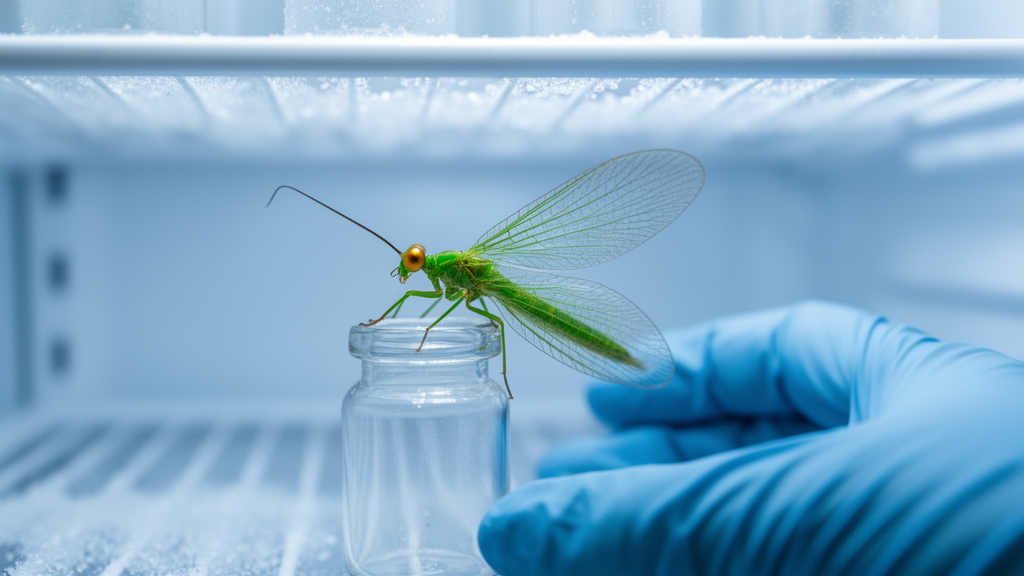
The green lacewing Chrysopa formosa is one of the most versatile predators in the biological control arsenal. Its larvae and adults devour aphids, thrips, whiteflies, mealybugs and the eggs and larvae of moths, and the species is widely distributed across Asia and Europe. Yet turning that appetite into a dependable commercial product has always been awkward, because live insects cannot simply be stockpiled on a shelf. A new laboratory study now maps out precisely how long these predators can be kept in cold storage before the benefits of preservation give way to the costs, and the answer is a surprisingly narrow window of roughly three to four months.
The research, published in the Egyptian Journal of Biological Pest Control, focused on a quirk of lacewing biology that makes storage possible at all: diapause. Diapause is a programmed developmental arrest that allows insects to survive unfavorable seasons, and in C. formosa it is triggered in third-instar larvae by cool temperatures and short days. Under 20 degrees Celsius and a short 8-hour photoperiod, larvae readily enter a prepupal diapause that can last up to 300 days. For insectaries, that dormant state is an opportunity, because it means immature lacewings can be parked in a refrigerator until pests appear in the field. The catch is that diapause must be ended on cue, and the insects must emerge from it fit enough to hunt and reproduce.
Earlier work by the same laboratory had already established that 5 degrees Celsius is the best storage temperature for C. formosa, outperforming both 0 and 10 degrees Celsius in maintaining diapause and promoting synchronized termination. The open question was duration. To answer it, the team chilled diapausing prepupae at 5 degrees Celsius in complete darkness for 60, 100, 110, 120, 180 or 240 days, then returned them to warm, long-day rearing conditions at 26 degrees Celsius and tracked pupation, adult emergence, longevity, fecundity and egg hatching. A non-diapausing control group, reared continuously at 26 degrees Celsius, provided the benchmark for full fitness.
The results split cleanly into three regimes. Short-term chilling of 60 days was clearly insufficient: pupation reached only 75 percent, significantly below the control, indicating incomplete diapause termination and poor emergence synchrony. At the other extreme, prolonged storage beyond 120 days eroded performance progressively. By 240 days, pupation had fallen to 59.7 percent, and adult longevity in both sexes dropped markedly once storage exceeded 180 days. In between sat the sweet spot. Storage for 100 to 120 days terminated diapause effectively, with pupation rates exceeding 89 percent and statistically indistinguishable from the non-diapause control at 110 days.
Developmental timing also shifted with storage duration in ways that matter for mass release. The time to pupation decreased as chilling lengthened, with the 180-day group pupating fastest of all, and pupation became increasingly synchronized once storage passed 120 days. That synchrony is a genuine operational asset, because it lets producers predict when batches of adults will become available for deployment. Adult emergence exceeded 65 percent across the 100 to 240 day treatments, and the 240-day group actually posted the highest eclosion rate at 86 percent, though the authors caution this may reflect strong cold tolerance selection among survivors, an interpretation they flag as speculative.
Reproduction told a more demanding story. Females emerging after 120 days of chilling showed the most favorable profile of any chilled group: a shortened pre-oviposition period, a prolonged oviposition span, high and stable fecundity, and egg hatchability statistically indistinguishable from controls at 73.3 percent. Females from the 180 and 240-day groups laid eggs in erratic bursts, with daily output occasionally spiking to 40 and 70 eggs respectively, but their egg viability collapsed below 60 percent. In other words, long-stored females could still produce many eggs, but far fewer of those eggs hatched, a hidden cost that would only become apparent after release.
Adult longevity added a sex-specific wrinkle. Males and females stored for 120 days lived as long as non-diapausing adults, while both sexes from the 180 and 240-day groups had significantly shortened lifespans, with males suffering more severely. In the control and 120-day groups, males outlived females, but that difference vanished in the longer storage treatments. The authors note that differences in resource allocation between the sexes might contribute to this pattern, but they emphasize that without direct physiological measurements such interpretations remain conjecture.
One consistent surprise across the experiment was that diapause-terminated females began laying eggs earlier than non-diapause controls, a pattern the authors note has also been reported in other insects such as Lygus hesperus and Pieris napi. That reproductive acceleration could help released predators establish populations quickly after deployment. The study also documented a U-shaped trend in pupation and emergence times, with the 180-day group terminating fastest but paying for it in later survival, echoing findings in other predators and parasitoids where chilling speeds diapause exit at the expense of downstream fitness.
The authors are careful about what their data do and do not show. The observed declines in survival and reproduction are phenotypic; the physiological mechanisms behind them were not measured. Previous work in this species showed that even short-term diapause depletes total protein, lipids, glycogen and sorbitol, and the literature points to candidate explanations such as energy reserve depletion, oxidative stress, altered endocrine signaling, reduced maternal egg provisioning or sperm limitation. But the study did not quantify any of these, so the researchers explicitly decline to draw mechanistic conclusions. They also acknowledge that their colony came from a single geographic population, which may limit how broadly the results generalize to other strains or environments, and that only the directly treated generation was assessed.
Even with those caveats, the practical message is clear. A storage window of 100 to 120 days at 5 degrees Celsius gives insectaries a flexible scheduling tool: predators can be accumulated in advance, held dormant for months, and released in synchronized, reproductively competent batches when pest outbreaks demand them. Shorter chilling leaves diapause incompletely terminated, while storage beyond 180 days imposes substantial costs in longevity, oviposition regularity and egg hatchability, defining a hard upper limit for commercial practice. The team plans follow-up work on adult predation capacity and offspring fitness under semi-field and field conditions, along with direct biochemical measurements, to complete the picture of how cold storage shapes this valuable predator’s performance from refrigerator to crop.
Subject of Research: Optimizing cold storage duration for diapause termination and post-diapause performance in the green lacewing Chrysopa formosa
Article Title: Optimizing cold storage for diapause termination and post-diapause performance in the green lacewing Chrysopa formosa Brauer (Neuroptera: Chrysopidae)
Article References: Wang, L., Wang, Y., Li, Y., Tian, X., Zhang, L., & Li, Y. (2026). Optimizing cold storage for diapause termination and post-diapause performance in the green lacewing Chrysopa formosa Brauer (Neuroptera: Chrysopidae). Egyptian Journal of Biological Pest Control, 36(1), Article 21. https://doi.org/10.1186/s41938-026-00900-8
Image Credits: AI Generated
DOI: 10.1186/s41938-026-00900-8
Keywords: Chrysopa formosa, green lacewing, diapause, cold storage, biological control, mass rearing, fecundity, egg hatchability, pupation, adult longevity, prepupae, 5 °C
News Source: Gavin Prescott. (October 29, 2026). Cold Storage Sweet Spot Keeps Green Lacewings Battle-Ready for Pest Control. Scienmag.



