


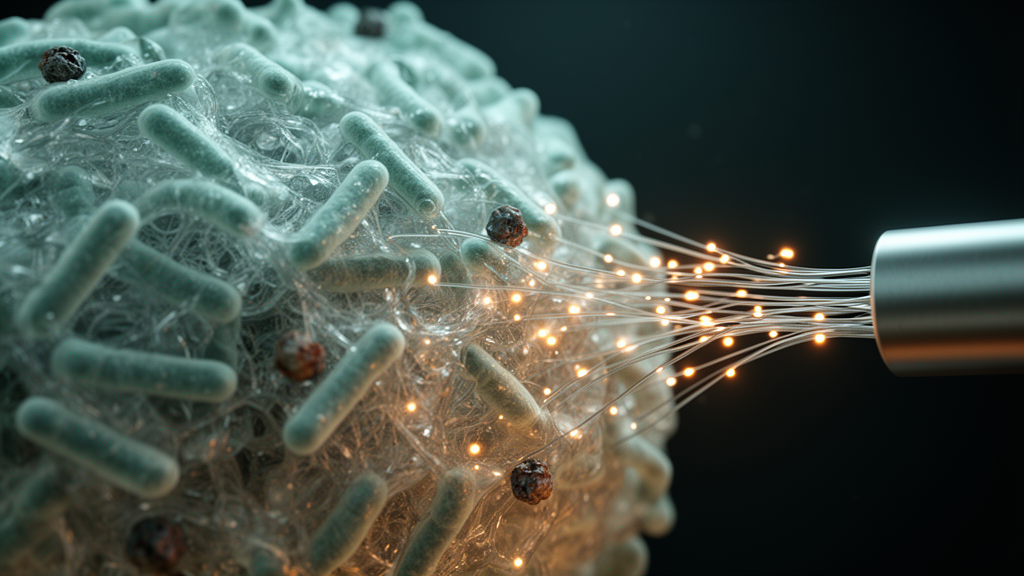
A slimy substance that microbes secrete to survive harsh conditions is emerging as one of biotechnology’s most versatile raw materials. A review published in Biotechnology for Sustainable Materials on 26 March 2026 argues that microbial exopolysaccharides, or EPSs, deserve attention not merely as sticky metabolic byproducts but as programmable biopolymers that could anchor everything from electricity-generating biofilms to heavy-metal cleanup and drug delivery. The authors, Abhinav Kumar Singh, Rahul Gautam, and Gaurav Manik, synthesize decades of research into a single framework that links the molecular chemistry of these polymers to their performance in microbial fuel cells, wastewater treatment, agriculture, green nanomaterial synthesis, and medicine.
Exopolysaccharides are high-molecular-weight biopolymers, generally ranging from 10^5 to 10^6 Daltons, secreted by bacteria, archaea, fungi, and algae. In nature they form the structural and functional core of extracellular matrices, mediating adhesion, stress tolerance, and nutrient acquisition. The review notes that EPS can constitute 80 to 90 percent of a biofilm’s dry mass, underscoring how dominant these polymers are in microbial communities. Their chemical diversity is enormous: homopolysaccharides such as dextran and levan consist of a single monosaccharide type, while heteropolysaccharides such as xanthan gum, produced by Xanthomonas campestris, combine glucose, mannose, and glucuronic acid. Functional substitutions including acetate, pyruvate, phosphate, and uronic acid groups give many EPSs a strongly anionic character, which drives their ability to chelate heavy metals and stabilize nanoparticles.
The historical arc of EPS research stretches back to the late 1800s, when thick, sticky substances were first observed during bacterial growth in sugar-rich media and dismissed as metabolic waste. Systematic study between the 1940s and 1960s revealed that some microbes produce large quantities of extracellular polysaccharides, and the commercial approval of xanthan gum in the 1960s marked the first large-scale industrial use of an EPS, establishing its value as a hydrocolloid. From the 1970s to the 1990s, advances in carbohydrate chemistry and electron microscopy clarified the composition of xanthan, dextran, alginate, and gellan. With the arrival of molecular biology and genomics in the early twenty-first century, researchers mapped the genetic and enzymatic pathways of EPS production, including the Wzx/Wzy-dependent and ABC transporter pathways.
Four major intracellular biosynthesis pathways are now recognized. The Wzx/Wzy-dependent pathway assembles repeating units on undecaprenol diphosphate anchors, translocates them across the cytoplasmic membrane, and polymerizes them extracellularly. The ABC transporter pathway handles capsular polysaccharide biosynthesis by dispatching a transporter complex accompanied by periplasmic proteins. The synthase-dependent pathway uses a single protein capable of both polymerizing and secreting the complete polymer chain across the cell envelope. Environmental conditions shape the outcome: low nitrogen concentrations in the growth medium have been shown to increase EPS production, and most microorganisms produce EPS optimally at temperatures between 25 and 30 degrees Celsius. Substrate type matters too. Agro-waste-derived substrates such as lignocellulosic hydrolysates and rice husk leachates stimulate polysaccharide-rich EPS with enhanced viscosity and high metal-binding capacity, whereas wastewater feedstocks yield protein- and lipid-enriched EPS that improve adhesion but complicate downstream purification.
The review’s central electrochemical focus is the role of EPS in microbial fuel cells, devices in which electroactive microorganisms transfer electrons to electrodes while breaking down organic matter. EPS-secreting bacteria such as Geobacter, Shewanella, and Pseudomonas species form robust biofilms on electrode surfaces, and the review reports that EPS-enriched biofilms have demonstrated improvements in MFC power densities ranging from 60 to 150 milliwatts per square meter and increases in anodic current densities of 20 to 80 percent. In soil-based microbial fuel cells, mixed EPS-secreting consortia simultaneously boost power output and pollutant removal, frequently reducing chemical oxygen demand and total organic carbon by more than 70 percent. EPS enables initial anode colonization by forming a hydrated, viscoelastic matrix that irreversibly attaches microbes to electrode surfaces through hydrogen bonding and electrostatic interactions, while proteinaceous and humic constituents condition the surface and balance hydrophobicity.
Beyond adhesion, EPS participates directly in extracellular electron transfer. Its matrix contains redox-active moieties including c-type cytochromes, humic substances, and flavin derivatives that enable mediated electron transfer through cyclic oxidation and reduction reactions. Conductive pili, or nanowires, embedded within the EPS matrix aid direct electron conduction, forming hybrid electron-transport networks. Reported conductivity values for EPS matrices span 10 to 10^3 microsiemens per centimeter, but the review stresses that this variability across species and growth conditions remains a matter of ongoing debate, and that standardized electrochemical characterization protocols are urgently needed to distinguish true redox conduction from ionic or diffusive charge transport. One cited study showed that reducing EPS produced a thinner biofilm with decreased cell viability and current generation, suggesting a direct correlation between EPS quantity and fuel cell output.
Environmental applications form the second pillar of the review. Because of their polyanionic character, conferred by uronic acids, sulfates, and phosphates, EPSs act as natural biosorbents for toxic metals including lead, copper, zinc, cadmium, and hexavalent chromium. Sequestration proceeds through ion exchange, in which counter-ions such as sodium, calcium, and magnesium are replaced by heavy metal cations; complexation, in which metal ions coordinate with electron-donating oxygen, nitrogen, and sulfur atoms within the EPS matrix; and, under supersaturated or alkaline conditions, surface precipitation of metal hydroxides or oxides on the EPS framework. Specific strains illustrate the potential: Pseudomonas sp. H7 and Agrobacterium sp. Z22, isolated from contaminated farmland, precipitate cadmium and lead as CdCO3 and PbCO3 respectively, significantly reducing metal uptake in crops such as pakchoi. A Bacillus cereus strain grown on sugar industry molasses achieved both higher EPS yields and improved removal of multiple metals, exemplifying a circular-bioeconomy approach that couples pollution control with waste valorization.
In agriculture, EPS acts as a natural binding agent that encourages the aggregation of soil particles, increases porosity, and improves water retention, enhancing resistance to erosion and drought stress. In the rhizosphere, EPS-mediated interactions between plant roots and beneficial microbes improve nutrient availability and root colonization. In materials science, EPS serves as a green matrix for nanoparticle synthesis: negatively charged functional groups attract positively charged metal ions such as silver, gold, palladium, and copper, which are then bioreduced to their zerovalent state by electrons donated from hydroxyl, phenolic, and amino groups and redox enzymes within the polymer network. The EPS subsequently coats the nanoparticles as a capping agent, preventing agglomeration and conferring biocompatibility, which makes the resulting materials candidates for drug delivery, antimicrobial coatings, bioimaging, catalysis, and sensing.
Biomedical prospects are similarly broad. Reported activities of EPSs include antioxidant, antitumor, antiviral, anti-inflammatory, and immunomodulatory effects. EPSs from lactic acid bacteria can act as immunobiotic agents that activate a tolerogenic immune response and may find use in vaccine formulations, and in vivo studies have shown that both acidic and neutral EPSs can modulate innate antiviral immune responses in intestinal cells. Dextran-coated magnetic nanoparticles for targeted therapy exemplify theragnostic systems that combine diagnostic and therapeutic functions. The review cautions, however, that translation to clinical use will require rigorous safety, efficacy, and regulatory assessments alongside scalable production methods, and it emphasizes that these are areas of active investigation rather than established therapies.
Commercialization remains the review’s most sobering theme. Downstream extraction, isolation, and purification of EPS from fermentation broths are labor-intensive and nonstandardized, and can induce structural alterations such as polymer cleavage or coprecipitation that compromise reproducibility and functionality between batches. Conventional carbon sources like glucose and sucrose impose a significant economic burden, and while renewable feedstocks including agricultural residues and industrial effluents have been tested at pilot scale, whole-system techno-economic analysis and life-cycle assessment remain rare. The structure-activity relationship is another unresolved gap: after many years of study, the connection between monosaccharide composition, glycosidic linkages, branching architecture, and biological function remains largely unmapped, and processing artefacts such as depolymerization make results difficult to replicate. Biosafety adds a further layer of complexity, since several prolific EPS producers, including Pseudomonas aeruginosa, Klebsiella pneumoniae, and pathogenic Escherichia coli strains, appear on the WHO Priority Pathogens List. The authors propose mitigation through GRAS strains such as Lactobacillus, Bacillus, and Leuconostoc, rigorous purification, genetically attenuated production strains, and routine contamination screening. Their conclusion is measured: significant progress has been made, but future breakthroughs will require coordinated efforts in microbial engineering, bioprocess optimization, and molecular characterization to enable scalable, application-specific EPS production within a genuine circular bioeconomy.
Subject of Research: Review of microbial exopolysaccharide applications in microbial fuel cells, bioremediation, agriculture, nanomaterials, and medicine
Article Title: Versatile applications of EPS secreting Microbes: advances in microbial fuel cells and beyond
Article References: Singh, A. K., Gautam, R., & Manik, G. (2026). Versatile applications of EPS secreting Microbes: advances in microbial fuel cells and beyond. Biotechnology for Sustainable Materials, 3(1), Article 4. https://doi.org/10.1186/s44316-026-00053-6
Image Credits: AI Generated
DOI: 10.1186/s44316-026-00053-6
Keywords: exopolysaccharides, microbial fuel cells, biofilms, bioremediation, heavy metals, green nanomaterials, drug delivery, sustainable agriculture, biosorption, extracellular electron transfer, circular bioeconomy, wastewater treatment
News Source: Morgan Morrow. (October 29, 2026). Microbial Slime Gets Serious: Exopolysaccharides Power Fuel Cells and Clean Up Pollution. Scienmag.



