


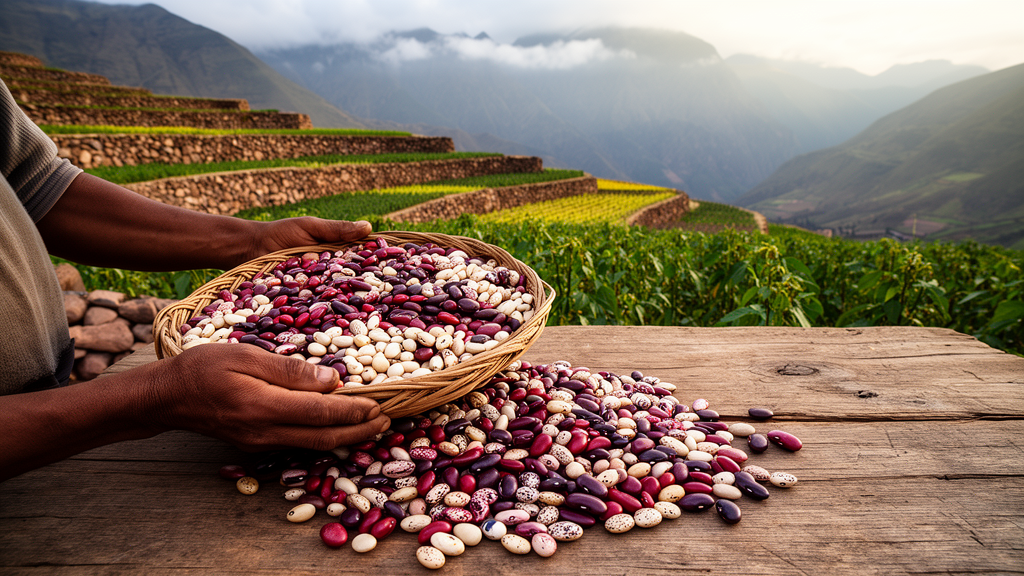
In the Andean foothills of southern Chile, thirty traditional bean varieties have been documented in unprecedented botanical detail, thanks to a two-year collaboration between researchers and local women gardeners. The study, conducted in the La Araucanía region between 2022 and 2024, recorded the morphological and phenological traits of 30 bean landraces grown under real cultivation conditions in family homegardens, marking what its authors describe as the first such documentation for these varieties.
The work formed part of the Porotarium Austral Seed Refuge, a communally managed seed bank established in 2022 that now houses more than 90 accessions of bean landraces. Researchers from the study team conducted an initial cadastre through meetings with seed curators, gardeners, and vegetable growers in the municipalities of Pucón, Curarrehue, and Padre Las Casas, using semi-structured interviews in which participants identified which of 66 landraces they knew and cultivated. From these meetings emerged both the seed refuge and the network of collaborators who would go on to cultivate the study varieties.
Beans of the genus Phaseolus have been cultivated in southern South America for more than a thousand years and hold deep cultural significance, particularly among the Indigenous Mapuche families who carry out 60 percent of small-scale farming in La Araucanía. Within Chile, a recognized Chile landrace has led researchers to identify the country as a secondary domestication center for beans in South America. Small-scale farming accounts for 70 to 80 percent of national bean production, yet bean consumption and cultivated hectares have been declining in the country, a trend the study’s authors frame against the broader global erosion of agrobiodiversity driven by the replacement of local varieties with modern high-yielding cultivars.
The propagation trials took place over two agricultural seasons. In the first, sowing occurred between October and April of 2022 to 2023 in nine homegardens, each under the care of a female gardener, with two additional gardens managed by the research team in La Unión and Pucón. Each gardener received 50 seeds of each landrace assigned to her, sown three seeds at a time with one foot between plants, while all other management decisions, from irrigation to weeding to companion planting, remained at the discretion of each gardener according to her customary practices. Each landrace was cultivated in at least two different homegardens as a replicate.
The second season brought methodological adjustments informed by the first year’s experience. Seedlings were raised in nursery trays and transplanted in mid-November, a decision made collectively with the gardeners after frosts during the first half of November had caused crop losses in the first season and in the two preceding years, which the authors cite as evidence of climate change. The study area narrowed to the municipality of Pucón, with six gardens enabling closer monitoring, and each landrace was represented by 144 seedlings. Monthly garden visits recorded phenology in detail, complemented by photographic records that the gardeners themselves took with their cell phones.
The researchers measured an extensive suite of traits across at least two gardens per landrace. These included growth habit, categorized as bush, half-runner, or pole; stem, leaf, flower, and inflorescence characteristics; pod profile shape, tip, and color; and, for five individuals per landrace, total height, maximum diameter, internode distance, and node count before the first flower. Leaflet dimensions, petiole lengths, and pod lengths were measured on those individuals. After harvest, seed width, length, and depth were recorded with a caliper, seed volume calculated, and 100-seed weight measured on a scale.
The data were analyzed using Principal Component Analysis across 15 traits, standardized to unit variance and run in R with the FactoMineR package. The first two principal components explained 97.08 percent of total variation. The first component, loaded on plant height, internode distance, central leaflet width, and pod length, served as an indicator of overall plant size. The second, loaded on seed length, width, depth, volume, and weight, captured seed size. When landraces were plotted along these axes, the three landraces of Phaseolus coccineus, known locally as Pallares, formed a group clearly distinct from the Phaseolus vulgaris landraces, driven principally by their large seeds and uniform pole growth habit.
Within P. vulgaris, the analysis revealed meaningful structure. Smaller seeds corresponded to smaller plants, while medium-sized seeds could produce plants of any size or growth habit. Growth habit mapped directly onto plant size, confirming that pole plants are tallest, half-runners intermediate, and bushes shortest. Pod shape also tracked plant size, with straight pods on smaller plants, semi-curved pods on medium plants, and curved pods on the largest. Seed color, by contrast, showed no relationship to plant or seed size, and pod tip shape failed to correlate with either principal component. Among the 27 P. vulgaris landraces, the researchers proposed four groupings based on agrobotanical traits: Coyundas, with pole growth and thin kidney-shaped seeds averaging 60 grams per hundred seeds; Hilum-Spotted, bearing large spots around the hilum and averaging 54 grams; Mottled, with patterns covering both pods and seeds and averaging 54 grams; and Solid, bush-type plants with small to medium solid-colored seeds averaging 42 grams. The Pallares group of P. coccineus stood apart with red flowers, thick yellow mottled mature pods, and large kidney-shaped seeds averaging 145 grams per hundred.
Phenological records, kept from November through April, showed flowering on average in January and pod development from February to April, with notable deviations. Some landraces, such as the Coyunda riñón, were exceptionally early, while others, such as the Sortelino, were late, traits the authors note are of practical interest when selecting varieties for garden cultivation. The researchers also observed occasional hybridization between P. coccineus and P. vulgaris, producing pink to magenta flowers and hybrid pods and seeds, but only in isolated plants, and the limited fertility of these hybrids suggested genetic barriers maintaining species integrity.
Beyond the botanical findings, the study documented a living network of conservation extending well beyond the original gardens. During the study period, more than three hundred farmers from Santiago to Chiloé participated in seed exchanges through La Colección Portera, a set of five randomly selected landraces distributed for cultivation. A public exhibition, the Huerta-Museo Porotarium Austral, held in Pucón in February 2024, brought together forty cultivated landraces and a community seed library, with the gardeners themselves guiding visitors through the display. The authors argue that documenting these landraces strengthens in situ and in vivo conservation, prevents both genetic erosion and the commodification of seeds that remain communal goods, and positions women-led homegardens as biocultural refuges where agricultural biodiversity is maintained through everyday cultivation rather than frozen storage. They caution that part of the observed variability may reflect differences in garden location, soil, orientation, and each gardener’s management techniques, and that trait comparison between seasons was observational rather than statistical, leaving room for further work across the refuge’s full collection of more than 90 accessions.
Subject of Research: Morphological and phenological characterization of bean landraces in southern Chile through participatory in vivo conservation
Article Title: Colourful agrobiodiversity: morphology and phenology of bean landraces to face commodification of the commons in the southern Andes
Article References: Romero-Silva, M. J., Liechti-Araneda, R., Ibarra-Eliessetch, J. T., Monterrubio-Solís, C., & Barreau-Daly, A. (2026). Colourful agrobiodiversity: morphology and phenology of bean landraces to face commodification of the commons in the southern Andes. Botanical Studies, 67(1), Article 1. https://doi.org/10.1186/s40529-025-00488-6
Image Credits: AI Generated
DOI: 10.1186/s40529-025-00488-6
Keywords: bean landraces, Phaseolus vulgaris, agrobiodiversity, La Araucanía, in vivo conservation, homegardens, phenology, seed banks, Mapuche, genetic erosion, Colourful, morphology
News Source: Drew Townsend. (October 29, 2026). Bean Landraces of the Southern Andes Documented in First Morphological and Phenological Study. Scienmag.



