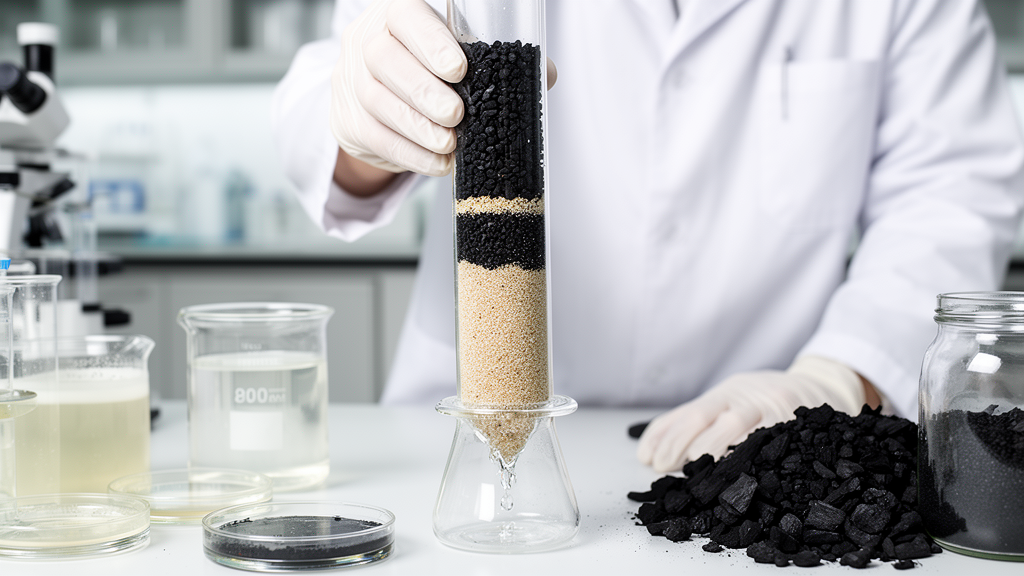
A biochar made from brewery waste dramatically improved the ability of sand to trap Escherichia coli in laboratory filtration columns, according to an open-access study published on 10 August 2026 in the journal Biochar. Researchers led by Christos P. Giannopoulos, Christos A. Kolotouros and Ioannis D. Manariotis pyrolyzed malt spent rootlets, an abundant byproduct of the malting industry, at 850 degrees Celsius and mixed the resulting biochar into saturated quartz sand packed into glass columns. When a suspension of roughly 100,000 E. coli CN-13 cells per milliliter was passed through the columns, removal efficiency climbed from 17.8 percent in unamended sand to 35.1 percent with 5 percent biochar by weight, and to 94.1 percent with 10 percent biochar, a more than fivefold improvement over plain sand.
The strain used, E. coli CN-13, derives from strain C (ATCC 13706) and is resistant to nalidixic acid, allowing selective plating on supplemented tryptic soy agar. It is classified as Biosafety Level 1 and is a non-pathogenic laboratory surrogate rather than a clinical pathogen. The authors chose it as a representative indicator organism for fecal contamination, the standard proxy used to gauge the potential presence of pathogenic microorganisms in water. Effluent concentrations were enumerated by the spread plate technique, with colony-forming units counted after overnight incubation at 37 degrees Celsius.
The biochar itself was a highly porous, heterogeneous material. Nitrogen adsorption measurements gave a Brunauer-Emmett-Teller specific surface area of 290 plus or minus 2.9 square meters per gram and a pore volume of 0.185 plus or minus 0.003 cubic centimeters per gram, with micropores accounting for 63 percent of the pore volume. Scanning electron microscopy revealed a fragmented, honeycomb-like pore network inherited from the original plant cell walls, interspersed with mineral ash deposits and marked by jagged ridges and irregular cavities. Although individual micropores are far too small to admit bacterial cells, which measure roughly one to two micrometers long, the authors argue that the extensive microporosity underpins the large surface area, while the rough external mesopore and macropore surfaces provide abundant high-energy contact sites for attachment.
Surface chemistry also favored bacterial binding. Prior work on the same feedstock and pyrolysis protocol shows that oxygenated functional groups are progressively eliminated above 300 degrees Celsius, leaving a predominantly aromatic, graphene-like, non-polar surface at 850 degrees Celsius. The team determined the point of zero charge of the biochar at 8.1 by the pH drift method. Because the experimental pH ranged from 6.6 to 7.6, below the point of zero charge, the biochar carried a net positive charge, while E. coli cells are negatively charged. Attachment was therefore governed by electrostatic attraction together with hydrophobic and van der Waals interactions between the aromatic carbon surface and the bacterial lipopolysaccharide outer membrane, rather than by specific chemical bonding.
A key methodological feature of the batch experiments was the explicit separation of bacterial inactivation from adsorption. Blank tubes without biochar showed that natural die-off of E. coli accelerated at higher ionic strength, an effect the authors attribute to cell membrane destabilization under an increased electrochemical gradient. Among four inactivation models tested, the Weibull model, which accommodates non-linear survival curves and heterogeneity in resistance within the population, performed best alongside the log-logistic model and was selected for its parsimony. Without this correction, adsorption rate constants would have been systematically overestimated, a flaw the authors identify in much of the earlier biochar adsorption literature.
With inactivation accounted for, adsorption kinetics followed pseudo-first-order behavior. The fitted first-order rate constants ranged from 0.0097 to 0.0592 per minute and were relatively consistent across initial concentrations spanning 100 to 10 million cells per milliliter, indicating that the approach to sorption equilibrium was independent of starting cell density. Although the pseudo-second-order model gave a marginally higher average coefficient of determination, its rate constants spanned five orders of magnitude and correlated strongly with initial concentration, suggesting overfitting. Equilibrium data were well described by the Freundlich isotherm, consistent with multilayer sorption on a heterogeneous surface, while the Langmuir monolayer model failed to fit within physically realistic parameters.
Ionic strength worked against adsorption. At 150 millimolar potassium chloride, the Freundlich affinity coefficient fell to 35.851 from 210.512 at 1 millimolar, and kinetic rate constants were correspondingly lower. The authors interpret this through classical Derjaguin-Landau-Verwey-Overbeek theory: for two oppositely charged surfaces, elevated salt compresses the electrical double layer, attenuating the electrostatic attraction that drives attachment. Competition by potassium and chloride ions for positively charged biochar surface sites may contribute as a secondary effect. The authors note that direct zeta potential measurements were not performed and recommend them for future work. The two ionic strengths were chosen to represent pristine groundwater and contaminated or impacted soil-water conditions, respectively.
Column modeling sharpened the mechanistic picture. Conservative chloride tracer breakthroughs were fitted with a one-dimensional advection-dispersion equation to estimate dispersivity, and bacterial breakthroughs with a one-dimensional biocolloid transport equation incorporating advection, dispersion, retardation, first-order attachment, straining and Weibull inactivation. Both models fit well, with coefficients of determination above 0.87. The fitted attachment coefficient increased 13.4-fold, from 0.022 per minute in unamended sand to 0.294 per minute at 10 percent biochar, while the straining coefficient rose only 1.7-fold, from 0.051 to 0.088 per minute. Within the model framework, physical straining, the entrapment of cells in restrictive pore throats, dominated retention at 0 and 5 percent biochar, whereas direct attachment became the dominant modeled mechanism at 10 percent. The authors stress that this assignment is model-dependent and would require independent spatial profiling of retained bacteria, such as column sectioning, to confirm experimentally.
The fitted detachment coefficient converged to zero in all three columns, and no tailing appeared in the post-pulse elution curves, indicating operationally irreversible attachment under the tested conditions. The authors caution that this is a model-fitted, boundary-constrained result rather than thermodynamic proof of irreversibility, but it is mechanistically consistent with electrostatic attraction, hydrophobic binding and physical entrapment in surface crevices creating high-energy states from which desorption is unfavorable at the experimental pore velocities of 3.1 to 3.8 centimeters per minute. Retardation also increased substantially only at the highest amendment rate, reaching 2.871 compared with unity in the other columns, alongside a shift in dispersivity that reflects more complex flow paths through the mixed grain-size medium.
The authors are careful to frame these results as proof of concept rather than field-ready performance. All experiments used sterilized quartz sand and a simple potassium chloride background electrolyte; a single initial cell concentration and flow rate were tested; flow was fully saturated and upward, whereas natural vadose conditions may involve unsaturated or preferential flow that reduces filtration efficiency; and no dissolved organic matter, biofilms, aged biochar or competing microorganisms were present, all factors known from prior work to modify bacterial retention. Each column configuration also represented a single experimental run, with effluent replicates being technical enumeration duplicates rather than independent columns, so formal statistical confidence in the removal differences awaits replicated studies. Leachate toxicity was addressed by showing that flushing with 15 to 18 pore volumes of deionized water, well beyond the three-wash threshold at which prior ecotoxicity testing of the same biochar found no acute effects, reduced chloride below 2 milligrams per liter before experiments began. Within those limits, the study demonstrates that a low-cost brewery byproduct, valorized at high pyrolysis temperature, can substantially enhance pathogen retention in sandy porous media while simultaneously addressing an industrial waste stream, with relevance to engineered sand filtration and agricultural sandy soils pending environmentally representative testing.
Subject of Research: Sorption and transport of E. coli CN-13 in saturated sand columns amended with malt spent rootlets biochar
Article Title: Sorption and transport of Escherichia coli CN-13 in saturated sand columns amended with biochar derived from malt spent rootlets
Article References: Giannopoulos, C. P., Kolotouros, C. A., & Manariotis, I. D. (2026). Sorption and transport of Escherichia coli CN-13 in saturated sand columns amended with biochar derived from malt spent rootlets. Biochar, 8(1), Article 130. https://doi.org/10.1007/s42773-026-00648-2
Image Credits: AI Generated
DOI: 10.1007/s42773-026-00648-2
Keywords: biochar, Escherichia coli, malt spent rootlets, sand filtration, groundwater, pathogen retention, column transport, pyrolysis, ionic strength, brewery waste, Sorption, transport
News Source: Alan Morgan. (October 29, 2026). Brewery Waste Biochar Traps E. coli in Sand Filters, Lab Study Shows. Scienmag.