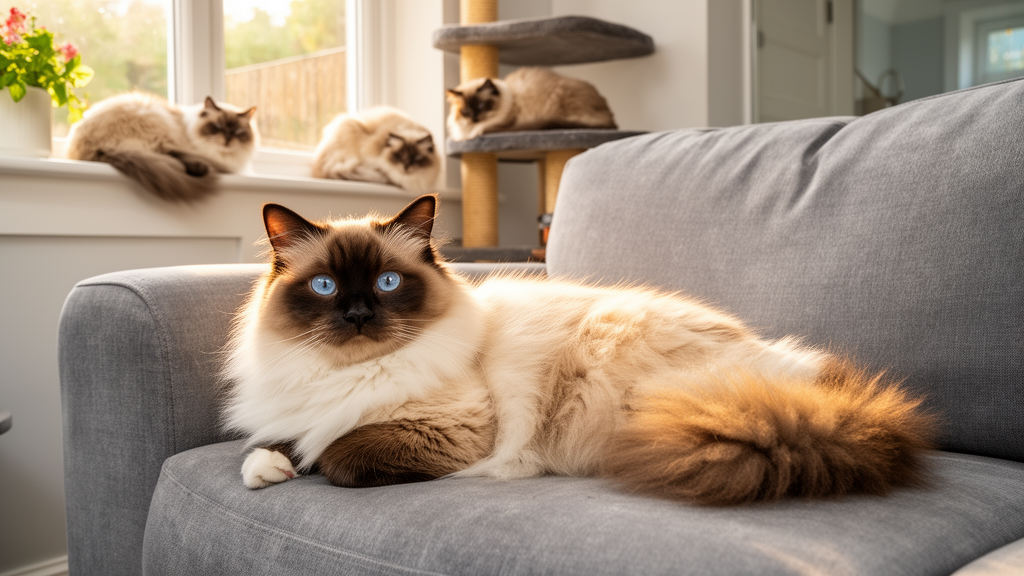
Ragdoll cats, one of the fastest-growing pedigree breeds in Britain, live to a median age of 12.85 years and are most often diagnosed with periodontal disease, diarrhoea and obesity, according to a large retrospective study of cats under primary veterinary care across the UK in 2019.
Ragdolls accounted for 21,358 of the 1.25 million cats in the study population, or 1.70% of all cats under veterinary care during 2019, making them the second most common purebred cat breed in the UK that year. Annual proportional birth rates traced a steep rise in the breed’s popularity: Ragdolls made up just 0.70% of all cats born in 2005, but 3.72% of those born in 2019, an almost five-fold increase in under fifteen years. The Cats Protection charity separately reported the Ragdoll as the equal-second most commonly acquired cat breed in the UK in 2023, at 4% of all cats acquired that year.
That rapid growth matters because experience with dogs has shown that surging public demand for particular pure breeds can create serious health and welfare problems. In French Bulldogs, high levels of inbreeding and extreme conformation, compounded by industrial-scale breeding, have produced a brachycephalic health crisis that has proved very difficult to resolve. The study’s authors argue that robust data on Ragdoll ownership and demography are needed in anticipation of similar potential welfare issues in rapidly popularised cat breeds, especially given that 37% of owners who acquired a cat in 2024 reported relying on information sourced from social media when making their purchase.
From the full Ragdoll population, the researchers manually reviewed the clinical records of a random sample of 2,025 cats, extracting every disorder recorded during 2019. In total, 1,241 of these cats, or 61.28%, had at least one disorder recorded during the year, while the remainder received only prophylactic care such as vaccination or no active veterinary care. There were 2,203 unique disorder events, with a median of one disorder per cat, and 277 distinct precise-level diagnostic terms. Elective and prophylactic events were excluded, and no distinction was made between pre-existing and newly recorded conditions.
At the most precise diagnostic level, the five most prevalent disorders were periodontal disease at 8.84% (95% CI 7.60–10.08), diarrhoea at 7.11% (95% CI 5.99–8.23), obesity at 6.91% (95% CI 5.81–8.02), overgrown nails at 5.68% (95% CI 4.67–6.69) and dental disease at 5.58% (95% CI 4.58–6.58). Grouping related diagnoses together, the most common categories were dental disorders at 14.52% (95% CI 12.98–16.05), enteropathy at 13.48% (95% CI 11.99–14.97), skin disorders at 7.75% (95% CI 6.59–8.92), obesity at 6.91% and claw and nail disorders at 6.17% (95% CI 5.12–7.22). Sex differences emerged within these lists: among the most common disorders, males had significantly higher probability of obesity, enteropathy and traumatic injury, while females had significantly higher probability of postoperative wound complications, aural discharge and complications associated with clinical care.
Age proved to be a major risk factor. When the researchers compared prevalence across three age bands — under 2 years, 2 to 6 years, and 7 years or older — the prevalence varied significantly between age groups for 12 of the 15 most common group-level disorders, with only claw and nail disorders, respiratory tract disorders and traumatic injury showing no statistically significant difference. The pattern for dental disease was particularly striking, rising steeply to a prevalence of over 35% at around 9 years of age before declining at more advanced ages. A previous study of periodontal disease across all UK cats using the same methodology showed a similarly steep rise in odds up to nine years, but maintained high odds thereafter, suggesting the pattern in older Ragdolls may differ from that of the general cat population, though the reasons are unclear.
Two findings point to possible breed predispositions. Diarrhoea and vomiting were recorded more frequently in Ragdolls than previously reported for UK cats overall, where vomiting affected 3.2% and diarrhoea 2.9% of cats in a comparable study. The authors suggest the breed may be predisposed to enteropathy, noting evidence of Ragdoll susceptibility to feline coronavirus infection: in a study of Japanese cats, 88.10% of Ragdolls were seropositive for feline coronavirus compared with 31.2% of crossbred cats, and the virus commonly causes mild, self-resolving diarrhoea when symptomatic. Haircoat disorders such as matting affected 4.00% of Ragdolls, versus 2.6% of all UK cats, a difference the authors link to the breed’s semi-longhaired coat, which cat organisations warn knots easily without regular grooming. They argue that the long-haired phenotype, which reached 12.7% prevalence as the most common disorder in Persian cats, should be considered an extreme conformation in cats, and point to the autosomal recessive inheritance of the trait via the FGF5 gene as offering a pathway to select against it.
On bodyweight, the median adult Ragdoll weighed 4.46 kg (interquartile range 3.79–5.19), with males significantly heavier than females at 4.97 kg versus 3.83 kg. Growth curves built from more than 125,000 bodyweight records showed that Ragdolls grow rapidly during their first year and continue gaining weight until around two years of age. The overall median age of the Ragdoll population was just 2.63 years, reflecting the breed’s recent surge in popularity, and the authors caution that this youthfulness could bias mortality figures downwards, as it did in earlier studies.
Mortality results came from 133 Ragdolls that died during the study period. The median age at death was 12.85 years (interquartile range 5.71–16.11), with no statistically significant difference between females, at 13.72 years, and males, at 11.41 years. Of the 107 deaths with a recorded method, 98, or 91.59%, involved euthanasia. Among the 85 deaths with a reported cause, the most common group-level causes were kidney disorder at 21.18% (95% CI 12.49–29.86) and poor quality of life at 12.94% (95% CI 5.81–20.08). The median age at death of cats with the most common group-level disorders ranged from 1.37 years for complications associated with clinical care to 14.63 years for kidney disorder.
Set against earlier research, the lifespan figure is revealing. A previous UK study of cats under primary veterinary care between 2009 and 2012 recorded a median age at death of 14.0 years for cats overall, but only 12.5 years for purebred cats, with crossbreds showing a substantial survival advantage. The 12.85-year median for Ragdolls is more than a year shorter than the figure for all cats, yet the authors conclude that the breed’s life expectancy is largely typical for purebred cats and that much of the gap relative to cats overall reflects purebred status rather than anything specific to the Ragdoll. The breed also appears broadly typical in its disorder profile, since few of the 13 predispositions listed in a veterinary textbook — including hypertrophic cardiomyopathy and feline infectious peritonitis — featured among the breed’s most commonly diagnosed conditions, a contrast the authors use to illustrate that prevalence reflects absolute risk while predisposition reflects relative risk. The researchers note important limitations: the analysis was univariable, involved many statistical tests without correction for multiple testing, so individual results should be treated as hypothesis-generating rather than hypothesis-confirming, and the retrospective design precluded collecting additional data such as body condition scores. Future work extracting comparable data on non-Ragdoll cats could support formal breed predisposition estimates.
Subject of Research: Demography, common disorders, cause-specific mortality and life expectancy of Ragdoll cats under UK primary veterinary care in 2019
Article Title: Demography, common disorders, cause-specific mortality and life expectancy of Ragdoll cats under primary veterinary care during 2019 in the UK
Article References: O’Neill, D. G., Bass, O., Brodbelt, D. C., Church, D. B., & Engdahl, K. S. (2025). Demography, common disorders, cause-specific mortality and life expectancy of Ragdoll cats under primary veterinary care during 2019 in the UK. Companion Animal Health and Genetics, 12(1), Article 8. https://doi.org/10.1186/s40575-025-00148-9
Image Credits: AI Generated
DOI: 10.1186/s40575-025-00148-9
Keywords: Ragdoll cats, VetCompass, feline health, periodontal disease, obesity, life expectancy, cause-specific mortality, purebred cats, UK veterinary care, enteropathy, breed popularity, retrospective cohort study
News Source: William Thompson. (October 29, 2026). Rising Ragdoll cat population in the UK shows typical purebred health and lifespan. Scienmag.