


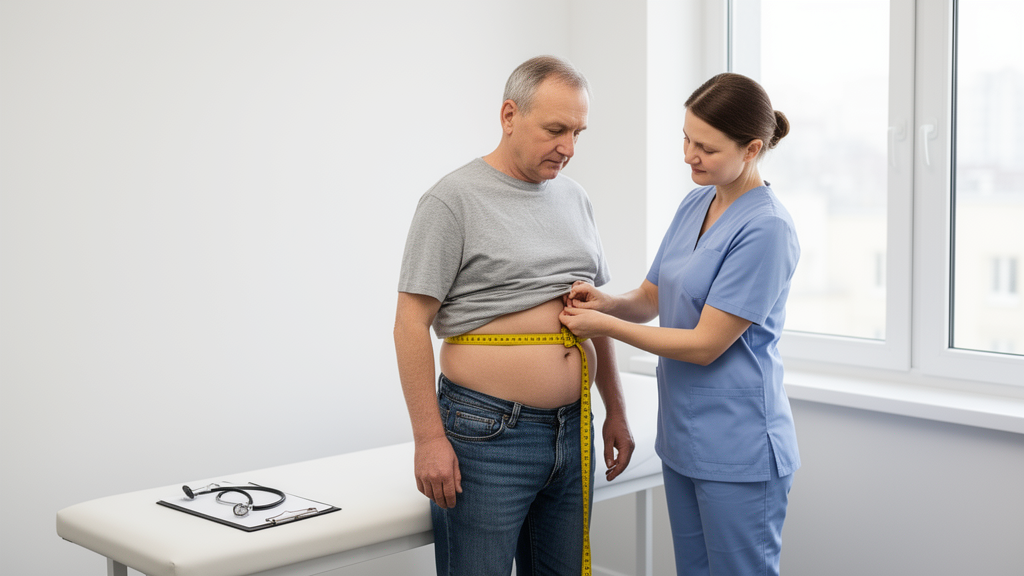
Nearly two-thirds of adults in a large Polish city carry excess weight, and one in four meets the criteria for obesity, according to a population-based study published in Diabetology & Metabolic Syndrome. The research, part of the Białystok PLUS cohort, also found that combining body mass index with waist circumference identified people with the heaviest burden of cardiovascular, metabolic and kidney disease.
The study enrolled 3,524 adults aged 20 to 79 years from the general population of Białystok, Poland. Participants underwent standardised anthropometric measurements including body mass index, waist circumference and waist-to-height ratio, alongside dual-energy X-ray absorptiometry scans to assess body composition directly. The examination programme also included fasting blood chemistry, oral glucose tolerance testing, blood pressure measurement, carotid ultrasound and kidney function assessment, allowing the researchers to map how different adiposity definitions relate to cardiovascular-kidney-metabolic health.
Weighted analyses were used to generate population-level estimates, with inferential comparisons adjusted for age and sex where appropriate. Based on body mass index, 63.5% of participants were classified as having overweight or obesity, including 25.4% with obesity. Abdominal overweight or obesity, judged by sex-specific waist circumference thresholds, was present in 53.2% of the cohort, a figure notably lower than the BMI-based estimate and highlighting how much the choice of measurement criterion changes the apparent scale of the problem.
The researchers defined adiposity phenotypes using BMI alone, waist circumference alone, and the two combined. After adjustment for age and sex, the combined BMI-plus-waist-circumference obesity phenotype showed the most adverse cardiovascular-kidney-metabolic profile and the greatest multimorbidity burden of any definition tested. By contrast, waist-only and BMI-only obesity were broadly comparable with respect to glycaemic indices, triglyceride levels and overall multimorbidity, suggesting neither single measure clearly outperforms the other in this population.
Dysglycaemia rose steadily across both BMI and waist circumference strata, and among participants with class III obesity, nearly all had prediabetes or diabetes. Triglycerides and blood pressure also increased with increasing adiposity. Kidney function told a different story: a crude decline in estimated glomerular filtration rate with higher adiposity was explained by age once the analysis was adjusted, indicating that the apparent kidney effect reflected the older age of participants with more body fat rather than adiposity itself.
A central contribution of the study was its use of waist-to-height ratio to detect fat accumulation that conventional BMI misses. High-risk fat accumulation, defined as a BMI of 25.0 to 29.9 kilograms per square metre together with a waist-to-height ratio of at least 0.5, was present in 28.2% of all participants and in 74.1% of those classified as having overweight. This means a substantial share of people whose BMI labels them merely overweight carry a central fat distribution associated with greater cardiometabolic risk.
Among individuals with overweight, a waist-to-height ratio of 0.5 or higher did identify a subgroup with a higher cardiovascular-kidney-metabolic disease burden. However, the authors report that its incremental discrimination beyond age, sex and BMI was modest, tempering expectations that this simple ratio alone will dramatically refine risk prediction in routine practice.
The findings carry the strengths and limits of a single urban cohort. Białystok PLUS captures one Polish city rather than a national sample, and the cross-sectional design links adiposity phenotypes to disease markers measured at the same time, so it cannot establish that excess weight causes the observed multimorbidity over time. Weighted estimates improve representativeness within the studied population, but generalisation to other regions or countries requires caution.
Even so, the scale of the numbers is striking: in this general-population sample, excess adiposity was highly prevalent and consistently associated with a greater burden of cardiovascular, metabolic and kidney disease. The results underscore that how obesity is measured matters, with combined anthropometric criteria painting a more detailed, and in some respects more concerning, picture than BMI alone.
Subject of Research: Population-based assessment of obesity prevalence and cardiovascular-kidney-metabolic multimorbidity in Białystok, Poland
Article Title: Tracking the obesity epidemic: a comprehensive population-based epidemiological assessment of obesity prevalence and its cardiovascular-kidney-metabolic complications
Article References: Zieleniewska, N., Jamiołkowski, J., Sowa, P., Kowalska, I., Dubatówka, M., Chlabicz, M., Stachurska, Z., Roszkowska, U., & Kamiński, K. (2026). Tracking the obesity epidemic: a comprehensive population-based epidemiological assessment of obesity prevalence and its cardiovascular-kidney-metabolic complications. Diabetology & Metabolic Syndrome. https://doi.org/10.1186/s13098-026-02319-5
Image Credits: AI Generated
DOI: 10.1186/s13098-026-02319-5
Keywords: obesity, BMI, waist circumference, waist-to-height ratio, cardiovascular-kidney-metabolic, Białystok PLUS, population-based cohort, prediabetes, dysglycaemia, anthropometry, multimorbidity, eGFR
News Source: Daisy Hatcher. (October 29, 2026). Obesity affects one in four adults in Polish city study, with waist measures flagging hidden risk. Scienmag.



