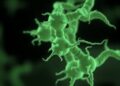

Credit: University of Colorado Cancer Center
EGFR is a common genetic target in lung cancer, but not all EGFR mutations are created equal. Patients with a type of EGFR anomaly called an "EGFR exon 20 insertion" often fail to respond to existing drugs targeting EGFR. Previous work shows this is because it simply takes a much higher concentration of anti-EGFR drugs to combat the exon 20 form of the mutation – and at the concentration needed to be effective, these drugs are too toxic to use in human patients.
A University of Colorado Cancer Center Study presented today at the AACR-NCI-EORTC International Conference on Molecular Targets 2017 proposes a unique way to reach the concentration of anti-EGFR drug needed to fight exon 20 insertions without harming healthy tissues: By pairing an anti-EGFR drug with a "tail" that only activates the drug when it is very near tumor cells, tarloxitinib brings the drug to tumors while keeping concentrations safe in surrounding tissues.
Tarloxitinib is one in a class of new medicines called "prodrugs" that are introduced into the body in an inactive form and then depend on changes within the body to activate their effects. In this case, the prodrug is composed of two pieces: A drug that attaches to and blocks EGFR receptor activity, and another piece that only activates the drug in the absence of oxygen. Because tumors grow so fast, they often outpace the development of blood vessels that deliver oxygen and so survive in low-oxygen conditions called "hypoxia". When tarloxitinib reaches a hypoxic tumor, the tail cleaves from the drug, activating the drug against EGFR receptors in the nearby tumor.
"The problem is that in order to treat patients with these mutations you would have to give existing drugs at levels that would be too toxic. With the prodrug, you can get those high doses but localized in the tumor," says Adriana Estrada, PhD, research instructor at CU School of Medicine and the paper's first author. Estrada worked in the lab of CU Cancer Center principal investigator Robert C. Doebele, MD, PhD.
One hurdle in testing tarloxitinib against lung cancer cells with EGFR exon 20 insertions was the fact that no patient-derived cell lines existed with this kind of mutation.
"We've known about the mutation from patient biopsies, but previous teams have studied exon 20 insertions by placing the mutation into cells or other artificial techniques. Our group was the first to isolate and maintain cell lines from patient samples that express exon 20 insertion," says Estrada.
In fact, the group isolated three cell lines, each with a slightly different form of EGFR exon 20 insertion, allowing the researchers to test tarloxitinib against a range of related alterations.
The group saw significant response in cells and when they tested the drug in mice, "the results are really promising," says Estrada.
About 15 percent of lung cancers are caused by EGFR mutation. About 5-10 percent of these EGFR cancers are the subtype that depends on exon 20 insertions. The group now hopes to use their promising results with cells and mice to lay the groundwork for clinical trials of tarloxitinib specifically targeting lung cancers with EGFR exon 20 insertions.
###
Media Contact
Garth Sundem
[email protected]
@CUAnschutz
http://www.ucdenver.edu
Original Source
http://www.coloradocancerblogs.org/tarloxitinib-puts-tumor-seeking-tail-anti-egfr-drug-precisely-target-lung-cancer/