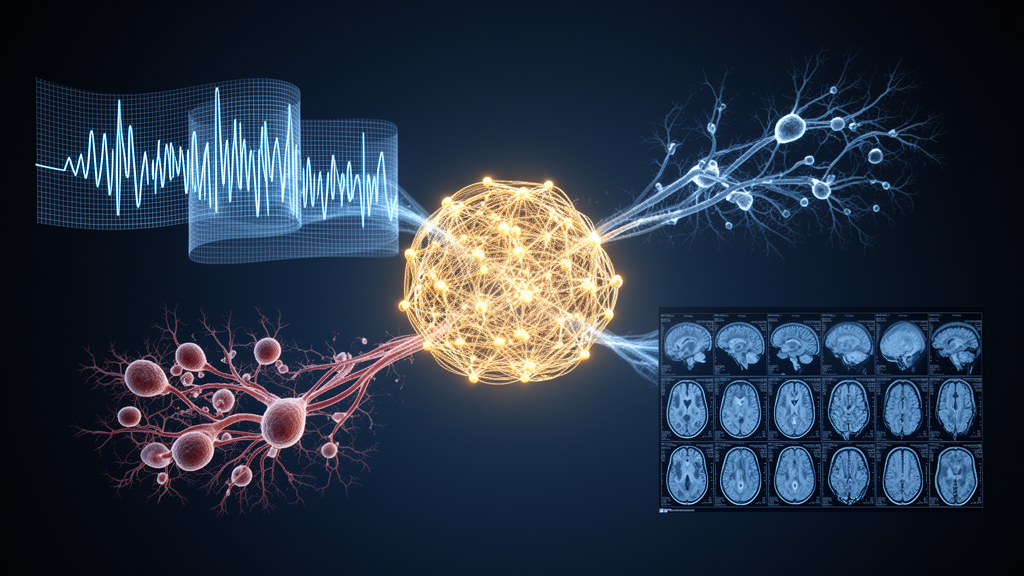
Brain-computer interfaces usually specialize. A system built to read imagined hand movements generally cannot read the flicker-driven brain responses that let users spell words on a screen, and a visual-spelling system goes silent the moment its flashing stimuli are switched off. A new study in Frontiers in Human Neuroscience reports that a single deep-learning architecture can handle all of these signals at once, classifying eight distinct EEG classes drawn from three different paradigms with a mean accuracy of 71.00% across 54 participants.
The work, carried out by Woo-Sung Choi and Hong-Gi Yeom of Chosun University in South Korea, extends a Transformer-based model the team previously developed called Analformer. Rather than training separate decoders for separate tasks, the researchers encoded four steady-state visual evoked potential (SSVEP) classes, two motor imagery (MI) classes, and two P300 event-related potential classes into one shared eight-way output. Every trial competed against every other in a single decision space, with no paradigm-specific shortcuts or masking at inference time. Under equal class priors, the nominal chance level was 12.5%.
The motivation lies in how these paradigms complement each other. P300 and SSVEP interfaces can offer many selectable commands, but both depend on continuous flashing or flickering visual stimulation, which is known to produce higher eye-fatigue ratings than motor imagery tasks. Once the stimuli stop, the evoked brain responses they rely on disappear entirely, so neither paradigm can generate a self-initiated command to restart itself. Motor imagery, by contrast, modulates sensorimotor rhythms without any external stimulation and can serve as a voluntary gating signal to switch a visual interface on or off.
The researchers tested their unified decoder on the public OpenBMI dataset, which contains recordings from 54 healthy adults aged 24 to 35 who completed all three paradigms in two experimental sessions. EEG was captured from 62 channels at 1,000 Hz. In the SSVEP task, participants attended to one of four stimuli flickering at 5.45, 6.67, 8.57, or 12 Hz. In the motor imagery task, they imagined squeezing their left or right hand. In the oddball ERP task, rare target images appeared among frequent non-targets.
Analformer’s architecture combines a fixed analytical front end with learned attention. Forty fixed Morlet wavelet kernels, with center frequencies from 1 to 40 Hz in 1-Hz steps, first filter each electrode’s signal into frequency-selective temporal responses. A learned convolution then compresses these across the frequency axis and across electrodes, and average pooling reduces the sequence to 31 temporal tokens of 62 features each. Six Transformer encoder blocks with ten-head self-attention model dependencies across those tokens before a classification head produces the eight logits.
Training proceeded in two stages. The model was first pre-trained on pooled Session 1 data from all 54 participants, roughly 32,400 trials in total, and then fine-tuned separately on each participant’s own Session 1 data. The final personalized model was evaluated once on that participant’s Session 2 data, which never contributed to gradient computation or any model-selection decision. The same fixed evaluation protocol was applied to every compared model.
The results were decisive. Unified Analformer reached 71.00% mean accuracy, against 54.53% for EEG-Conformer, 52.30% for EEGNet, and 45.35% for ShallowConvNet under identical conditions, exceeding the strongest baseline by 16.47 percentage points. Paradigm-wise, SSVEP classification was strongest at 80.49%, followed by motor imagery at 66.93% and ERP at 65.59%. The confusion matrix showed that the largest errors were within-paradigm confusions, such as between the two imagined hands, while cross-paradigm mistakes were smaller, indicating the shared classifier preserved the boundaries between heterogeneous signal types.
Ablation tests showed both defining components mattered. Replacing the fixed wavelets with learnable convolutions of the same kernel size dropped mean accuracy from 71.00% to 63.15%. Removing the pooled pre-training stage produced the larger reduction, down to 47.38%, with ERP accuracy collapsing from 65.59% to 33.32%. The authors note these contrasts associate the model’s advantage with frequency-selective initialization and cohort-level representation learning within this specific framework, rather than proving fixed kernels are generally superior to learnable wavelets.
The model’s built-in analysis module, AnalNet, also recovered physiologically meaningful structure. Because it operates on parameter-free fixed-wavelet activations normalized against a prestimulus baseline, its maps reflect class-discriminative structure in the input EEG itself. For motor imagery, the strongest discriminative F-values appeared over the C3 and C4 sensorimotor regions in the mu (8-13 Hz) and beta (15-30 Hz) bands. For SSVEP, discriminative activity concentrated over occipital channels O1, O2, and Oz at stimulus-related frequencies. ERP responses, dominated by transient low-frequency deflections, were excluded from this wavelet-based visualization.
The authors are careful about scope. The experiment establishes offline feasibility in a personalized, cue-paced, cross-session setting on OpenBMI; it does not demonstrate a closed-loop asynchronous system. A practical hybrid interface would still need an idle-state detector and control logic around this classifier core, and measures such as false activation rate and transition latency would become the real tests of on-demand control. Within those limits, the study shows that one participant-adapted architecture can keep eight heterogeneous brain signals separable, providing the shared classifier core that self-initiated hybrid BCIs have lacked.
Subject of Research: A unified Transformer architecture for decoding motor imagery, P300, and SSVEP EEG signals in hybrid brain-computer interfaces
Article Title: A unified fixed-wavelet transformer decodes eight EEG classes across motor imagery, P300, and SSVEP paradigms
Article References: Choi, W.-S., & Yeom, H.-G. (2026). A unified fixed-wavelet transformer decodes eight EEG classes across motor imagery, P300, and SSVEP paradigms. Frontiers in Human Neuroscience, 20, Article 1973838. https://doi.org/10.3389/fnhum.2026.1973838
Image Credits: AI Generated
DOI: 10.3389/fnhum.2026.1973838
Keywords: brain-computer interface, EEG, Transformer, motor imagery, P300, SSVEP, OpenBMI, deep learning, wavelet, cross-paradigm decoding, Analformer, hybrid BCI
News Source: Cassandra Pierce. (October 29, 2026). One Transformer Reads Three Brain-Signal Types at Once, Hitting 71% Accuracy. Scienmag.