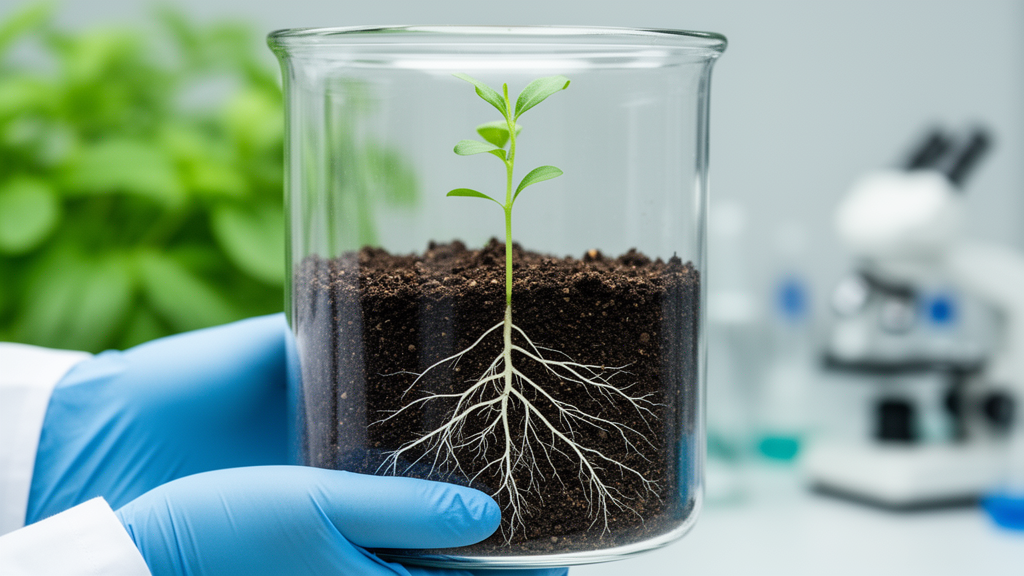
Plants are usually assumed to draw all of their carbon from the atmosphere through photosynthesis, but a new open-access study in the journal Biogeochemistry reports that seedlings of two very different species can also take up carbon from the soil through their roots. The uptake is real and measurable, yet the researchers found it is strongly constrained under realistic soil conditions, recovering only small fractions of the tracer carbon they supplied.
The team, led by Franziska B. Bucka with colleagues including Lea Giese, Kristiina Karhu, Heljä-Sisko Helmisaari and Nele Meyer, ran two complementary 13C-tracer experiments. They used ribwort plantain (Plantago lanceolata), an herbaceous species, and Norway spruce (Picea abies), a conifer, to compare how a woody and a non-woody plant handle carbon arriving at the root surface.
In the first experiment, seedlings of both species grew for four weeks in nutrient solutions containing 13C-labelled glucose or the amino acid L-lysine. After four weeks, between 2.0 and 5.5 percent of the applied 13C was recovered in plant tissues, and the isotope signature of the plants shifted dramatically, from roughly −31 per mille to values as high as +78 per mille. Tracer recovery tended to be higher when lysine, rather than glucose, was the carbon substrate.
The second experiment moved closer to real soil conditions. Both species were grown for eight weeks in two contrasting soils that had been pre-incubated with 13C-labelled glucose. Here the picture changed sharply: at most 0.74 percent of the tracer was recovered in plant tissues. The authors say this still provides evidence for root-mediated incorporation of tracer-derived carbon from soil, but the recovery was markedly lower than in nutrient solution.
Species identity mattered in soil. Tracer recovery was higher in Picea abies than in Plantago lanceolata, and in the conifer most of the recovered tracer remained in the roots. Soil texture, by contrast, had no significant effect on recovery, although the data showed a tendency toward higher recovery in the sandy soil compared with the other soil tested.
The researchers emphasize that the pathway is quantitatively small. Even in the most favourable nutrient-solution setting, less than six percent of the labelled carbon ended up in plant tissue, and under soil conditions the figure fell below one percent. The magnitude of the effect therefore depends heavily on the growth medium, with dissolved organic substrates apparently far more available to roots in solution than in a structured soil matrix.
Why does a small flux matter? The authors argue that root-mediated carbon uptake should be considered when scientists interpret tracer budgets and carbon fluxes in planted soil systems. Experiments that label soil carbon and then measure where it goes could misattribute small amounts of tracer-derived carbon if root uptake is not accounted for, potentially skewing estimates of carbon stabilization or plant-derived inputs.
The study is being shared early as open-access, peer-reviewed accepted research with a permanent DOI; the version is subject to further edits before the final Version of Record. Its scope is also limited to two species grown under controlled conditions, so the findings describe the investigated woody and herbaceous species rather than a general rule for all plants.
Nonetheless, the work adds a concrete data point to a long-standing question in plant physiology and biogeochemistry: whether roots can act as more than water and nutrient organs. The answer from these tracer experiments is that they can, detectably, take up carbon from their surroundings — but under soil conditions that contribution remains a minor, tightly constrained term in the plant carbon budget.
Subject of Research: Root-mediated uptake of carbon from soil by herbaceous and woody plant seedlings, measured with 13C tracers
Article Title: Root-mediated carbon uptake: a limited but detectable pathway in plant–soil systems
Article References: Bucka, F. B., Giese, L., Karhu, K., Helmisaari, H.-S., & Meyer, N. (2026). Root-mediated carbon uptake: a limited but detectable pathway in plant–soil systems. Biogeochemistry. https://doi.org/10.1007/s10533-026-01383-3
Image Credits: AI Generated
DOI: 10.1007/s10533-026-01383-3
Keywords: root-mediated carbon uptake, 13C tracer, Plantago lanceolata, Picea abies, soil carbon, biogeochemistry, glucose, L-lysine, soil texture, nutrient solution, carbon cycling, plant physiology
News Source: Bethany Barker. (October 29, 2026). Plants Can Pull Carbon From Soil Through Their Roots, Tracer Study Shows. Scienmag.