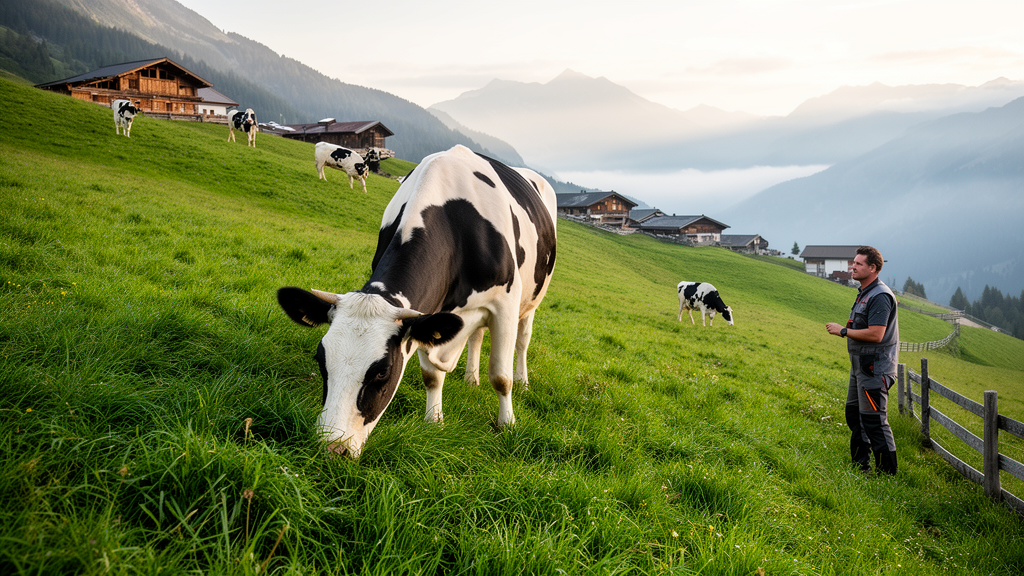
High-yielding dairy cows can produce milk in mountain systems that rely almost entirely on grazed grass, but only if farmers are willing to abandon rigid breeding schedules and let some cows lactate for nearly two years, a five-year experiment at a French research farm has found. The study, run at INRAE’s Herbipôle experimental farm in the Massif Central at 1,100 metres above sea level, tested two carefully designed low-input dairy systems and showed that both could stay technically viable with Holstein and Montbéliarde breeds — provided management adapted repeatedly to reproductive shortfalls.
The Very-Low-Input system, or VLI, used 59.9 hectares of diverse permanent grassland, spread no mineral fertiliser, and gave concentrates only to female calves — a total of just 3.12 tonnes over five years. The Low-Input system, or LI, used half the land, 29.6 hectares, some mineral nitrogen fertiliser and concentrates for adult cows at 4 kg per day during the grazing season, well below the 8–12 kg per day typical of conventional systems in the region.
The economics of the two systems diverged in striking ways. Over five years, VLI produced 486,000 kg of milk and LI produced 550,000 kg. That translated into 156.8 kg of milk per kilogram of concentrates in VLI versus only 4.2 kg in LI, making the near-zero-input system extraordinarily efficient per unit of purchased feed. VLI also generated a higher milk income — about 3,600 euros more per year than LI — and a much better ratio of milk revenue to input costs, at 13.8 versus 3.5.
But VLI’s self-sufficiency came at the cost of land. Because it carried a low stocking rate on permanent, species-rich grassland, it produced only 1,630 kg of milk per hectare per year, while LI achieved 3,720 kg — more than double — on its more productive temporary grassland supported by about 37 kg of mineral nitrogen per hectare annually. The researchers conclude that VLI suits contexts where inputs must be slashed dramatically and land is plentiful, whereas LI is the better choice where land is scarce.
The central twist of the experiment came from reproduction. Yet in the first year, only 44% of adult cows were confirmed pregnant after the spring mating season, regardless of system or breed. The reason, the authors argue, is that high-yielding cows calving on a grass-only diet lose large amounts of body condition — body condition score dropped from around 2.5–2.7 at calving to about 1.24–1.25 at its nadir roughly seven weeks later — and many cows had not begun recovering when the breeding window opened.
Rather than abandoning the systems, the team adapted. Non-pregnant cows had their lactations extended by eight to ten months and were mated the following spring, allowing them time to rebuild body reserves while still producing milk. Depending on the year, between 7 and 24 of the 48 cows carried extended lactations. These cows proved far more successful at breeding in their second lactation year — proportionally twice as many calved the following year compared with cows inseminated within ten weeks of calving — and, importantly, they produced about 80% as much milk over two years as two standard lactations would have yielded, rising to roughly 85% when corrected for energy content. Their milk also contained more fat and protein in the second year.
Further adjustments secured herd renewal. From the third year, heifers — which have better fertility than older cows — were inseminated with sexed semen, producing 70% female calves, and Limousine beef bulls were replaced by Holstein and Montbéliarde dairy bulls for natural mating. Together these changes raised the proportion of purebred female calves from 30% to 43% of calvings, enough to sustain herd replacement even though nearly 30% of cows still failed to reproduce each year.
Breed differences proved modest. Holstein cows produced more milk than Montbéliarde — in VLI, 4,495 kg of energy-corrected milk per year versus Montbéliarde figures, and in LI, 5,245 kg ECM on 825 kg of concentrates — but at the expense of greater body-reserve mobilisation and lower body condition after calving. Montbéliarde cows suffered half as many mastitis cases, a difference that was statistically significant in the VLI system. Reproductive performance, however, did not differ between breeds, suggesting neither breed holds a decisive advantage in low-input management.
Animal welfare emerges as a genuine tension in the findings. Cows spent roughly half the year at pasture, which the authors note would score highly on welfare frameworks for ease of movement and expression of natural behaviour. But the very lean condition many cows reached after calving — scores below 1.3 on a 0–5 scale — would fall into the worst category for absence of hunger under the Welfare Quality protocol, a concern the researchers flag explicitly and propose to mitigate through measures such as once-a-day milking early in lactation or concentrating a limited concentrate allowance around the breeding period.
Health outcomes were dominated by lameness, with 57 cases among 112 cow-years in VLI and 39 among 111 in LI, followed by mastitis and urogenital disorders. Cows in the second year of extended lactation were notably healthier and bred more successfully than freshly calved cows. The authors caution that the reproductive results rest on a limited number of animals — at most 24 calvings per system per year — and that further work is needed on environmental impacts and full economic accounting including labour and replacement costs. Still, the core message stands: mountain dairy farms can retain their high-yielding breeds while cutting inputs sharply, if they treat reproduction as a flexible, adaptive process rather than a fixed annual calendar.
Subject of Research: Feasibility of low-input pasture-based dairy systems with high-yielding cow breeds in mountain regions
Article Title: The need for adaptive management of high-yielding dairy cows in low-input mountain systems
Article References: Pomiès, D., Farruggia, A., Fournier, F., & Veissier, I. (2025). The need for adaptive management of high-yielding dairy cows in low-input mountain systems. Dairy Science and Management, 2(1), Article 14. https://doi.org/10.1186/s44363-025-00017-7
Image Credits: AI Generated
DOI: 10.1186/s44363-025-00017-7
Keywords: dairy farming, low-input systems, mountain agriculture, Holstein, Montbéliarde, extended lactation, grazed grass, concentrates, reproduction, body condition, land use efficiency, animal welfare
News Source: Alan Morgan. (October 29, 2026). High-Yielding Dairy Cows Can Thrive on Nearly Grass-Only Mountain Farms, Five-Year Trial Shows. Scienmag.