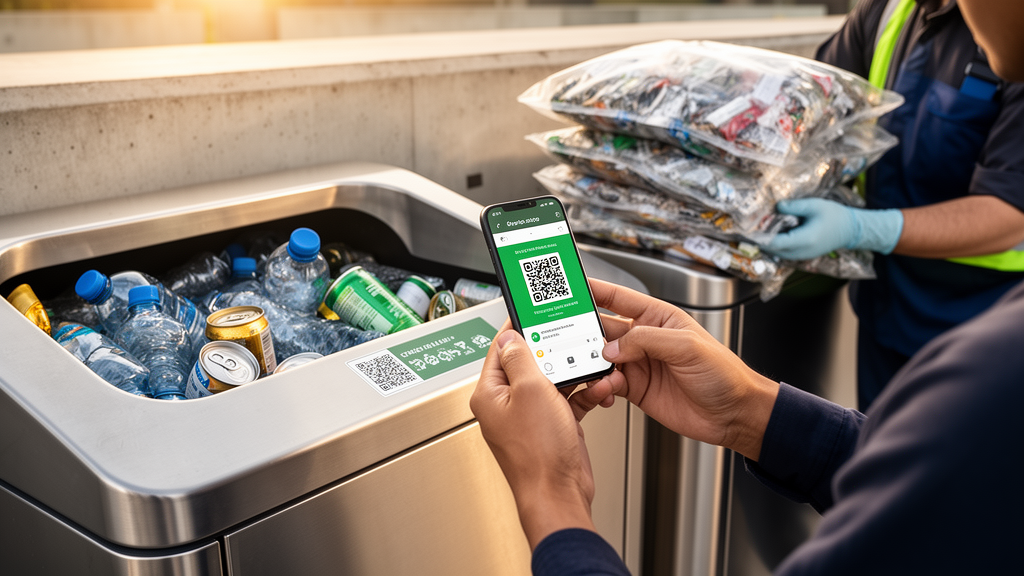
Researchers have proposed a blockchain-based system that uses Semi-Fungible Tokens (SFTs) to reward participants in waste resource recycling and regeneration, according to a study published in Cluster Computing. The scheme, described by Ling-Chun Liu, Chin-Ling Chen, and Yong-Yuan Deng, combines distributed ledger technology with token-based incentives to encourage waste sorting, recycling classification, and regenerative manufacturing.
At the core of the proposal is the claim that blockchain technology can ensure data security, traceability, and non-tamperability for recycling records. Because every transaction is recorded on a distributed ledger, the authors argue that participants’ contributions and activities can be confirmed, verified, and rewarded through smart contracts and cryptographic mechanisms.
In the proposed system, the extent of each participant’s contribution and its environmental impact would be assessed, quantified, and rewarded in cryptocurrency. Resource recyclers, conversion processors, and recycled manufacturers can all take part, each earning tokens in proportion to their verified activity in the recycling and regeneration pipeline.
Government oversight agencies are assigned an essential role in the design. They would formulate policies and regulatory measures intended to ensure the fairness and effectiveness of the token economy, providing an institutional layer on top of the technical infrastructure. The authors suggest that this combination of automated verification and regulatory supervision could motivate participants to become more actively involved in waste recycling, sorting, and regenerative manufacturing.
The abstract frames the scheme as a response to the damage that large volumes of waste cause to the global ecological environment. By making recycling contributions measurable and financially rewarded, the system is intended to help reduce that damage and promote the development of a circular economy, in which discarded materials are recovered and returned to productive use rather than discarded. The authors also argue that participation brings opportunities and benefits to the participants themselves, creating a dual incentive of environmental protection and personal gain.
It is important to note that the published material describes a proposed scheme rather than a deployed system with measured results. The claims about security, traceability, and behavioral motivation are design objectives stated by the authors; the available evidence does not include field trials, adoption data, or quantitative performance measurements demonstrating that the system achieves these goals in practice. As with many blockchain incentive designs, real-world effectiveness would depend on factors such as token valuation, participant uptake, and regulatory acceptance, none of which are established in the available material.
The article appears in Volume 29 of Cluster Computing as article number 888, published on 22 October 2026. The publication includes multiple figures and algorithms, indicating a technical treatment of the system’s cryptographic and contract-based mechanisms, though the full text sits behind a subscription access barrier.
The present study’s contribution is a specific architecture linking waste recycling activities to SFT rewards under government oversight, a design the authors present as a promising approach to combining blockchain technology with incentive mechanisms for sustainable waste management.
Subject of Research: A proposed blockchain-based waste recycling system that rewards recycling, sorting, and regenerative manufacturing with Semi-Fungible Token incentives.
Article Title: A blockchain-based traceable waste resource recycling and regeneration system with SFT rewards
Article References: Liu, L.-C., Chen, C.-L., & Deng, Y.-Y. (2026). A blockchain-based traceable waste resource recycling and regeneration system with SFT rewards. Cluster Computing, 29(15), Article 888. https://doi.org/10.1007/s10586-026-06651-3
Image Credits: AI Generated
DOI: 10.1007/s10586-026-06651-3
Keywords: blockchain, Semi-Fungible Tokens, waste recycling, circular economy, smart contracts, traceability, cryptocurrency rewards, regenerative manufacturing, environmental sustainability, Cluster Computing, blockchain-based, traceable
News Source: Denise Maddox. (October 29, 2026). Blockchain Recycling System Uses Semi-Fungible Tokens to Reward Waste Recovery. Scienmag.