


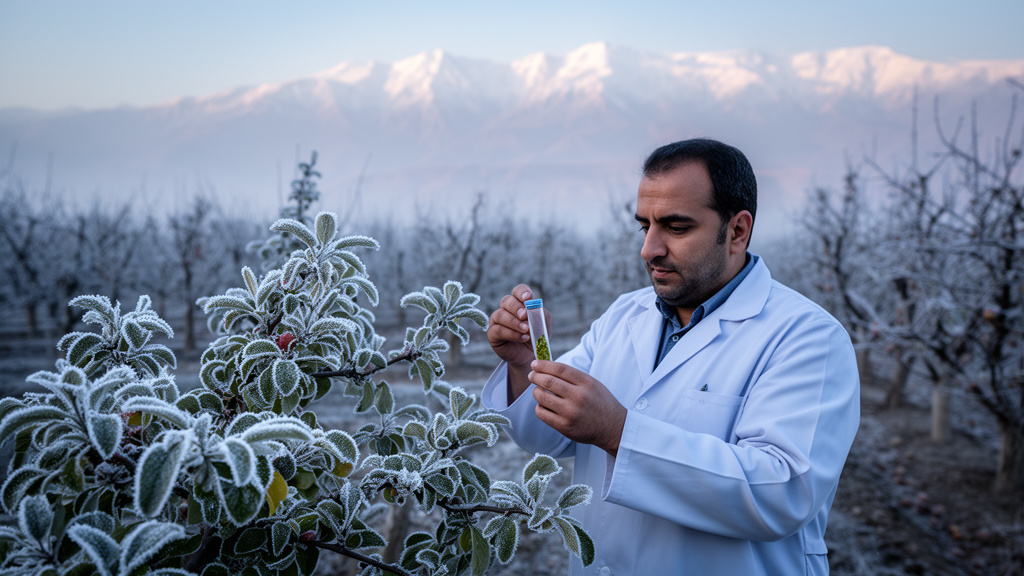
The research, published as an original article in Annals of Microbiology, isolated bacteria from the phyllosphere and caulosphere of eight deciduous fruit species across nine sites in East Azerbaijan province, sampling during autumn 2023 and spring 2024.
When such bacteria colonise plant surfaces, late-spring frosts can form at warmer temperatures than they otherwise would, damaging buds, blossoms and young fruit in temperate orchards. Understanding which INA species are present, and where, is therefore relevant to frost risk in fruit-growing regions.
From the survey, 94 purified isolates were obtained, and 35 of them — 37.2 percent — tested positive for ice nucleation activity in a droplet-freezing assay. The 22 strains with the highest freezing efficiency were selected for polyphasic characterisation, combining phenotypic profiling with molecular methods.
BOX-PCR fingerprinting resolved these 22 high-efficiency strains into four genomic clusters at 45 percent Jaccard similarity, a result the authors describe as revealing notable inter-cluster heterogeneity. One representative strain from each cluster was then chosen for detailed analysis.
Sequencing of the 16S rRNA gene, with identity scoring against the EzBioCloud database and Bayesian phylogenetic analysis, confirmed the taxonomic identities of three representatives: Pantoea agglomerans strain Ab445, Erwinia billingiae strain Ab432 and Bacillus safensis strain Ab399, each with a GenBank accession recorded. A fourth strain, Ab431, was assigned to Bacillus wiedmannii on the basis of 98.0 percent sequence identity, an assignment the authors present as more provisional than the three confirmed identifications.
Temperature–time kinetic assays separated the strains into two functional groups. Pantoea agglomerans and Bacillus safensis acted as strong ice nucleators, initiating crystallisation at −2 °C within 20 to 30 minutes of exposure. In contrast, Bacillus wiedmannii and Erwinia billingiae functioned as weak nucleators, requiring lower temperatures and longer exposure times before ice formation was triggered.
A pronounced geographic pattern emerged from the survey. Isolates collected from high-altitude sites such as Tabastanagh and Uzbak were exclusively strong nucleators, while isolates from lower-elevation areas such as Marand and Ashan were uniformly weak. The study reports this as an observed association between elevation and nucleation strength among the sampled isolates; it does not establish a causal mechanism for the pattern.
The authors state that, to their knowledge, this is the first systematic report of Bacillus strains exhibiting strong ice nucleation activity in Iranian deciduous orchards, and among few such accounts globally.
The work remains a survey of one province over two sampling seasons, and the characterisation rests on a small number of representative strains per genomic cluster. The authors note that further protein-level characterisation and targeted gene analyses are warranted to elucidate the molecular mechanisms underlying Bacillus-mediated ice nucleation. The article was published open access on 14 September 2026 as a peer-reviewed, accepted manuscript shared ahead of the final version of record.
Subject of Research: Ice nucleation-active epiphytic bacteria on deciduous fruit trees in northwest Iran
Article Title: Molecular characterization of epiphytic ice nucleation-active bacteria on deciduous fruit trees in northwest Iran
Article References: Bakhsheshi, S., Khakvar, R., Narmani, A., & Aliasgharzad, N. (2026). Molecular characterization of epiphytic ice nucleation-active bacteria on deciduous fruit trees in northwest Iran. Annals of Microbiology. https://doi.org/10.1186/s13213-026-01876-4
Image Credits: AI Generated
DOI: 10.1186/s13213-026-01876-4
Keywords: ice nucleation-active bacteria, epiphytic bacteria, deciduous fruit trees, East Azerbaijan, Iran, Pantoea agglomerans, Bacillus safensis, Erwinia billingiae, Bacillus wiedmannii, phyllosphere, frost damage, 16S rRNA
News Source: Juliet Wilcox. (October 29, 2026). Research report: Molecular characterization of epiphytic ice nucleation-active bacteria on deciduous fruit trees in northwest Iran. Scienmag.



