


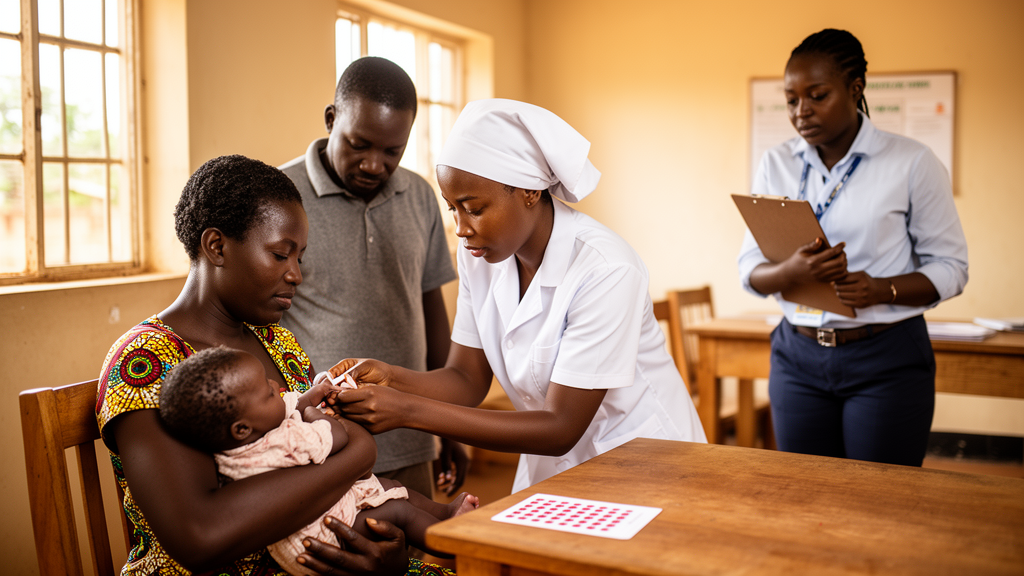
Sickle cell disease screening can save children’s lives, but the programmes that deliver it often collapse once outside money runs out. That is one of the central findings of a new qualitative evidence synthesis published in BMC Global and Public Health, which systematically reviewed qualitative research on prenatal and newborn screening for sickle cell disease (SCD) in the countries where the condition is most common at birth. The review team, led by Amelia Seabold and Helene-Mari van der Westhuizen, analysed 18 papers published between 2004 and 2024, covering nine countries, and distilled the evidence into four themes intended to guide policymakers planning new screening programmes.
The stakes are high. Estimates cited in the review suggest that 50 to 90 percent of children born with SCD in low- and middle-income countries die before their fifth birthday, and that more than 90 percent of SCD cases occur in low- and middle-income countries, with sub-Saharan Africa accounting for roughly 75 percent of the global burden. A 2026 review and modelling study found SCD prevalence of 1.51 percent among children under five in sub-Saharan Africa, and a meta-analysis estimated an under-five SCD mortality rate in Africa of 7.3 per 100 years of observation, more than ten times the global average. Early identification matters because prophylactic treatment started within the first few months of life, ideally before symptoms appear, improves the chances of surviving the first five years.
The reviewers searched Embase, MEDLINE, Global Health, CINAHL and Global Index Medicus in February 2025, including primary qualitative studies from any of the 30 countries with more than 500 SCD cases per 100,000 livebirths according to 2021 Global Burden of Disease data. Eighteen articles met the inclusion criteria, spanning Angola, Cameroon, the Democratic Republic of Congo, Ghana, Liberia, Nigeria, Senegal, Tanzania and Uganda. Thirteen papers concerned newborn screening, three concerned prenatal screening and two covered both, meaning the evidence base for prenatal screening was markedly thinner. The team appraised each paper with the Critical Appraisal Skills Programme qualitative checklist, reporting major methodological concerns about five studies, including three meeting reports lacking details of data analysis, but retained them because of the scarcity of data on the topic. They developed themes through reflexive thematic analysis and graded confidence in each key finding using the GRADE-CERQual approach.
The first and most system-level theme is that sustainable screening programmes require financial and political support from government and integration into existing healthcare infrastructure. In the included studies, funding for newborn screening most often came from external, non-governmental actors, and when those funders completed their predefined projects, programmes frequently scaled down or halted. One researcher quoted in the review described external funding as a “double-edged sword”: necessary for programmes to exist at all, yet complicating long-term sustainability because permanent funding from outside sources was not feasible. Programmes that continued beyond a pilot phase tended to ascribe their longevity to government involvement, while those that struggled pointed to a lack of government ownership.
Integration with existing services emerged as a practical route to that involvement. Healthcare workers advocated delivering SCD testing and care at primary and secondary facilities rather than only at tertiary hospitals, which families often reach only after long, expensive journeys. In Ghana, community health nurses responded positively to the idea of adding SCD screening to duties they already perform, such as immunisation, outreach and home visits. Researchers also suggested pairing SCD programmes with established disease programmes, most commonly HIV and AIDS services and immunisation campaigns, to share costs and logistics, and stressed that screening should be delivered alongside counselling and care rather than in isolation.
The second theme concerns community knowledge. Most parents who had a child or a relative with SCD viewed testing favourably, and in some settings mothers of children with SCD actively facilitated new diagnoses in their communities, encouraging other mothers to take their children for testing and sometimes paying the associated costs. Many participants said parents rejected newborn screening mainly because they did not understand SCD or the benefits of testing, and education about the disease was among the most frequently voiced needs across the included articles. Timing mattered too: mothers in Tanzania noted that information delivered immediately after childbirth, mixed with breastfeeding and other advice, was hard to retain, and preferred shorter sessions starting in antenatal clinics.
Religion and traditional beliefs cut both ways. Some stakeholders described myths linking SCD to witchcraft, or sentiments that prayer should replace testing, as obstacles to screening. Yet many parents drew simultaneously on biomedical, religious and traditional frameworks to make sense of the disease, referring to a diagnosis as part of God’s plan while still seeking medical care. The reviewers, who reported high confidence in this finding, concluded that religion can act as both a risk factor and a protective factor, and that policies grounded only in a biomedical model are likely to miss how communities actually understand SCD.
The third theme addresses the consequences of a screening decision for the family. Most parents supported joint decision-making by mother and father, and believed extended family and religious leaders should not be consulted. After a positive result, many parents struggled to accept the diagnosis, particularly when the child appeared healthy; education about inheritance patterns, exposure to others living with SCD, time and practical management information helped move families toward acceptance. Blame, however, fell disproportionately on mothers even though an affected child inherits an SCD allele from both parents. Marital strain, stigma and the financial burden of care, which one Cameroonian parent described as unsustainable without support, were recurrent. Some mothers concealed results from partners or communities for fear of abandonment or stigmatisation, and stigma itself deterred some parents from testing at all.
The fourth theme compares the two screening modalities. Prenatal screening offers information earliest, and some mothers said knowing in advance would reduce worry and help them prepare. Others felt a prenatal diagnosis would cause undue stress during pregnancy, and termination of affected pregnancy, often associated with prenatal screening, was frequently rejected on religious grounds. Newborn screening gives parents less lead time but still allows early medical care to reduce suffering and complications, and the included studies showed overall more acceptance of newborn screening than prenatal screening. The reviewers reported low confidence in findings specific to prenatal screening because so little qualitative research exists in that area.
The authors conclude that policymakers should plan for sustainability from the outset, leverage existing community knowledge, alleviate stigma and offer families different testing options. They also flag the review’s own limits: only nine of the 30 eligible countries were represented, 16 of the 18 studies were single-country studies dominated by Ghana and Tanzania, and many papers shared overlapping authorship, so the themes may not generalise to all high-livebirth-prevalence settings. Most included research focused on individual decision-making rather than health-system implementation, and the authors call for more qualitative, systems-level inquiry, including into the effects of external funding transitions, before screening programmes can be scaled with confidence.
Subject of Research: Qualitative evidence synthesis on implementation considerations for prenatal and newborn sickle cell disease screening in countries with high livebirth prevalence
Article Title: A qualitative evidence synthesis on perinatal screening for sickle cell disease in high-burden countries
Article References: Seabold, A., Luchyshyn, A., Roberts, N., Schuh, A., Chirande, L., & van der Westhuizen, H.-M. (2026). A qualitative evidence synthesis on perinatal screening for sickle cell disease in high-burden countries. BMC Global and Public Health, 4(1), Article 98. https://doi.org/10.1186/s44263-026-00316-4
Image Credits: AI Generated
DOI: 10.1186/s44263-026-00316-4
Keywords: sickle cell disease, newborn screening, prenatal screening, qualitative evidence synthesis, sub-Saharan Africa, health policy, stigma, GRADE-CERQual, reflexive thematic analysis, global health, qualitative, evidence
News Source: Ophelia Keating. (October 29, 2026). What Parents and Policymakers Say Shapes Sickle Cell Screening in High-Burden Countries. Scienmag.



