


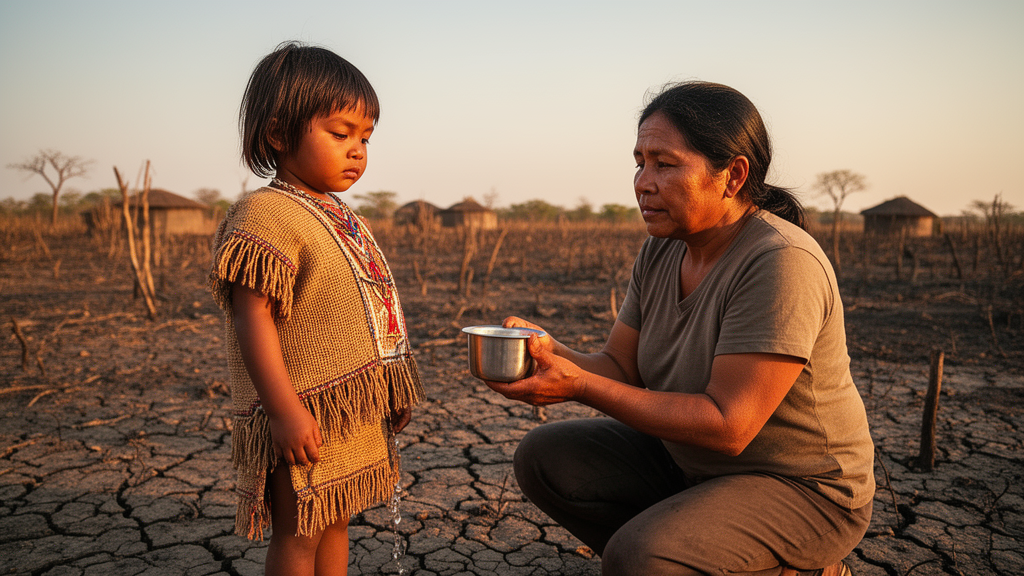
Indigenous children around the world are already experiencing adverse health outcomes linked to climate change, according to what its authors describe as the first systematic review to synthesise the global evidence on this question. The review, published in the journal Globalization and Health, screened more than 2,000 records retrieved from five databases and included 53 studies spanning qualitative, quantitative non-randomised, quantitative descriptive, and mixed-methods designs. Its central conclusion is sobering but carefully qualified: Indigenous children across diverse contexts are experiencing climate-related harms, yet the evidence base itself is sparse, unevenly distributed geographically, and better suited to establishing broad associations than definitive causal effects.
They used a population, exposure, comparator, outcome framework to structure the search, screened studies collaboratively in Covidence, and appraised methodological quality with the 2018 mixed methods appraisal tool. Two reviewers assessed each study independently while blinded to one another’s ratings, resolving all initial disagreements, 32 of 265 criterion judgements or 12.1 percent, through discussion. Inter-rater reliability was substantial, with a Cohen’s kappa of 0.6397. No studies were excluded on methodological quality; instead, appraisal findings informed how the synthesis was interpreted.
The review also took an unusually explicit reflexive approach. Five of the six co-authors are non-Indigenous, and the paper acknowledges their positionality as outsiders to the lived experiences and cultural Knowledge of the communities studied. Dr West’s ongoing engagement shaped the methodology framing and ethical considerations, including how the team defined Indigenous peoples, children, health, and climate change. The authors applied United Nations Declaration on the Rights of Indigenous Peoples criteria to identify Indigenous populations and used Indigenous-informed definitions of health, recognising wellbeing as inseparable from land, culture, family, community, and spirituality.
From the 53 included studies, five interconnected health-outcome themes emerged inductively: psychosocial and cultural wellbeing, malnutrition, infectious diseases, perinatal health, and mortality and morbidity. Because meta-analysis was not feasible given the heterogeneity and scarcity of studies, the team used a convergent integrated synthesis approach, mapping climate exposures against health outcomes in matrices adapted from climate-health frameworks. Many studies addressed multiple exposures and outcomes at once, reflecting what the authors describe as the interconnected and relational nature of Indigenous health conceptualisations. Psychosocial and cultural wellbeing proved the most cross-cutting theme, linked to all but one climate exposure and connected directly or indirectly to every other health domain.
That psychosocial theme was the most frequently reported outcome, identified in 19 of the 53 studies, or 35.8 percent. Poor emotional wellbeing among Indigenous children, including stress, anxiety, depression, trauma, and substance abuse, was linked to diminished cultural wellbeing arising from disconnection from land, cultural identity, language, traditional knowledge, and land-based practices. Most of these studies, 14 of 19, centred on Arctic and sub-Arctic populations, mainly Inuit and First Nations in Canada and Sámi and Nenets in Northern Europe and Russia. Rising temperatures and altered seasonal cycles drive permafrost thaw, unstable ice, reduced snowfall, and shifts in wildlife migration, undermining land access, traditional hunting, intergenerational Knowledge transfer, safe travel, and access to cultural sites. Inuit youth in six studies reported ecological grief and psychosocial distress, describing reduced opportunities for land-based learning as increasing feelings of isolation, distress, hopelessness, low self-worth, and grief.
Food security emerged as a second major pathway of harm. Eleven studies showed that climate-related environmental changes disrupt food security and result in malnutrition among Indigenous children. In Arctic and sub-Arctic regions, shifts in precipitation and snowfall tied to rising temperatures reduce the availability of traditional food sources for Inuit, First Nations, Nenets, and Alaska Native communities by delaying sea ice formation, cutting harvest yields, and altering wildlife behaviour and migration cues. Seven studies identified undernutrition, measured by stunting, wasting, low body mass index, or dietary recall, as a main climate-related outcome in tropical and subtropical countries. Among Batwa children in Uganda, Tsimane children in Bolivia, Shawi children in Peru, Temiar children in Malaysia, and Baiga children in India, increased rainfall and flooding deepen existing structural and geographic inequalities; Tsimane children in remote areas face higher undernutrition risk after flooding because organised food aid is hard to reach. Dietary shifts away from traditional foods also contribute to micronutrient deficiencies through greater reliance on low-nutrient processed foods.
Infectious disease risks clustered around temperature and precipitation shifts. Seven studies linked these exposures to greater vulnerability to vector- and water-borne diseases. Rising temperatures and stagnant water from changing rainfall patterns heighten malaria incidence among Batwa children in Uganda and Awajún and Wampís children in Peru, with risk exacerbated by limited healthcare access and poverty. In Canada’s Nunatsiavut region, heavy rainfall and snowmelt caused bacterial contamination of drinking water, and infectious gastrointestinal illnesses including giardiasis were observed in Inuit children afterwards. Flooding was associated with heightened diarrhoea risk among Tsimane and Shawi children in Bolivia and Peru through compromised sanitation and water supplies. In Australia, Aboriginal children show disproportionate vulnerability to respiratory infections tied to temperature variability: in the Northern Territory, hospital admissions for acute respiratory disease increase following hot nights, and in Brisbane, heatwaves, cold spells, and day-to-day temperature fluctuations were associated with more emergency department visits for pneumonia, with impacts likely exacerbated by housing and socio-economic disparities.
Mortality, morbidity, and perinatal outcomes complete the picture, though with important caveats about how precisely children can be counted. Fifteen studies linked mortality and morbidity to heat stress, acute disasters, air pollution, and changing seasonal and oceanic patterns, but of the 12 examining heat stress, only three disaggregated findings specifically for Indigenous children. Those three associated high ambient temperatures with increased heat-related fatalities and hospital admissions for non-communicable diseases among Māori and Pacific Islander children in New Zealand and Aboriginal children in Adelaide. On perinatal health, ten studies found that climate exposures affecting pregnant Indigenous women contribute to adverse outcomes: higher late-gestation temperatures and wildfire-smoke-degraded air quality were linked to increased preterm birth and low birth weight in Native American and Alaska Native communities in the United States, extreme heat produced similar outcomes in Aboriginal communities in Australia’s Northern Territory and Brisbane, and in Uganda prolonged dry seasons brought undernutrition, dehydration, and emotional distress during pregnancy for Batwa women, contributing to miscarriage, stillbirth, and low birth weight. In Greenland, climate-driven pollutant transport contaminates food sources, raising heavy metal concentrations in pregnant Inuit women’s blood and contributing to reduced fetal growth and preterm birth.
The review’s authors are candid about the evidence base’s weaknesses. Methodological quality varied: almost one-third of quantitative non-randomised studies did not adequately address incomplete outcome data, and just over one-third inadequately considered or controlled confounding. Five of eight mixed-methods studies did not adequately address divergences between their qualitative and quantitative findings. Geographically, Canada, the United States, and Australia accounted for over half of all studies, with Indigenous children in Central America, the Caribbean, and most of Africa absent from the evidence base entirely, and multiple publications reporting on the same communities. Twenty-six of the 53 studies did not disaggregate findings for Indigenous children specifically, often subsuming children’s experiences within broader community narratives. Combined with the predominance of observational research and the exclusion of non-English studies, the authors conclude the findings should be read as evidence of broad associations rather than definitive causal effects, and they call for more geographically diverse, disaggregated, and methodologically rigorous research.
What the review offers beyond diagnosis is a direction for response. The authors developed an evidence-informed model centring the engagement of Indigenous younger generations, including children, in Indigenous-led climate action, arguing that such engagement strengthens cultural identity, self-determination, intergenerational Knowledge transfer, and community ownership of adaptation. Several included studies described how involving youth in community-led climate efforts reinforces protective factors underpinning psychosocial and cultural wellbeing. The model aligns with Article 7.5 of the Paris Agreement, which calls for integrating Indigenous Knowledges into climate action, and with recommendations from the United Nations Permanent Forum on Indigenous Issues. The authors frame their contribution as supporting Indigenous Peoples’ long-standing advocacy to decolonise climate-health research, arguing that equitable, culturally grounded responses require genuine leadership by and partnership with Indigenous communities, with their Knowledge systems at the centre rather than the margin of climate-health action.
Subject of Research: Climate change impacts on the health and wellbeing of Indigenous children
Article Title: Global systematic review of how climate change degrades the wellbeing and health of Indigenous children
Article References: Turnbull, J. J., Hemy, N. R., West, M., Le Souëf, P. N., Bradshaw, C. J. A., & Judge, M. A. (2026). Global systematic review of how climate change degrades the wellbeing and health of Indigenous children. Globalization and Health, 22(1), Article 73. https://doi.org/10.1186/s12992-026-01235-7
Image Credits: AI Generated
DOI: 10.1186/s12992-026-01235-7
Keywords: climate change, Indigenous children, systematic review, global health, food insecurity, psychosocial wellbeing, perinatal health, infectious disease, heat stress, health equity, Global, systematic
News Source: Sloane Callahan. (October 29, 2026). Climate Change Is Harming the Health of Indigenous Children Worldwide, Review Finds. Scienmag.



