


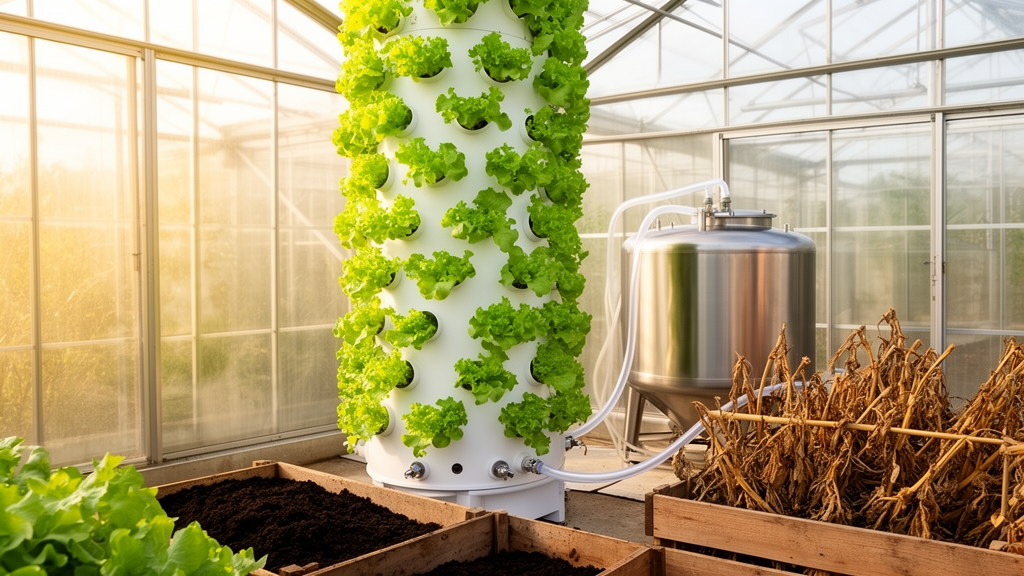
Hydroponic farming, long praised for growing crops with a fraction of the water and land that soil agriculture demands, has a hidden problem: most commercial setups still run on a linear model in which spent nutrient solutions, surplus biomass, and energy losses simply flow out of the system as waste. A new study published in the journal Green Technology, Resilience, and Sustainability argues that this partial circularity is the key bottleneck standing between hydroponics and genuinely sustainable food production, and it offers a structured framework for closing the loop.
The research, authored by Abhijeet Das and Satchidananda Mishra and published on 9 March 2026, is explicitly conceptual and analytical rather than experimental. The authors did not conduct primary experiments or dynamic simulations; instead, they combined system mapping, resource-flow analysis, and indicator structuring to translate circular economy principles into measurable environmental, operational, and economic metrics for hydroponic production. Their stated aim is to move beyond earlier reviews that discussed conceptual alignment or isolated efficiency gains, and to provide a transferable decision-support model that designers, growers, and policymakers can apply across different hydroponic configurations.
The motivation is grounded in well-documented global pressures. The study cites projections that the world population will reach roughly 9.8 billion by 2050, while global water demand is expected to rise from 3,500 to 5,425 cubic kilometres between 2000 and 2050, a 55 percent increase. Approximately 70 percent of the world’s freshwater is already used in agricultural production, and fertilizer runoff generates pollution and greenhouse gas emissions. The authors also cite estimates suggesting that each 1 degree Celsius of warming may render about 10 percent of arable land unsuitable for cultivation, underscoring the case for production systems that decouple yield from soil and minimize input losses.
At the heart of the framework is a clear definition of system boundaries. The authors model the hydroponic unit as a semi-closed loop comprising upstream inputs such as water, nutrients, energy, and seeds; core processes including nutrient preparation, plant growth, climate control, and recirculation; and downstream outputs such as harvested biomass, residual plant matter, and discharged solution fractions. Within this boundary, closed-loop logic means that water and nutrients are continuously recirculated rather than discharged, with monitoring data feeding back into adaptive adjustments of nutrient dosing, flow rates, and system configuration.
The framework distinguishes three configuration types: linear systems that discharge spent solutions, partial-recirculation systems, and near-zero discharge systems. According to the authors’ analytical assessment, circular configurations improve resource retention through continuous nutrient recirculation and controlled dosing, minimize discharge through closed-loop management, and enhance operational stability when buffering capacities across the water, nutrient, and energy subsystems are aligned. Near-zero discharge systems, they find, demonstrate higher resource retention but demand greater operational stability and buffering capacity to prevent nutrient imbalances from accumulating.
On the quantitative side, the study reports that recirculation loops can reduce freshwater withdrawal by 40 to 70 percent, depending on system scale and recirculation efficiency. These figures derive from the authors’ system-level analytical modelling rather than from longitudinal field measurements, a distinction the researchers themselves emphasize. Nutrient retention through optimized dosing and partial solution rebalancing is described as minimizing losses and reducing eutrophication risk, while residual biomass routed into composting, biofertilizer production, or soil amendment pathways prevents organic waste discharge.
A distinctive contribution of the paper is its insistence that performance cannot be judged by yield alone. The authors propose an integrated indicator set, normalized per kilogram of marketable crop per production cycle, spanning environmental metrics such as water-use efficiency, nutrient-use efficiency, and discharge volume; operational metrics such as growth consistency, intervention frequency, and sensitivity to disturbances like pump or sensor failures; and economic metrics such as input cost reductions, productivity per unit area, and cost avoidance in waste management. Improvements in one dimension, they caution, may come at the expense of another, which is why integrated evaluation is needed to prevent trade-offs between efficiency gains and system instability.
The framework also extends circularity beyond the primary crop. Root matter, senescent leaves, and non-marketable plants can be processed into compost, vermicompost tea, or biofertilizers and reintegrated as nutrient supplements for secondary crops or soil-based applications. Spent nutrient solutions contain residual macro- and micronutrients suitable for secondary production, including halophytes and other resilient plants, and residual biomass can feed value-added streams such as essential oils, extracts, compost, or bioenergy. Energy flows receive parallel attention: the authors stress that pumps, lighting, and climate control can offset water and nutrient savings if not managed, and they advocate renewable energy integration and demand-responsive scheduling.
Feedback behaviour emerges as a central theme. The study describes positive feedback loops, in which improved nutrient recovery boosts biomass production and thereby generates more residual material for secondary cycles, and negative feedback loops, in which nutrient overconcentration triggers corrective dilution that stabilizes growing conditions. The authors conclude that system performance is constrained primarily by the alignment of capacities across subsystems rather than by the efficiency of any individual component, and that operational resilience depends on feedback-driven nutrient management and controlled handling of variability.
The researchers are candid about the limits of their work. The analysis remains primarily conceptual and framework-driven rather than empirical; context-specific factors such as crop type and regional conditions are not explicitly modelled; economic performance is discussed in relative rather than quantified terms; and no long-term operational data or full life-cycle assessments were incorporated. Large-scale empirical validation across diverse climatic, technological, and economic contexts, they write, is still required. They propose future research directions including empirical testing across hydroponic configurations, quantification of trade-offs between efficiency, resilience, and cost, integration of life-cycle and techno-economic assessments with system dynamics models, and exploration of policy-driven scaling pathways. On the policy front, the study suggests shifting incentives toward closed-loop water and nutrient systems, supporting circular infrastructure and monitoring technologies, and incorporating circularity indicators such as resource circulation efficiency and waste avoidance into sustainability standards and certification schemes.
Subject of Research: A conceptual framework integrating circular economy and zero-waste principles into hydroponic agriculture
Article Title: Integration of circular economy and zero-waste practices with hydroponics for sustainable agriculture
Article References: Das, A., & Mishra, S. (2026). Integration of circular economy and zero-waste practices with hydroponics for sustainable agriculture. Green Technology, Resilience, and Sustainability, 6(1), Article 6. https://doi.org/10.1007/s44173-026-00030-2
Image Credits: AI Generated
DOI: 10.1007/s44173-026-00030-2
Keywords: hydroponics, circular economy, zero-waste agriculture, water recirculation, nutrient recovery, sustainable agriculture, controlled environment agriculture, resource efficiency, biomass valorisation, food security, systems analysis, Integration
News Source: Alan Morgan. (October 29, 2026). Circular Hydroponics Framework Aims to Turn Farm Waste into Closed-Loop Resources. Scienmag.



