


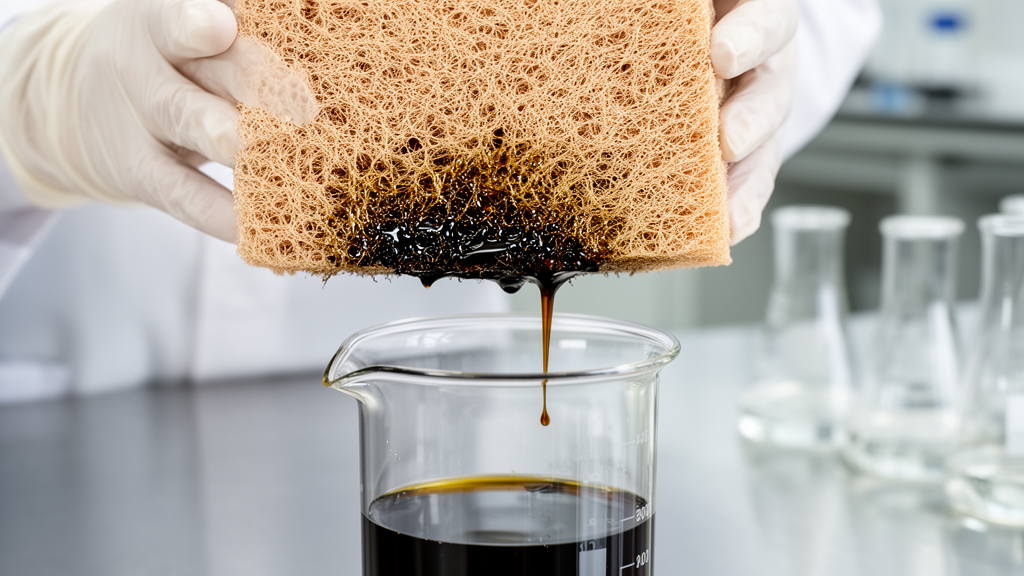
A new study published in Discover Applied Sciences reports the preparation and testing of hydrophobic aerogels made from sodium alginate and coconut coir fiber as candidate materials for oil spill remediation.
This approach relies on calcium carbonate and glucono-delta-lactone (GDL) to trigger gelation internally within the alginate–fiber mixture. The resulting gels were then surface-modified with methyltrimethoxysilane (MTMS), a silane compound that imparts water-repelling, hydrophobic characteristics to the aerogel surface.
To understand how formulation affects performance, the researchers systematically varied two parameters: the sodium alginate concentration, ranging from 0.3 to 0.5 grams, and the amount of MTMS used in the surface treatment, ranging from 0.5 to 2 milliliters. They then measured how these changes influenced both the internal structure of the aerogels and their oil absorption capacity.
The optimum result was an oil absorption capacity of 288.10 percent, achieved with 0.4 grams of sodium alginate and 0.5 milliliters of MTMS. The experiments revealed a clear trade-off in both directions. Increasing the alginate concentration produced a denser structure with reduced pore accessibility, which lowered absorption capacity. Conversely, applying too much MTMS blocked the pores, again reducing performance. The best formulation therefore balanced sufficient hydrophobic modification with an open, accessible pore network.
Structural analysis supported these findings. Fourier-transform infrared spectroscopy indicated that the surface modification was successful, while scanning electron microscopy showed a more uniform porous structure after treatment. According to the authors, these structural characteristics contributed to the improved oil absorption performance observed in the optimized aerogel.
The study, published open access on 28 October 2026, is presented as an early-release, peer-reviewed accepted article that remains citable while awaiting final editorial formatting. As with any laboratory-scale materials study, further work would be needed to evaluate performance under real-world spill conditions before practical deployment.
Subject of Research: Hydrophobic sodium alginate and coconut fiber aerogels prepared by internal gelation and MTMS modification for oil absorption
Article Title: Preparation and characterization of hydrophobic sodium alginate/coconut fiber aerogels via GDL–CaCO₃ internal gelation and MTMS surface modification
Article References: Susmanto, P., Sari, T. I., Putri, N. A., Sitompul, A. G., Rendana, M., & Zuki, F. M. (2026). Preparation and characterization of hydrophobic sodium alginate/coconut fiber aerogels via GDL–CaCO₃ internal gelation and MTMS surface modification. Discover Applied Sciences. https://doi.org/10.1007/s42452-026-09812-6
Image Credits: AI Generated
DOI: 10.1007/s42452-026-09812-6
Keywords: aerogel, sodium alginate, coconut coir fiber, MTMS, oil spill remediation, hydrophobic materials, internal gelation, porous structure, FTIR, SEM, sustainable materials, Preparation
News Source: Denise Maddox. (October 29, 2026). Coconut Fiber Aerogel Soaks Up Oil in New Spill Cleanup Study. Scienmag.



