Flexible zinc-air batteries promise a rare combination of virtues: high theoretical energy density of 1,086 watt-hours per kilogram, abundant and cheap zinc, easy recyclability, and inherent safety compared with the flammable organic electrolytes of many lithium-ion cells. Yet the component that makes them bendable, the gel electrolyte, is also the component that most readily falls apart. A new mini review in Frontiers in Chemistry lays out, in unusually systematic fashion, the five principal ways these gels degrade in service, and the strategies researchers have devised to keep them alive.
Gel electrolytes have become the preferred medium for quasi-solid zinc-air batteries because they combine the high ionic conductivity of a liquid with the dimensional stability and mechanical flexibility of a solid. Common polymer hosts include polyacrylamide, polyacrylic acid and polyvinyl alcohol, alongside natural polysaccharides such as starch, cellulose, agar, carrageenan and konjac gum. These polysaccharides dissolve at elevated temperature and, on cooling, their linear chains intertwine into double-helical networks. Their abundant hydroxyl, aldehyde and ether groups form hydrogen bonds that boost water absorption, water retention and mechanical strength. But the same aqueous character that makes gels workable also makes them vulnerable.
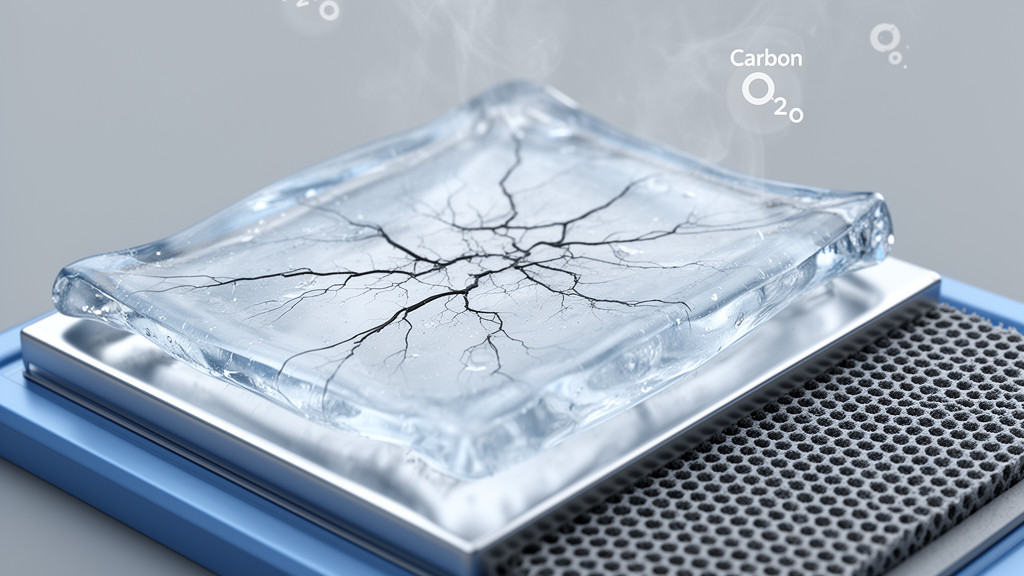
The first and most fundamental threat is water loss. Gel electrolytes are inherently aqueous systems, and their performance depends heavily on water content: water solvates the ions and participates in the hydrogen-bond network that governs polymer chain mobility and ion transport. Once dehydration begins, ionic conductivity falls, interfacial charge transfer efficiency drops, and internal resistance and polarization climb. The problem is structural rather than incidental. Zinc-air batteries have a semi-open architecture that exposes all components to flowing air, so water loss is unavoidable, and unlike liquid systems, quasi-solid cells cannot simply top up a reservoir.
One countermeasure is to build hygroscopic components into the polymer network. When the ionic liquid 1-butyl-3-methylimidazolium bromide was introduced into a polyacrylamide gel, its hygroscopicity and the hydrogen-bonding network it formed with water and polymer chains significantly improved water retention: the gel kept 81.2 percent of its initial water after 50 hours at 25 degrees Celsius and 60 percent relative humidity, with an ionic conductivity of 340 millisiemens per centimeter. The resulting flexible battery delivered 433 cycles, a power density of 101.2 milliwatts per square centimeter and a specific capacity of 727.8 milliampere-hours per gram. A complementary approach combines porous architecture with water-holding additives: crosslinking sodium hyaluronate with polyacrylamide while adding silicon dioxide nanoparticles as a pore-forming agent yielded a gel that retained 80.6 percent of its water after 96 hours, inhibited zinc dendrite formation, and powered a cell that maintained 62 percent efficiency over 480 charge-discharge cycles.
The second degradation pathway is chemical. Alkaline electrolytes react with atmospheric carbon dioxide, producing carbonate species that are poorly soluble in alkaline media and precipitate at the cathode-electrolyte interface, blocking oxygen diffusion channels and occupying active sites for the oxygen reduction reaction. The generated bicarbonate and carbonate ions also migrate far more slowly than hydroxide ions, so the ionic conductivity of the gel declines continuously. Conventional liquid systems fight this with carbon dioxide absorption filters, oxygen-selective membranes or periodic electrolyte replacement, but the structural constraints of flexible batteries rule out most of these fixes.
Two more elegant strategies emerge from the review. The first is carbon dioxide pre-fixation: inspired by the reversible reaction of carbon dioxide with alcohols and by carbon capture in superbase media, researchers fixed carbon dioxide onto polyvinyl alcohol chains using the strong organic base tetramethylguanidine. The pre-fixed carbon dioxide forms a protective layer on the electrolyte surface that blunts further attack by environmental carbon dioxide while also suppressing zinc dendrite growth and zinc oxide deposition, and enhancing ionic conductivity, water retention and thermal stability. In a carbon dioxide-rich atmosphere of 22.7 percent, cycling stability improved roughly twelvefold compared with pristine polyvinyl alcohol. The second strategy sidesteps the chemistry entirely: near-neutral gel electrolytes, such as a polyvinyl alcohol gel soaked in a chloride solution with low zinc chloride concentration and fixed 2.8 molar ammonium chloride, avoid significant carbonate precipitation because hydroxide concentration is low. Under optimized conditions of 0.6 molar zinc chloride, the cell achieved a cyclic lifetime exceeding 100 hours and a power density of 15.3 milliwatts per square centimeter.
Mechanical damage is the third enemy. The entire selling point of a flexible battery is that it survives bending, folding and twisting, but if the gel cracks during such deformation, the electrode-electrolyte interface and internal ion transport pathways are compromised and the battery fails. Mechanical performance is governed by the intermolecular interactions within the polymer network, including hydrogen bonds, covalent bonds and ionic bonds; a greater variety and density of these bonds dissipates energy and resists crack propagation. One widely adopted tactic is the dual network: combining in situ polymerized, covalently crosslinked polyacrylamide with freeze-thaw polymerized, physically crosslinked polyvinyl alcohol produced a gel with an ionic conductivity of 309.9 millisiemens per centimeter, a mechanical toughness of 0.69 megajoules per cubic centimeter, a maximum fracture stress of 498.4 kilopascals at a tensile strain of 237.85 percent, far outperforming single-network polyvinyl alcohol at roughly 86.1 kilopascals and polyacrylamide at roughly 107 kilopascals.
Embedding a rigid skeleton inside the gel works too. Incorporating agar into a porous hydrophilic melamine foam scaffold improved mechanical performance by 365.3 percent compared with pristine agar, because the continuous skeleton bears and distributes external stress, preventing stress concentration and crack propagation. The reinforced gel sustained no structural damage after 100 cycles of 180-degree bending and withstood a compressive force of 138.2 newtons without fracturing, while its porous structure alleviated zinc anode passivation, enabling a power density of 126 milliwatts per square centimeter and an areal capacity of 24 milliampere-hours per square centimeter.
Temperature is the fourth challenge. At low temperatures, water molecules freeze, disrupting continuous ion-transport pathways and causing surface icing and reduced conductivity; at high temperatures, rapid evaporation dehydrates the gel, degrading mass and charge transfer. Adding functional additives that lower water activity can help: incorporating 2 molar zinc perchlorate into a dual-network gel of carboxymethyl chitosan and polyacrylamide exploits the Hofmeister effect, in which perchlorate ions form weak hydrogen bonds with water and the polymer matrix, disrupting the strong hydrogen-bond network among water molecules and lowering the freezing point. The resulting gel maintained excellent electrochemical performance at minus 30 degrees Celsius, with symmetric zinc cells cycling stably for 1,200 hours at that temperature. A more sweeping solution is microphase separation: using cellulose nanofibers to partition the gel into polymer-rich and solvent-rich domains achieved an ionic conductivity of 30.95 millisiemens per centimeter in a non-alkaline system, rising to 318.21 millisiemens per centimeter in an alkaline one, and stable charge-discharge performance across a range from minus 40 to 80 degrees Celsius.
The fifth failure mode, contact failure, is subtler. Zinc dendrite growth reduces electrode surface area, consumes active material and aggravates polarization, and although gels can mechanically confine dendrites, their interfacial contact with the zinc anode is less stable than in liquid electrolytes. Poor contact creates uneven electric field and ion concentration distributions, producing localized current hotspots that drive preferential zinc deposition at protrusions; the resulting interfacial resistance paradoxically accelerates dendrite growth. Countermeasures include a self-adaptive interface, in which sodium alginate in a poly(acrylamide-co-acrylic acid) network preferentially adsorbs onto the zinc anode through high hydrophilicity and zincophilicity, suppressing dendrites and zincate by-products and enabling stable symmetric cell cycling for 800 hours at 2 milliamperes per square centimeter. Alternatively, regulating zinc ion solvation with a ternary deep eutectic solvent of acetamide, zinc chloride and water in polyacrylic acid lets acetamide’s carbonyl and amine groups coordinate zinc ions, weakening their binding to water and enabling dendrite-free cycling for 900 hours. The review’s overarching conclusion is sobering but clear: no single modification simultaneously fixes all five problems, so future gel electrolytes will need multi-mechanism synergistic integration, deeper study of structural evolution under extreme conditions, and in situ characterization to link structure with performance in real time.
Subject of Research: Degradation mechanisms and stabilization strategies for gel electrolytes in quasi-solid zinc-air batteries
Article Title: Degradation and stabilization of gel electrolytes for quasi-solid Zn-air batteries
Article References: Wei, M., Chen, Z., Li, J., Wang, K., Peng, Y., & Xu, Z. (2026). Degradation and stabilization of gel electrolytes for quasi-solid Zn-air batteries. Frontiers in Chemistry, 14, Article 1983516. https://doi.org/10.3389/fchem.2026.1983516
Image Credits: AI Generated
DOI: 10.3389/fchem.2026.1983516
Keywords: zinc-air batteries, gel electrolytes, quasi-solid electrolytes, water retention, CO2 poisoning, mechanical reinforcement, wide-temperature operation, zinc dendrites, flexible electronics, polymer networks, ionic conductivity, energy storage
News Source: Faith Mcneil. (October 29, 2026). Gel Electrolytes Face Water Loss, CO2 and Cracking on the Road to Flexible Zinc-Air Batteries. Scienmag.