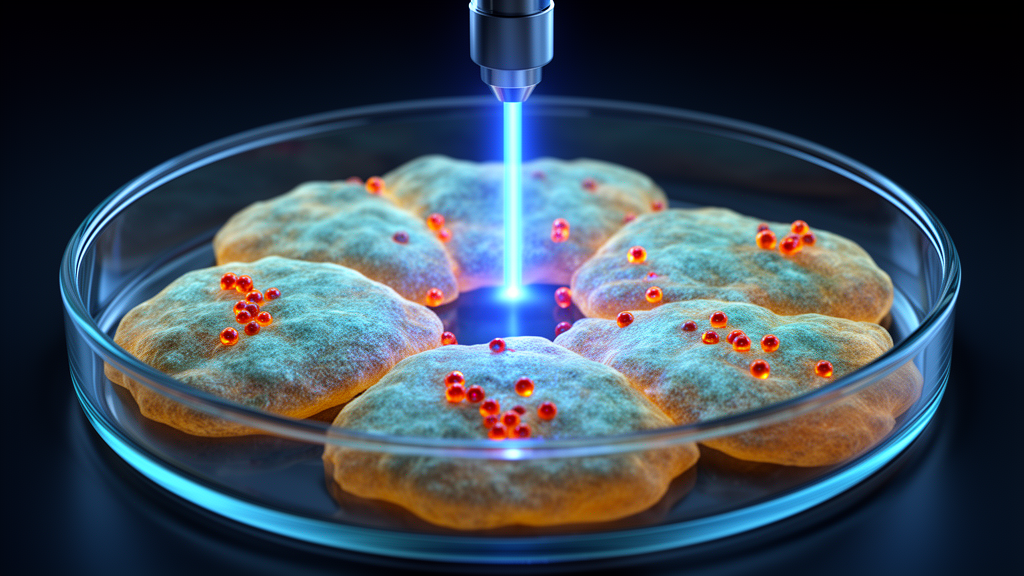
Lung cancer remains the leading cause of cancer-related mortality worldwide, with approximately 2.4 million new cases and 1.8 million deaths recorded in 2022, and non-small cell lung cancer accounting for about 85 percent of all cases. For tumors arising in the central airways, where proximity to the trachea, major blood vessels and esophagus often renders surgery unfeasible, local control remains a persistent clinical problem. A new study published in Frontiers in Pharmacology reports that a photodynamic therapy regimen combining a 450-nanometer blue laser with the photosensitizer sinoporphyrin sodium, abbreviated DVDMS, suppresses lung cancer growth in cells and in mice by driving tumor cells into a senescent, growth-arrested state rather than killing them outright through acute cytotoxicity.
Photodynamic therapy works by delivering a photosensitizing drug that accumulates in target tissue and then activating it with light of a matching wavelength. The activated drug transfers energy to oxygen, generating reactive oxygen species that damage tumor cells, disrupt tumor microvasculature and can modulate antitumor immunity. Because the light can be delivered locally, for example through a bronchoscope to endoluminal lesions, the approach offers spatial selectivity with limited collateral damage. Yet clinical adoption has been constrained by the shallow penetration of conventional excitation sources, the suboptimal pharmacokinetic profiles of existing photosensitizers, and an incomplete understanding of the signaling pathways that mediate the antitumor effect.
The research team, based at Tangdu Hospital of the Fourth Military Medical University and Xi’an Jiaotong University in China, built on their earlier development of a 450-nanometer blue laser surgical system, which has received regulatory approval for clinical application and research from the National Medical Products Administration of China. The absorption spectrum of DVDMS, an ether-linked porphyrin dimer sodium salt derived from Photofrin II, overlaps strongly with the 450-nanometer emission of the blue laser. DVDMS offers superior chemical stability, high aqueous solubility and rapid systemic clearance compared with first-generation photosensitizers, making the combination a rational pairing for photodynamic activation.
In laboratory experiments, the researchers treated human lung squamous carcinoma cells of the NCI-H838 line, human lung adenocarcinoma A549 cells, and normal bronchial epithelial BEAS-2B cells with DVDMS concentrations ranging from 0.1 to 0.8 micromolar, followed by blue laser irradiation at a power density of 10 milliwatts per square centimeter for 600 seconds, a total energy dose of 6 joules per square centimeter. Photodynamic treatment produced a dose-dependent reduction in lung cancer cell viability, with minimal impact on the normal bronchial epithelial cells under the same conditions. DVDMS alone, even at the highest concentration, showed negligible dark toxicity without irradiation. Colony formation assays confirmed a significant long-term reduction in clonogenic survival after treatment.
Because reactive oxygen species are the principal mediators of photodynamic cytotoxicity, the team quantified intracellular ROS using DCFH-DA fluorescence microscopy and flow cytometry. Treated cells showed a robust, DVDMS dose-dependent increase in ROS-specific fluorescence, and this elevation was effectively abrogated by pretreatment with N-acetylcysteine, a ROS scavenger. Crucially, NAC pretreatment also significantly attenuated the treatment-induced suppression of cell viability, confirming that ROS generation is the indispensable driver of the antitumor effect in this regimen. The researchers then deliberately shifted to sub-toxic DVDMS doses of 0.1 and 0.2 micromolar to investigate the mechanisms of low-dose treatment, motivated by concerns over photosensitivity-related adverse effects in patients.
Transcriptome sequencing of treated A549 cells revealed that the therapy remodeled the expression of 2,595 genes, with 1,482 upregulated and 1,113 downregulated. Gene ontology and gene set enrichment analyses consistently pointed toward tumor-suppressive pathways, specifically cellular senescence, DNA damage response and cell cycle arrest. Senescence and DNA damage markers including TP53, H2AFX, GADD45A and CDKN1A were significantly upregulated, while cell cycle drivers such as CCNB1, CDK1 and CDC25C were downregulated. The alkaline comet assay provided physical evidence of genomic instability, showing significant DNA strand breaks that intensified with increasing DVDMS dose, and Western blotting confirmed a robust, dose-dependent upregulation of gamma-H2AX, a sensitive marker of DNA double-strand breaks.
Downstream of the DNA damage, the treated cells accumulated in the G2/M phase of the cell cycle. Western blotting showed significant decreases in Cyclin B1 and CDK1, proteins required for entry into mitosis, and flow cytometry confirmed a marked, dose-dependent expansion of the G2/M population. Concurrently, the cells acquired a senescent phenotype, evidenced by a sharp increase in senescence-associated beta-galactosidase activity and by elevated secretion of the senescence-associated secretory phenotype factors interleukin-6 and interleukin-8, measured by ELISA in culture supernatants collected 48 hours after treatment. Cellular senescence is an irreversible state of growth arrest triggered by stressors including oxidative stress and DNA damage, and inducing it has emerged as a therapeutic strategy for permanently suppressing tumor proliferation.
Two rescue experiments established the causal chain. When cells were pretreated with NAC, the DNA damage was reduced, gamma-H2AX elevation was reversed, interleukin-6 and interleukin-8 secretion dropped, G2/M arrest was alleviated, and Cyclin B1 and CDK1 levels returned toward homeostatic values. KEGG enrichment analysis had identified the p53/GADD45A signaling pathway as a candidate mediator, and Western blotting confirmed that the combined treatment, but neither laser nor drug alone, upregulated p53 and GADD45A. When the researchers used the p53-specific inhibitor Pifithrin-alpha, the activation of the p53/GADD45A axis was attenuated, senescence-associated beta-galactosidase activity and SASP factor secretion fell, and the expression profiles of cell cycle arrest-related proteins were reversed. Together, these data support a pathway in which moderate ROS production inflicts DNA damage, activating p53/GADD45A signaling that enforces cell cycle arrest and senescence.
The therapeutic effect was then tested in vivo. Female BALB/c nude mice bearing subcutaneous A549 xenografts received DVDMS at 2 milligrams per kilogram via caudal vein injection, followed by local tumor irradiation at 60 joules per square centimeter 24 hours later, with mice stratified into control, laser-only, drug-only and combination groups of six animals each. The combination therapy significantly suppressed tumor progression, with marked reductions in final tumor volume and weight. Body weights remained stable across all groups, and histopathological examination of the heart, liver, spleen, lungs and kidneys found no abnormalities. Immunohistochemistry of excised tumors showed upregulation of p53 and GADD45A alongside elevated gamma-H2AX, mirroring the mechanism observed in cell culture.
The authors acknowledge important limitations. The subcutaneous xenograft model does not recapitulate the anatomical complexity or optical limitations of central lung tumors, where delivering light to deep-seated lesions remains a major clinical challenge; the superficial tumor location and external illumination in this model bypass those difficulties. Future studies using orthotopic lung cancer models or large animal models with endoscopic light delivery will be needed to evaluate clinical feasibility. The findings, derived from cell lines and immunodeficient mice, position low-dose blue-laser photodynamic therapy with DVDMS as a mechanistically defined, senescence-associated strategy that warrants further optimization, with the eventual goal of offering a complementary option for patients with inoperable lung cancer, particularly for managing residual disease alongside existing therapies.
Subject of Research: Photodynamic therapy using a 450-nm blue laser and sinoporphyrin sodium inducing senescence in lung cancer via p53/GADD45A signaling
Article Title: BL-DVDMS-mediated photodynamic therapy induces oxidative response associated with cellular senescence via p53/GADD45A signaling in lung cancer
Article References: Li, X., Ma, M., Mei, Y., Zhang, P., Liang, X., Huang, R., Zhang, Y., He, D., & Wang, L. (2026). BL-DVDMS-mediated photodynamic therapy induces oxidative response associated with cellular senescence via p53/GADD45A signaling in lung cancer. Frontiers in Pharmacology, 17, Article 1935296. https://doi.org/10.3389/fphar.2026.1935296
Image Credits: AI Generated
DOI: 10.3389/fphar.2026.1935296
Keywords: lung cancer, photodynamic therapy, sinoporphyrin sodium, blue laser, cellular senescence, reactive oxygen species, DNA damage, p53, GADD45A, G2/M arrest, xenograft model, SASP
News Source: Nathaniel Bowman. (October 29, 2026). Blue laser light plus porphyrin drug pushes lung cancer cells into senescence. Scienmag.