


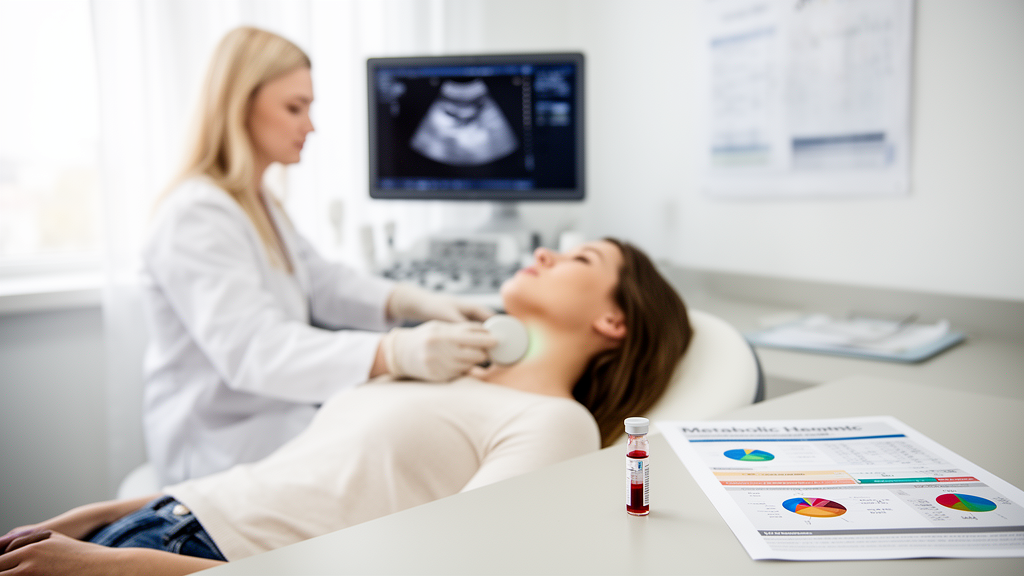
A cross-sectional study of 50,023 adults attending a Beijing health-management centre has found that a body-mass-index-based “metabolic syndrome-like” phenotype is associated with thyroid nodules of 1.0 cm or larger, the size threshold the researchers used to filter out clinically trivial lesions. The work, published as an open-access research article in BMC Endocrine Disorders, analysed the first thyroid ultrasound of each adult attendee between 2014 and 2026, linking metabolic laboratory data to each examination within a window of plus or minus 60 days.
Most previous evidence linking metabolic syndrome to thyroid nodules has relied on detecting nodules of any size, a measure dominated by small lesions of little clinical significance, and has typically adjusted for few confounders. To address this, the team defined a MetS-like phenotype operationally using BMI rather than waist circumference, and examined its association with size-threshold nodules as the primary outcome and with sonographically suspicious nodules, graded TI-RADS 4 or higher, as an exploratory outcome.
The metabolic-burden score ranged from 0 to 5 and counted five components: BMI-defined obesity at 28 or above, elevated blood pressure, elevated glucose, high triglycerides and low HDL-cholesterol. After excluding participants without ultrasound or with incomplete metabolic data, the complete-case sample reached 50,023, and the researchers compared included and excluded participants as part of their analysis.
Nodules of at least 1.0 cm were found in 3,854 participants, or 7.7 percent of the sample, while TI-RADS 4 or higher nodules appeared in 619 participants, or 1.2 percent. The MetS-like phenotype was associated with nodules of 1.0 cm or larger, with an odds ratio of 1.52 (95 percent confidence interval 1.42 to 1.63) and a prevalence ratio of 1.45 (1.36 to 1.54), both adjusted for age and sex.
When the five components were entered simultaneously into the models, BMI-defined obesity, elevated blood pressure, elevated glucose and low HDL-cholesterol each remained associated with size-threshold nodules, whereas high triglycerides did not. Prevalence of nodules rose in a graded fashion from 4.4 percent among people with none of the five components to 12.2 percent among those with all five, with a trend P value below 0.001.
The researchers tested the robustness of the finding in several ways. Substituting the waist-based Chinese Diabetes Society definition of metabolic syndrome yielded a similar odds ratio of 1.61. Additional adjustment for uric acid, C-reactive protein and thyroid peroxidase antibody in available subsets, stratification by examination period, and multiple imputation that included the outcome all left the estimate essentially unchanged, with the imputed analysis giving an odds ratio of 1.50. The E-value, a measure of how strong an unmeasured confounder would need to be to explain away the association, was 2.30.
The picture was different for sonographically suspicious nodules. Because structured TI-RADS grading only became available from 2020 onward, that analysis was restricted to later examinations. No association was observed between the MetS-like phenotype and TI-RADS 4 or higher nodules, with an odds ratio of 0.97 (0.82 to 1.16). The authors note, however, that this estimate was imprecise and that a small-to-moderate association could not be excluded.
The study’s design limits how far these findings can be taken. As a cross-sectional analysis, it captures metabolic measurements and ultrasound findings at the same point in time, so it cannot establish whether metabolic burden causes nodule formation or progression. The authors state that the associations may inform metabolic-health counselling but do not support changing the intensity of thyroid-ultrasound follow-up.
Subject of Research: Cross-sectional associations between a BMI-based metabolic syndrome-like phenotype and size-threshold thyroid nodules
Article Title: Metabolic syndrome-like phenotype, BMI-based metabolic burden, and size-threshold thyroid nodules: a cross-sectional study of 50,023 health-examination attendees
Article References: Zhang, Y., Cui, Z., An, Y., Yin, T., Liu, Y., Zhang, L., Li, X., Wang, J., Niu, F., Feng, M., Ma, R., & Zhou, Y. (2026). Metabolic syndrome-like phenotype, BMI-based metabolic burden, and size-threshold thyroid nodules: a cross-sectional study of 50,023 health-examination attendees. BMC Endocrine Disorders. https://doi.org/10.1186/s12902-026-02691-3
Image Credits: AI Generated
DOI: 10.1186/s12902-026-02691-3
Keywords: thyroid nodules, metabolic syndrome, obesity, BMI, cross-sectional study, metabolic burden, TI-RADS, ultrasound, insulin resistance, epidemiology, Metabolic, syndrome-like
News Source: Daisy Hatcher. (October 29, 2026). Metabolic Burden Linked to Larger Thyroid Nodules in 50,000-Person Study. Scienmag.



