Rice bran, the fibrous by-product left behind when rice is polished, has long been recognized as a nutritional treasure that food processors mostly discard or underuse. A new open-access study published on 1 May 2026 in a Springer Nature journal dedicated to agricultural products processing and storage reports that a green, non-thermal technology called cold plasma can substantially unlock the nutritional potential locked inside one of its least accessible components: insoluble dietary fiber. The research team, led by Hong Zhu, Wanqiu Zhang, Bo Zhao, Yanlan Liu and Cuiping Yi, systematically tested how different cold plasma conditions change the extractability of phenolic compounds and the physical behavior of rice bran insoluble dietary fiber, and their results point to a surprisingly simple recipe: moderate treatment at 70 kilovolts for 20 minutes.
The problem the researchers set out to solve is structural. Insoluble dietary fiber typically makes up roughly 60 to 80 percent of the total fiber in rice bran and forms its main structural framework, built from cellulose, lignin and some hemicellulose. Remarkably, nearly 90 percent of the phenolic compounds in rice bran are bound to this insoluble fiber fraction, anchored predominantly through covalent interactions such as ester, ether and glycosidic linkages. Because these bound forms show substantially lower bioavailability than their free counterparts, and because the coarse texture and unsatisfactory sensory properties of the fiber further restrict its use in food systems, direct utilization of rice bran fiber has remained limited. Modifying the fiber, the authors argue, is therefore a critical step toward enhancing its functional and nutritional value.
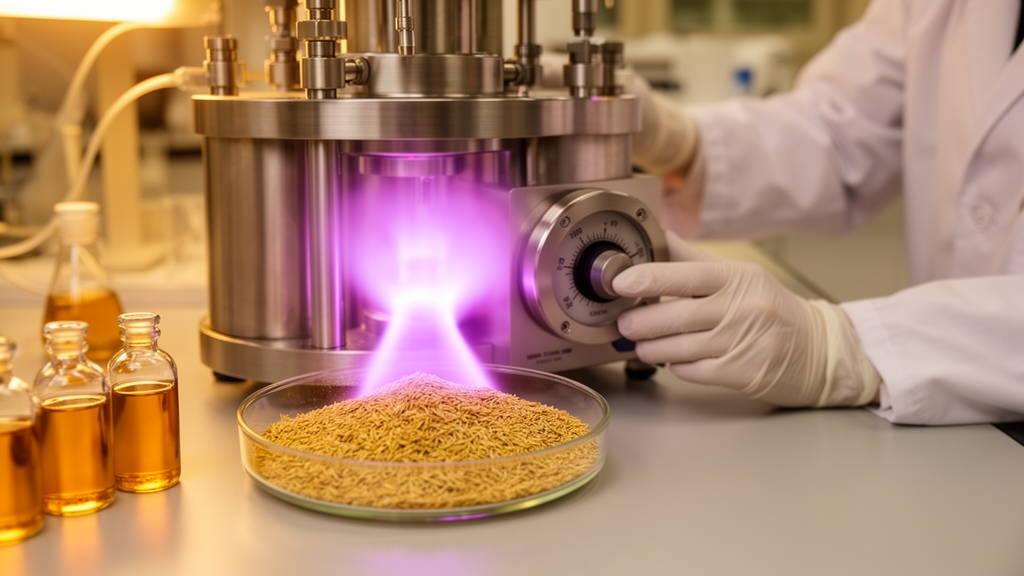
Cold plasma works quite differently from the heat, chemicals or enzymes that dominate current modification strategies. The technology generates partially ionized species, including electrons, ions and reactive radicals, by ionizing gas under an electric field. In this study the team used a dielectric barrier discharge reactor with air as the discharge gas. Two mechanisms are thought to act in concert: physical etching caused by ion bombardment disrupts the dense surface layer and creates micro-scale roughness, while chemical reactions involving reactive radicals cleave key bonds such as glycosidic and hydrogen bonds, reducing the aggregated structure of the fiber and enhancing its adsorption capacity. Unlike chemical modification, which raises environmental concerns and can irreversibly alter fiber properties, and biological approaches, which are often time-consuming and sensitive to external factors, cold plasma offers non-thermal operation, high reactivity and eco-efficiency.
The experimental setup was straightforward. Fresh rice bran was defatted with n-hexane, and the insoluble dietary fiber was extracted through a sequence of enzymatic digestions: starch was hydrolyzed with alpha-amylase and glucoamylase, proteins were degraded with neutral protease, and the residue was washed, dried, ground and sieved to 150 micrometers. The purity of the extracted fiber, determined according to the Chinese National Standard GB 5009.88-2023, was 75.03 percent. For plasma treatment, 2.0 grams of fiber were dispersed in 10 milliliters of distilled water in an evaporating dish, with the electrode gap held at 15 millimeters. Applied voltages ranged from 40 to 80 kilovolts at a discharge current of 1.0 ampere, and treatment times varied from 10 to 40 minutes. Treated samples were freeze-dried and sieved before analysis.
The headline result concerns phenolic extractability. Free phenolic content increased significantly with longer treatment times and, up to a point, with higher voltages. The optimum was 70 kilovolts for 20 minutes, under which the free phenolic content reached 153.65 milligrams of gallic acid equivalents per 100 grams dry weight, an 86.06 percent increase compared with the untreated sample. Notably, when the voltage exceeded 70 kilovolts and reached 80 kilovolts, the phenolic content decreased, indicating that excessively high voltage can degrade phenolic compounds. The authors also observed that increasing the applied voltage was generally more effective than extending the treatment time, citing a quinoa study in which raising the voltage from 50 to 60 kilovolts for 5 minutes outperformed extending treatment at 50 kilovolts to 10 minutes. They caution that the effect of cold plasma on phenolics depends on multiple factors, including the fiber source, the type of plasma and the treatment parameters.
Antioxidant capacity rose in step with the released phenolics. After treatment at 70 kilovolts for 20 minutes, DPPH radical-scavenging activity increased by 85.58 percent, ABTS radical-cation scavenging activity increased by 72.31 percent, and ferric-reducing power improved by 87.00 percent, all measured in vitro. These changes were positively correlated with the free phenolic content. The proposed mechanism is that plasma-generated reactive species depolymerize cell-wall polysaccharides and cleave the bonds between phenolic compounds and the cell-wall matrix, facilitating the release of conjugated phenolics, while large phenolic polymers may be fragmented into smaller molecules through plasma-induced ionization, increasing their extractability and antioxidant activity. The study also recorded a significant drop in the pH of the fiber suspension after treatment, a phenomenon commonly observed in plasma-treated aqueous systems, attributed to reactive oxygen and nitrogen species promoting the formation of acidic functional groups.
The physicochemical profile of the fiber shifted in ways that matter for food formulation. Compared with the untreated sample, cold plasma-modified fiber showed a 30.15 percent increase in water-holding capacity, an 11.99 percent increase in oil-holding capacity and a 26.41 percent increase in swelling capacity, while thermal stability decreased. The authors attribute the water-holding gains to plasma etching that alters sample porosity and capillary forces, and to an increased content of oxygen-containing functional groups such as carbonyl and hydroxyl groups on the fiber surface, which is associated with higher hydrophilicity. The modest oil-holding increase may reflect exposure of lipophilic groups and structural changes in the fiber matrix, and the swelling increase may stem from a higher proportion of amorphous regions in the fiber.
Structural analyses told a consistent story. Scanning electron microscopy revealed that the untreated fiber had an intact, relatively smooth surface, while treated samples became progressively rougher with visible wrinkles and fractures, and, under prolonged treatment or higher voltage, distinct honeycomb-like structures appeared. The irreversible disruption of the fibrous network is attributed to a combination of etching by charged particles, oxidation by reactive species, penetration of the high-voltage electric field and mechanical stress from shock waves. Fourier-transform infrared spectroscopy showed changes in band intensities associated with hydrogen bonding and C-O vibrations in cellulose and hemicellulose, suggesting weakened intermolecular hydrogen bonding and exposure of more hydroxyl groups. X-ray diffraction confirmed that the cellulose I-type crystalline form was preserved, but relative crystallinity declined for all treated samples, initially dropping with treatment intensity and only partially recovering under milder conditions, while at 70 to 80 kilovolts extensive damage to both crystalline and amorphous regions drove a further decline. Thermogravimetric analysis showed that the final residual mass of treated samples, ranging from 31.00 to 33.37 percent, was significantly lower than the 34.22 percent of the untreated fiber, consistent with the reduced crystallinity.
The authors conclude that cold plasma treatment can be regarded as an efficient, green and mild physical modification method for improving the functionality and utilization of rice bran insoluble dietary fiber, with the reduced structural order plausibly increasing solvent permeability and facilitating the migration of phenolic compounds from the fiber matrix. The findings are laboratory-scale in vitro results on a single fiber preparation, and the study does not report sensory testing, human bioavailability data or food-product trials, so translating the 70-kilovolt, 20-minute protocol into commercial whole-grain processing remains a task for future work.
Subject of Research: Cold plasma modification of rice bran insoluble dietary fiber and its effects on phenolic extractability, physicochemical and structural properties
Article Title: Cold plasma modification of rice bran insoluble dietary fiber: effects on phenolic extractability, physicochemical and structural properties
Article References: Zhu, H., Zhang, W., Zhao, B., Liu, Y., & Yi, C. (2026). Cold plasma modification of rice bran insoluble dietary fiber: effects on phenolic extractability, physicochemical and structural properties. Agricultural Products Processing and Storage, 2(1), Article 40. https://doi.org/10.1007/s44462-026-00072-6
Image Credits: AI Generated
DOI: 10.1007/s44462-026-00072-6
Keywords: cold plasma, rice bran, insoluble dietary fiber, phenolic compounds, antioxidant capacity, dielectric barrier discharge, water-holding capacity, X-ray diffraction, food processing, dietary fiber modification, Cold, plasma
News Source: Alan Morgan. (October 29, 2026). Cold Plasma Unlocks Hidden Antioxidants in Rice Bran Fiber. Scienmag.