


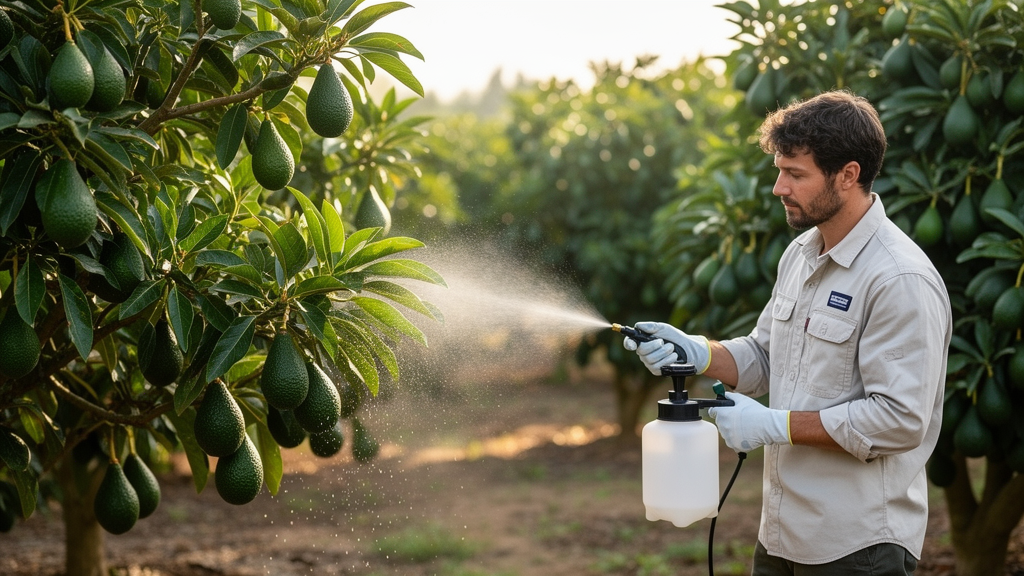
A three-year field trial in avocado orchards suggests that spraying trees with sodium hydrosulfide (NaHS), a donor of the signaling gas hydrogen sulfide (H2S), may raise commercial fruit yields of the ‘Hass’ avocado, the cultivar that dominates global production. The study, published as an open-access research article in BMC Plant Biology, reports that treated trees out-yielded controls in every year of the trial, although the differences were not statistically significant in all analyses.
The trial involved 80 ‘Hass’ trees, 40 untreated controls and 40 NaHS-treated trees. Spray treatments were applied three times in winter and three times in early summer each year across the three study seasons. Over the full period, the cumulative yield of NaHS-treated trees was 36 percent higher by weight and 48 percent higher by fruit number than that of control trees, with the largest single-year difference recorded in year two of the trial.
The rationale builds on the team’s earlier work. Hydrogen sulfide is an endogenous signaling molecule known to prime plants against multiple abiotic stresses and to inhibit organ abscission, the process by which plants shed organs such as leaves, flowers and fruit. Previous studies by the same group had demonstrated beneficial effects of priming ‘Hass’ trees with NaHS against cold stress, prompting the current evaluation of combined winter and summer applications on fruit yield.
‘Hass’ avocado is particularly vulnerable to weather extremes. The cultivar is susceptible to winter frost and to spring-summer heatwaves, and the latter can intensify immature fruit abscission, the phenomenon growers know as ‘June drop’, in which young fruitlets fall from the tree before maturing. Reducing this pre-harvest loss is a major goal for avocado production.
A key strength of the new study is its spatial analysis. By assessing individual tree yields and the alternate bearing index across the orchard plot, the researchers found that alternate bearing, the tendency of avocado trees to alternate heavy and light crop years, was asynchronous across the plot. This suggests that the higher yields of NaHS-treated trees were independent of the trees’ baseline physiological bearing state, rather than an artifact of comparing trees that happened to be in different bearing phases.
The authors are careful about mechanism. They note that the established anti-abscission properties of H2S, combined with the fact that the summer NaHS applications coincided temporally with the natural fruit drop period, suggest that exogenous H2S may mitigate premature avocado fruitlet abscission. However, they emphasize that this remains a hypothesis that has not yet been tested directly in the study.
The researchers also frame the finding as preliminary in practical terms. They state that, pending the development of suitable agricultural formulations and confirmation in larger replicated field trials, orchard NaHS application presents a promising agronomic strategy that may enhance climate resilience, reduce pre-harvest crop loss and improve commercial avocado yields. The current trial, while spanning three years and 80 trees, did not show statistically significant yield differences in all analyses, underscoring the need for further confirmation.
The article was published on 23 October 2026 and is being shared early to provide faster access to peer-reviewed, accepted research; it is citable and carries a permanent DOI, with the version subject to further edits before the final Version of Record. For growers and researchers watching climate pressures on avocado production, the study adds a candidate intervention to the pipeline, while making clear that the direct causal link between H2S signaling and reduced fruitlet drop in 'Hass' remains to be demonstrated experimentally.
Subject of Research: Effects of sodium hydrosulfide, a hydrogen sulfide donor, on Hass avocado fruit yield in a three-year orchard trial
Article Title: Sodium hydrosulfide as a potential orchard treatment for increasing the yield of avocado (Persea americana Mill.) cv. ‘Hass’
Article References: Kamara, I., Regon, P., Bugaiski, M., Dikman, C., Cohen, M., Greenstein, S., & Charuvi, D. (2026). Sodium hydrosulfide as a potential orchard treatment for increasing the yield of avocado (Persea americana Mill.) cv. ‘Hass’. BMC Plant Biology. https://doi.org/10.1186/s12870-026-10261-x
Image Credits: AI Generated
DOI: 10.1186/s12870-026-10261-x
Keywords: avocado, Hass cultivar, sodium hydrosulfide, hydrogen sulfide, fruit abscission, alternate bearing, field trial, crop yield, abiotic stress, plant signaling, BMC Plant Biology, horticulture
News Source: Alan Morgan. (October 29, 2026). Research report: Sodium hydrosulfide as a potential orchard treatment for increasing the yield of avocado (Persea americana Mill.) cv. ‘Hass’. Scienmag.



