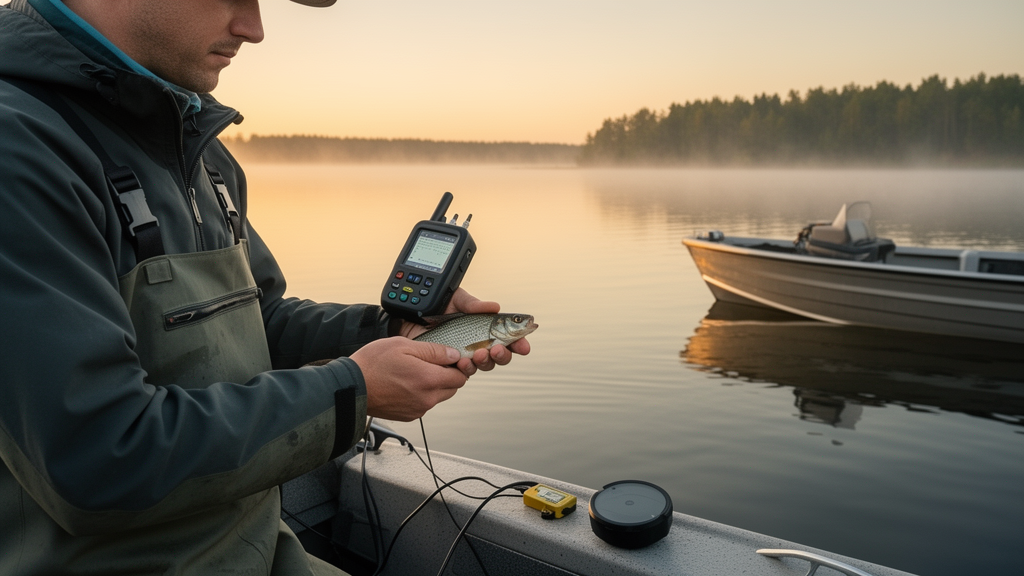
A new field study, published in the journal Animal Biotelemetry, reports the first field-based assessment of detection efficiency and range for Innovasea’s high-frequency 307 kHz acoustic telemetry system, tested in a small freshwater lake in Ontario, Canada.
The study site was a lake of roughly 0.23 square kilometres with a maximum depth of about 10 metres. The researchers deployed an array of 33 receivers together with 10 stationary reference tags and internal synchronization tags, allowing them to measure how reliably the system detected transmissions at known distances and times.
The 307 kHz system is designed around miniaturized tags that transmit at high rates. The V3-1x tags used in the study send one transmission every 25 to 35 seconds, while the larger V6-4x tags transmit once every 6 to 10 seconds. That combination of small size and rapid signalling is what makes the system suitable for implantation in small-bodied fish and enables fine-scale movement studies that were not previously possible with conventional 69 kHz systems.
The central result was a steep decline in detection probability with distance. Hourly detection probability fell strongly as tags moved farther from receivers, and the decline differed between tag types: the larger V6-4x tags maintained higher detection probabilities than the smaller V3-1x tags across longer distances.
One way to summarise that decline is the R50, the distance at which the probability of detecting a single transmission drops to 50 percent. In this lake, the R50 was 55 metres for V3-1x tags and 85 metres for V6-4x tags. Those figures describe the fate of one individual transmission, not what a researcher would actually observe over a study period.
Because the tags transmit repeatedly, the practical detectability of a tagged animal is much higher than any single-transmission figure suggests. The study defines practical detectability as the cumulative probability of detecting a tag at least once within a given time window. Over one- and two-minute intervals, the per-transmission R50 distances translate into much larger effective ranges: 91 to 138 metres for V3-1x tags and 262 to 330 metres for V6-4x tags.
Environmental conditions also shaped performance, though the effects were mostly modest. Wind speed and ambient noise had small negative effects on detection efficiency, while water temperature and precipitation had negligible effects. One factor worked in the opposite direction: ice cover increased detection efficiency by about 3.5 percent compared with open-water conditions.
The equipment itself was not uniform either. Receivers varied slightly in their detection performance, but reference tags did not, a pattern the authors suggest points to an effect of local conditions around each receiver rather than differences among the tags. That distinction matters for anyone interpreting gaps in detection data, since a quiet stretch of record may reflect the receiver’s surroundings rather than the behaviour of the fish.
The authors present these findings as a practical guide for future work. Knowing how detection probability changes with distance, tag type and environmental conditions allows researchers to design arrays with appropriate receiver spacing and to account for variation in performance when interpreting detection data from studies using the 307 kHz system to track fine-scale movements of small-bodied fish.
As a field-based assessment conducted in a single small lake, the study’s quantitative ranges apply most directly to systems and conditions similar to those tested. Even so, it provides the first published performance benchmarks for this new high-frequency system, giving researchers planning fine-scale tracking studies a concrete starting point for array design and data interpretation.
Subject of Research: Field performance of a high-frequency 307 kHz acoustic telemetry system for tracking small fish in a freshwater lake.
Article Title: Performance of a 307 kHz acoustic telemetry system in a small freshwater lake
Article References: Howitt, L. C., Shorgan, M. B., Burr, W. S., Howell, B. E., LaRochelle, L., Cooke, S. J., Fisk, A. T., & Raby, G. D. (2026). Performance of a 307 kHz acoustic telemetry system in a small freshwater lake. Animal Biotelemetry. https://doi.org/10.1186/s40317-026-00501-0
Image Credits: AI Generated
DOI: 10.1186/s40317-026-00501-0
Keywords: acoustic telemetry, 307 kHz, detection efficiency, freshwater lake, small-bodied fish, Innovasea, reference tags, range testing, environmental effects, array design, Performance, acoustic
News Source: Drew Townsend. (October 29, 2026). New 307 kHz acoustic tags show how far small fish can be tracked in a lake. Scienmag.