

• HOME
  • NEWS
  • EXPLORE
    • CAREER
      • Companies
      • Jobs
    • EVENTS
    • iGEM
      • News
      • Team
    • PHOTOS
    • VIDEO
    • WIKI
  • BLOG
  • COMMUNITY
    • FACEBOOK
    • INSTAGRAM
    • TWITTER
Friday, October 30, 2026
BIOENGINEER.ORG
No Result
View All Result
  • Login
  • HOME
  • NEWS
  • EXPLORE
    • CAREER
      • Companies
      • Jobs
        • Lecturer
        • PhD Studentship
        • Postdoc
        • Research Assistant
    • EVENTS
    • iGEM
      • News
      • Team
    • PHOTOS
    • VIDEO
    • WIKI
  • BLOG
  • COMMUNITY
    • FACEBOOK
    • INSTAGRAM
    • TWITTER
No Result
View All Result
Bioengineer.org
No Result
View All Result
Home NEWS Science News Chemistry

Manganese complex boosts electrode performance for guanine sensing

by
October 29, 2026
in Chemistry
Reading Time: 2 mins read
0
Manganese complex boosts electrode performance for guanine sensing

Manganese complex boosts electrode performance for guanine sensing

Share on FacebookShare on TwitterShare on LinkedinShare on RedditShare on Telegram

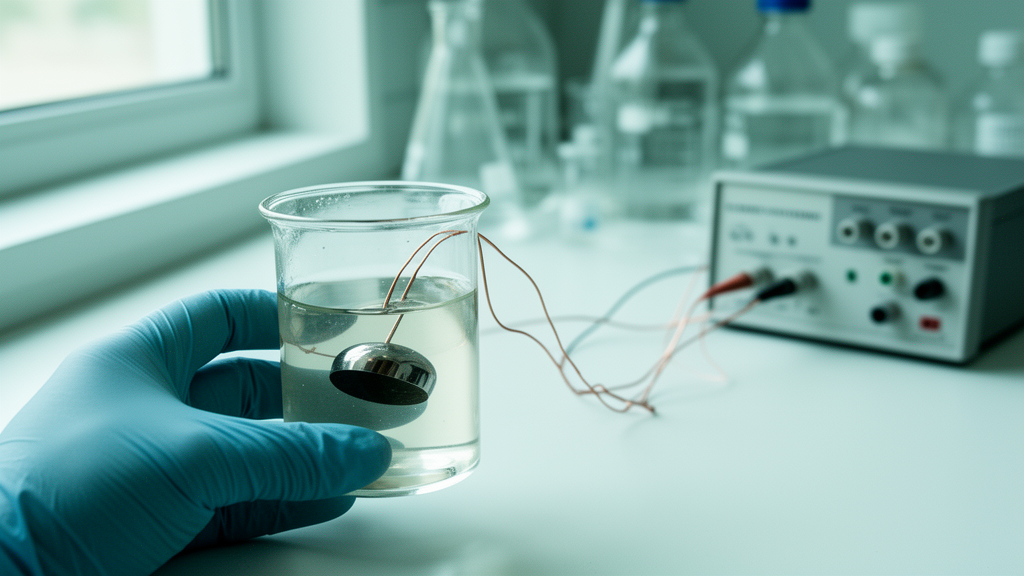
Chemists have synthesized a new manganese(II) complex containing 2,2′-bipyridine and hydrogen tartrate ligands, and report that a polymerized form of the compound substantially improves the performance of a glassy carbon electrode for detecting guanine oxidation. The work, published in BMC Chemistry, combined physicochemical, spectroscopic, electrochemical and antibacterial methods to characterize both a precursor compound, Na₂[Mn(HTA)₂Cl₂], and the final complex, [Mn(HTA)₂(2,2-bpy)].

The characterization relied on solubility testing, melting and decomposition behavior, molar conductance measurements, chloride testing, gravimetric manganese analysis, FTIR spectroscopy and UV–Vis spectroscopy. The available data support coordination of the tartrate-derived ligand through oxygen donor atoms and 2,2′-bipyridine through nitrogen donor atoms. The authors propose an octahedral coordination environment, although they note this geometry is proposed rather than definitively confirmed. The precursor and final complex showed molar conductance values of 255 and 299 S cm² mol⁻¹ respectively, indicating substantial ionic conductivity in water, though the authors caution that these values alone do not establish a definite electrolyte stoichiometry for the neutral final complex.

When poly([Mn(HTA)₂(2,2-bpy)]) was deposited on a glassy carbon electrode, the electroactive surface area increased from 0.15 to 0.44 cm², and the charge-transfer resistance dropped from 6266 to 273 Ω. The modified electrode also shifted the oxidation potential of guanine from 705 to 623 mV, a change that could make guanine detection easier in electroanalytical applications. Taken together, the authors conclude that these results support further investigation of the polymerized manganese complex as an electrode-modifying material.

The antibacterial arm of the study was far less conclusive. Testing at a concentration of 1000 ppm showed no measurable inhibition zones for the synthesized complexes, but the DMSO control also produced inhibition zones, complicating the interpretation. The authors therefore describe the antibacterial findings as preliminary and requiring confirmation using a solvent concentration that is itself inactive. Similarly, the proposed molecular structure of the complex requires additional validation.

Subject of Research: Synthesis and characterization of a manganese(II) bipyridine-tartrate complex for electrochemical guanine sensing and preliminary antibacterial testing

Article Title: Synthesis, characterization, electrochemical application, and antibacterial activity investigation of 2,2-bipyridineditartaratemanganese (II) complex

Article References: Desta, D. A., Metto, M., Teshager, M. A., Tigneh, G. T., & Abebe, A. (2026). Synthesis, characterization, electrochemical application, and antibacterial activity investigation of 2,2-bipyridineditartaratemanganese (II) complex. BMC Chemistry. https://doi.org/10.1186/s13065-026-01955-2

Image Credits: AI Generated

DOI: 10.1186/s13065-026-01955-2

Keywords: manganese complex, 2,2-bipyridine, hydrogen tartrate, electrochemistry, glassy carbon electrode, guanine oxidation, charge-transfer resistance, FTIR spectroscopy, UV-Vis spectroscopy, antibacterial activity, BMC Chemistry, Synthesis

News Source: Bethany Barker. (October 29, 2026). Manganese complex boosts electrode performance for guanine sensing. Scienmag.


Tags: 2,2-bipyridineantibacterial activityBMC Chemistrycharge-transfer resistanceelectrochemistryFTIR spectroscopyglassy carbon electrodeguanine oxidationhydrogen tartratemanganese complexsynthesisUV-Vis spectroscopy
Share12Tweet7Share2ShareShareShare1

Related Posts

Computational screen flags five natural compounds that bind a tuberculosis virulence enzyme

Computational screen flags five natural compounds that bind a tuberculosis virulence enzyme

October 30, 2026
Gut bacterium Blautia sp. MRG-PMF1 cleaves bulkier isoflavone ether bonds

Gut bacterium Blautia sp. MRG-PMF1 cleaves bulkier isoflavone ether bonds

October 30, 2026

Fluorine–silicon acrylate sizing agent boosts specialty paper strength and water resistance

October 30, 2026

Filamentous fungi reshape kombu chemistry and aroma in solid-state fermentation study

October 30, 2026

POPULAR NEWS

  • Microbial Sources and Stress Shape the Hidden Endophytes of an Invasive Plant

    Microbial Sources and Stress Shape the Hidden Endophytes of an Invasive Plant

    29 shares
    Share 12 Tweet 7
  • Firebreaks Leave Lasting Scars in Grasslands While Wildfire Heals Fast

    29 shares
    Share 12 Tweet 7
  • ZNF207 shields glutamine transporter ASCT2 from degradation to fuel liver cancer growth

    29 shares
    Share 12 Tweet 7
  • Systematic review maps sustainability tensions in offshore wind development

    29 shares
    Share 12 Tweet 7

About

We bring you the latest biotechnology news from best research centers and universities around the world. Check our website.

Follow us

Recent News

Microbial Sources and Stress Shape the Hidden Endophytes of an Invasive Plant

Firebreaks Leave Lasting Scars in Grasslands While Wildfire Heals Fast

ZNF207 shields glutamine transporter ASCT2 from degradation to fuel liver cancer growth

Subscribe to Blog via Email

Enter your email address to subscribe to this blog and receive notifications of new posts by email.

Join 86 other subscribers
  • Contact Us

Bioengineer.org © Copyright 2023 All Rights Reserved.

Welcome Back!

Login to your account below

Forgotten Password?

Retrieve your password

Please enter your username or email address to reset your password.

Log In
No Result
View All Result
  • Homepages
    • Home Page 1
    • Home Page 2
  • News
  • National
  • Business
  • Health
  • Lifestyle
  • Science

Bioengineer.org © Copyright 2023 All Rights Reserved.
