


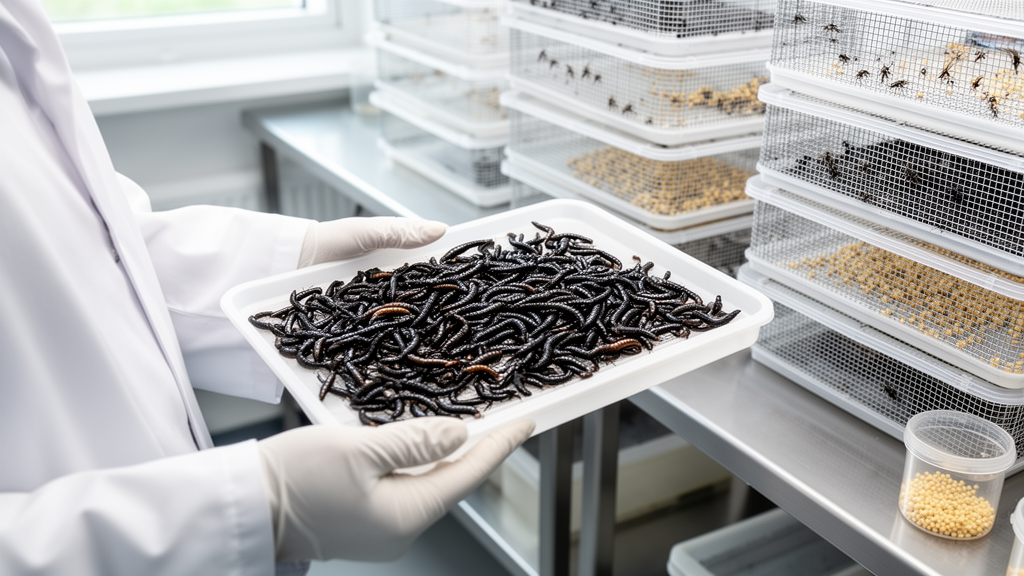
Black soldier fly larvae have become one of the most important protein sources in the rapidly expanding insect farming industry, and breeders are now trying to apply the same quantitative genetics toolbox that transformed livestock and aquaculture production.
The research team, led by Armel S. L. Donkpegan and Romuald Rouger, phenotyped a total of 15,179 individuals from 266 full-sib isofamilies across thirteen generations of an experimental line. Their goal was twofold: to estimate genetic parameters for seven traits of economic relevance using multivariate REML animal models, and to test whether pedigree-informed selection, based on estimated breeding values predicted with Best Linear Unbiased Prediction, could deliver genetic gain in a species whose group-dependent mating system makes classical pedigree recording notoriously difficult.
The heritability estimates revealed a strikingly uneven genetic architecture. Larval weight at the first growth stage, seven days after hatching, showed a heritability of 0.12 plus or minus 0.08, and larval weight at the second stage, fourteen days after hatching, reached 0.13 plus or minus 0.04 under standard feeding. But when the same second-stage trait was measured under restricted feeding, with larvae receiving only 0.75 grams of feed each, heritability jumped to 0.58 plus or minus 0.03. Female body weight at emergence was essentially non-heritable in this population, at 0.006 plus or minus 0.005, while pupal perimeter was similarly low at 0.06 plus or minus 0.09. In contrast, oocyte number, a key reproductive trait, showed a heritability of 0.43 plus or minus 0.09, and thorax size 0.40 plus or minus 0.09.
The restricted-feeding result carries practical weight for industrial producers. Because phenotypic variance of larval weight depends strongly on the local rearing environment, selecting for performance under rationed conditions could allow improvement of a key production trait at reduced feed cost. The authors note that similar environment-dependent changes in genetic variance have been documented in other black soldier fly strains reared on different diets, where significant strain-by-diet interactions were observed for growth-related traits, and that genotype-by-environment interactions detected in their internal research may further modulate the expression of this trait.
Common environmental effects, the shared rearing conditions experienced by siblings growing in the same container, were substantial for most traits, with c2 estimates ranging from 0.11 to 0.57. The effect was strongest for early larval weight, where c2 reached 0.57 plus or minus 0.04, consistent with the well-established sensitivity of early developmental traits to environmental influences in dipteran insects. Only oocyte number and pupal perimeter showed relatively weak environmental contributions, at 0.06 and 0.11 respectively. This pattern suggests that early-life phenotypes in mass-reared insects are shaped more by the shared container environment than by additive genetics, while later traits become increasingly governed by heritable variation.
Genetic correlations painted a nuanced picture. Because of large standard errors, most estimates could not be considered significantly different from zero, but strong positive correlations emerged among the three larval body-weight traits and between these traits and thorax size and oocyte number. Such positive correlations between production and reproductive traits provide a promising basis for multi-trait breeding objectives, echoing empirical selection studies in the yellow mealworm, where selection for increased body size concurrently enhanced fecundity. In a surprising contrast, female body weight at emergence showed negative genetic correlation estimates with the larval body-weight traits, a result the authors flag as unexpected and in need of cautious interpretation.
The selection experiment itself began after five generations of random crossing to stabilise egg production. From generation G5 onward, a selection pressure of roughly 18 to 22 percent was applied, choosing the best isofamilies as breeders based on their average estimated breeding value for second-stage larval weight. Selection differentials between selected and unselected isofamilies reached 13.8, 12.4, 25.8, 18.7, 17.2, 15.4 and 56.9 milligrams across the seven selection generations, and comparisons of larval weight averages showed consistent and significant differences between selected and unselected families, which the authors take as confirmation that the pedigree-based scheme functioned as designed.
Yet the phenotypic trajectory told a more complicated story. The overall population mean for larval weight actually declined during the early selection phase, falling from 288 milligrams in G5 to 280 in G6 and 268 in G7, before rising to 301 milligrams in G9 and then sliding again to 284, 276 and 262 milligrams in G10 through G12. Meanwhile, estimated breeding values rose sharply in the first selection generations, with gains of 248.6 percent from G4 to G5, 38.5 percent from G5 to G6 and 18.8 percent from G6 to G7, before turning slightly negative at G8 and dropping 13.8 percent at G9. The authors attribute the plateauing and decline to a concurrent surge in inbreeding, which climbed from below 5 percent in the early generations to 24 percent by G8, and they caution that in the absence of a contemporaneous control line, environmental contributions to these patterns cannot be fully excluded.
A pivotal event came at generation G8, when substantial egg-laying failures forced the team to introduce individuals from the original production population, equivalent to G0, to restore breeding performance. This admixture immediately increased additive genetic variance and reduced kinship, and genetic gain resumed in the following generations, with increases of 51.2 percent from G9 to G10, 38.2 percent from G10 to G11 and 26.6 percent from G11 to G12. Even so, the magnitude of improvement progressively declined toward the end of the experiment, and the authors discontinued selection at G12. Across the full thirteen-generation pedigree, the mean inbreeding coefficient was 9.6 percent, corresponding to an annual increase of 12.7 percent, a rate the authors link to the small effective size of the initial selection nucleus and the intensity of selection applied.
The study also confronts an unavoidable source of uncertainty: pedigree accuracy. Because black soldier fly males mate competitively in large groups and solitary mating is largely ineffective, the researchers used a group-mating design in which each cage of twenty males and twenty females was treated as a single parental group, producing a maternal half-sib structure with unknown sires. Recent work showing that polyandry is common in the species, with females frequently remating and producing clutches fertilised by multiple males, directly challenges the assumption of strict full-sib family structure, and a parentage-assignment study using genomic tools indicated a pedigree misassignment rate of 10 to 20 percent within the system. The authors argue that such imprecision is not disqualifying, noting that pedigree error rates of 5 to 15 percent, sometimes exceeding 20 percent, are routine in global dairy cattle populations without preventing sustained genetic improvement. Still, they estimate that true selection gains for larval weight may have been greater than observed if pedigree assignment had been error-free. Looking forward, they point to simulation work suggesting that the most effective strategy for breeders is to expand the number of families contributing to the breeding nucleus from roughly 60 to 200 or more, reducing inbreeding risk and improving the long-term reliability of selection. Their broader message is that sustainable improvement in black soldier fly production will ultimately require multi-trait breeding objectives that integrate production, reproductive and robustness traits, supported by an adequately sized selection nucleus and careful pedigree management.
Subject of Research: Estimation of genetic parameters and pedigree-based selective breeding outcomes for productivity traits in the black soldier fly
Article Title: Genetic parameters and pedigree–based selective breeding outcomes for productivity traits in industrial black soldier fly (hermetia illucens L.) production systems
Article References: Donkpegan, A. S. L., Guigue, A., Berteau, N., Compernolle, L., & Rouger, R. (2026). Genetic parameters and pedigree–based selective breeding outcomes for productivity traits in industrial black soldier fly (hermetia illucens L.) production systems. Genetics Selection Evolution, 58(1), Article 67. https://doi.org/10.1186/s12711-026-01088-z
Image Credits: AI Generated
DOI: 10.1186/s12711-026-01088-z
Keywords: black soldier fly, Hermetia illucens, selective breeding, heritability, animal model, BLUP, inbreeding, larval weight, insect farming, genetic correlations, pedigree, animal feed
News Source: Juliet Wilcox. (October 29, 2026). Black soldier fly breeding trial shows genetic gains in larval weight, but inbreeding looms. Scienmag.



