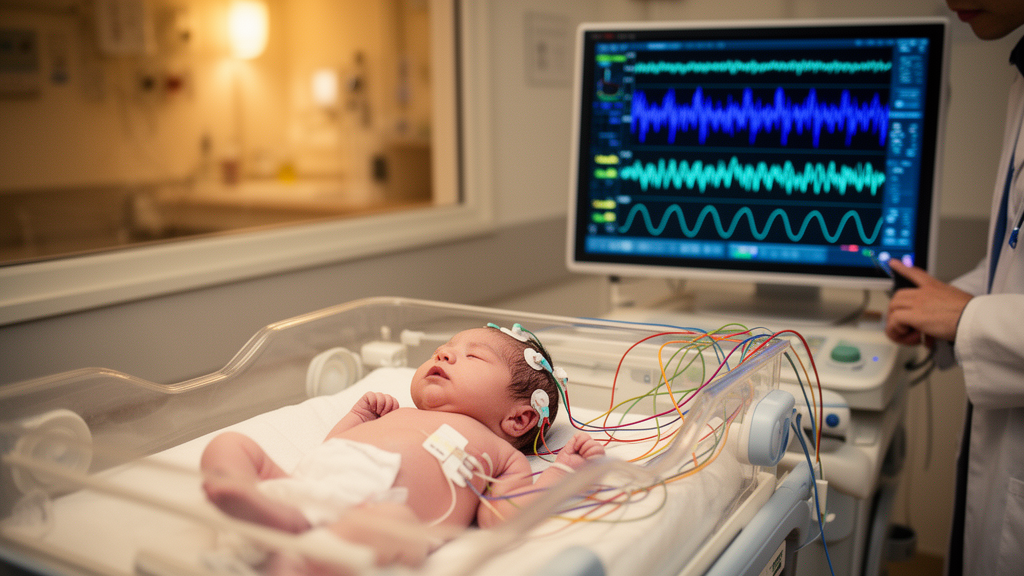
Researchers have developed an automated framework that classifies seizures in newborns by feeding topographic maps of brain electrical activity into deep transfer learning models, reporting a peak subject-wise accuracy of 97.1 percent. The study, published in Brain Informatics as an open-access research article, addresses a pressing clinical need: epilepsy is among the most common neonatal neurological disorders, and early detection of seizures is critical for timely intervention and for reducing long-term neurological consequences.
The team, led by Athar Al-azzawi with colleagues including Saif Al-jumaili, Adil Deniz Duru, Osman Nuri Uçan and Ivan Miguel Pires, built its approach on electroencephalography (EEG) signals. Rather than analyzing raw waveforms directly, the method uses topographic brainpower maps extracted from EEG signals. These images are then processed using deep transfer learning architectures.
Three widely used architectures were rigorously evaluated: GoogLeNet, ResNet-18 and ShuffleNet. The underlying data came from a publicly accessible dataset comprising recordings from 79 newborns. To probe how the length of the analysis window affects performance, the researchers tested three temporal window scenarios of 1, 5 and 8 seconds each.
A key methodological distinction in the study lies in how the models were validated. In initial results, performance approached the optimal accuracy across all temporal windows. To ensure clinical generalizability, they implemented a stricter subject-wise protocol in which the models were tested on entirely unseen patients.
Under this strict validation, ResNet-18 emerged as the superior architecture, achieving the remarkable peak subject-wise accuracy of 97.1 percent in the 8-second window scenario. The authors state that these findings confirm the proposed framework is highly robust against inter-patient variability, and they describe it as a reliable and methodologically sound strategy for automated neonatal intensive care monitoring. Because the article was shared early as an accepted, peer-reviewed manuscript with a permanent DOI, some details may be refined in the final version of record.
Subject of Research: Automated detection of neonatal seizures using deep transfer learning on EEG topographic maps
Article Title: Discrimination of seizure topographical images utilizing transfer learning approaches
Article References: Al-azzawi, A., Al-jumaili, S., Duru, A. D., Uçan, O. N., & Pires, I. M. (2026). Discrimination of seizure topographical images utilizing transfer learning approaches. Brain Informatics. https://doi.org/10.1186/s40708-026-00330-0
Image Credits: AI Generated
DOI: 10.1186/s40708-026-00330-0
Keywords: neonatal seizures, epilepsy, EEG, transfer learning, ResNet-18, GoogLeNet, ShuffleNet, deep learning, brain topographic maps, neonatal intensive care, subject-wise validation, Brain Informatics
News Source: Cassandra Pierce. (October 29, 2026). Deep learning model spots neonatal seizures from EEG brain maps with 97% accuracy. Scienmag.