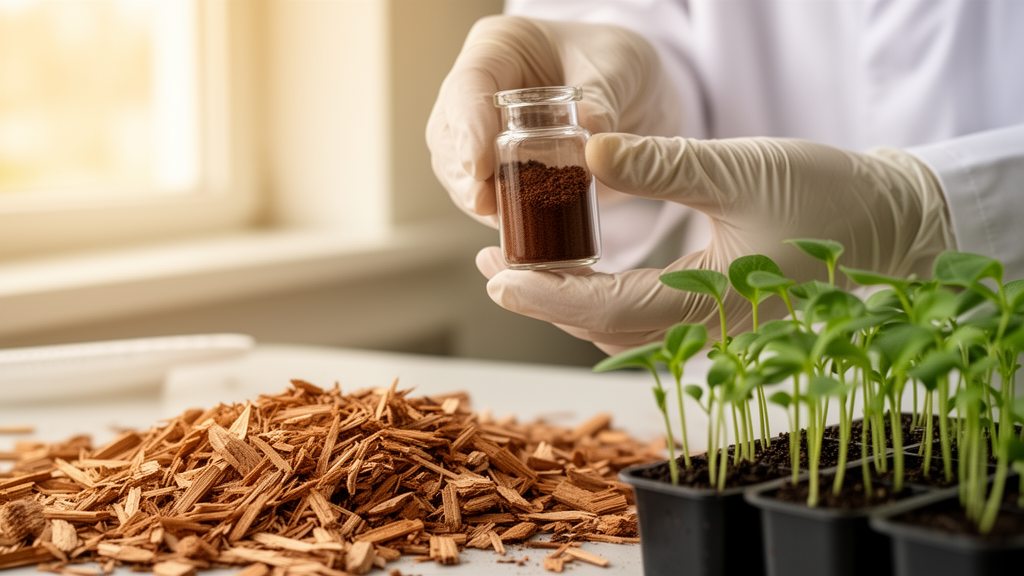
Lignin, the aromatic polymer that gives wood its rigidity and is routinely discarded as a low-value by-product of pulping and biorefineries, could become the raw material for a new generation of environmentally friendly agricultural inputs. A review published in Carbon Research on 6 August 2026 surveys recent advances in converting lignin into controlled-release fertilizers, soil amendments, pesticide carriers, mulch films and seed coatings, arguing that the same molecule blamed for clogging industrial waste streams may help agriculture cut its dependence on petroleum-derived plastics and chemicals.
The authors searched Web of Science, Scopus and CNKI for publications from 2020 onward, supplemented by earlier seminal work, and organized the findings around structure–property–performance relationships. Their central argument is that lignin’s intrinsic traits—antioxidant activity, ultraviolet shielding, antimicrobial functionality and tunable degradability—map directly onto the functional requirements of green agricultural materials.
Lignin is a major component of lignocellulosic biomass, making up 15 to 30 percent of plant dry weight and ranking as the most abundant natural source of aromatic polymers. It is an amorphous macromolecule built from phenylpropane units of three types, known as G, S and H, joined by carbon–oxygen and carbon–carbon linkages. Softwoods are rich in G-units, hardwoods in S- and G-units, and herbaceous plants contain all three. The β-O-4 ether linkage is the most common and least stable bond, accounting for roughly 50 percent of linkages in softwoods and 60 percent in hardwoods, and it largely determines how the polymer can be processed. Carbon–carbon bonds, which account for about 15 to 30 percent of linkages, are far harder to break and remain a major obstacle to efficient utilization.
That structural variability is both an asset and a liability. Lignin’s density ranges from 1.30 to 1.50 grams per cubic centimeter, its molecular weight from 500 to 50,000 daltons, and its glass transition temperature from 90 to 170 degrees Celsius, with properties shifting according to plant source and extraction method. To tame this heterogeneity, the review catalogs fractionation techniques—organic solvent separation, gradient acid precipitation, membrane filtration, ionic liquids and hydrothermal treatment—each with trade-offs in purity, cost and energy. Chemical modifications such as hydroxymethylation, sulfonation, amination, phenolation, etherification and esterification then tailor reactivity and solubility for specific applications.
In fertilizers, the review identifies two main design philosophies. Physical barrier systems coat granules of urea or diammonium phosphate with lignin-based shells that slow nutrient dissolution through diffusion or rupture mechanisms. Single-layer lignin coatings are simple but typically sustain release for less than 30 days because of the polymer’s residual hydrophilicity; composite coatings with synthetic polymers or natural gums extend release periods, and acetylated or alkoxylated lignin improves barrier performance at the price of higher-purity feedstocks and extra processing. Chemically synthesized systems take a different route, bonding nutrients directly to lignin. Oxidative ammoniation of kraft lignin in ammonia solution under oxygen at 150 degrees Celsius produced material containing 12 percent nitrogen, and ammonia-oxidized lignin has been shown to improve nitrogen use efficiency in potted maize. Mannich amination has yielded aminated lignin with nitrogen contents as high as 17.34 percent, while lignin’s carboxyl and phenolic hydroxyl groups chelate metal ions such as copper, zinc and calcium to form slow-release micronutrient fertilizers.
For soil, lignin-based hydrogels act as three-dimensional cross-linked networks that store water, trap nutrients and chelate heavy metals. One reported alkaline lignin hydrogel cross-linked with poly(ethylene glycol) diglycidyl ether achieved a water retention capacity of 34 grams of water per gram of hydrogel with low sensitivity to salinity and good biodegradability, though it lost roughly 59 percent of its mass within a year. A degradable lignosulfonate hydrogel developed by Bai and colleagues captures moisture from air; under normal sunlight it released 0.81 kilograms of water per square meter, equivalent to boosting average annual precipitation in Tianjin, China’s temperate monsoon climate by 51 percent. Composite materials extend the toolkit further: lignin anchored to clay–polyacrylic acid hybrids reached a water retention capacity of 257 percent and a cation exchange capacity of 48.7 milliequivalents per 100 grams, and silicon/magnesium-enhanced lignin biochar applied to smelter-contaminated soil in Shaanxi raised available silicon by 109 to 450 percent and exchangeable magnesium by 276 to 879 percent while reducing heavy-metal bioavailability and promoting potted Pakchoi growth.
More than 90 percent of applied pesticides are lost to soil and rivers, and lignin’s ultraviolet shielding addresses a key degradation route for light-sensitive actives. Lignosulfonates act as dispersants for hydrophobic ingredients, while self-assembled lignin nanoparticles form microcapsules, Pickering emulsions and aqueous coacervates that encapsulate, protect and gradually release payloads. In a comparison with the synthetic polymer PLGA, optimized lignin nanoparticles achieved encapsulation efficiencies of 85 to 95 percent for the insecticide abamectin, comparable to PLGA’s 80 to 90 percent, and preserved over 70 percent of photosensitive abamectin after 72 hours of ultraviolet exposure, whereas unprotected PLGA systems may lose more than half. The lignin particles typically mineralize in soil within two to four months, avoiding the persistent microplastic burden of slower-degrading synthetics, though achieving narrow particle-size distributions and batch-to-batch reproducibility remains difficult.
Films and coatings round out the application portfolio. Lignin blended with biodegradable polymers such as polyvinyl alcohol or polylactic acid yields mulch films with adjustable degradation timelines from months to more than a year and strong ultraviolet blocking from lignin’s chromophores. Sprayable liquid films coalesce on the soil surface to form flexible membranes that retain moisture and can co-deliver slow-release fertilizer granules, and lignin-coated paper mulches offer near-complete biodegradability with effective weed suppression. In seed coatings, lignin–polymer composites form semi-permeable barriers that time the release of pesticides and nutrients to seedling needs; reported film-formation times of about 115 seconds, coating detachment rates as low as 1.9 percent and uniformity near 97 percent on certain cereals suggest the technology is maturing. Lignin–chitosan coatings produced 100 percent germination of pepper seeds at one week and maintained 40 to 80 percent viability at five weeks, with antioxidant activity above 84 percent.
The review is candid about the distance between laboratory promise and field reality. Conventional fertilizers achieve utilization efficiencies of only 30 to 35 percent, which motivates controlled-release designs, yet most lignin fertilizer release experiments have been run in greenhouses or laboratory pots rather than actual fields. Lignin is generally considered biodegradable, but some studies report that phenolic degradation products and pigments from papermaking wastewater accumulate in surface soils, reducing microbial diversity and inhibiting plant growth, and long-term field data on lignin-based materials are lacking. Cost is another barrier: alkaline-extracted lignin runs roughly 3,000 to 3,500 yuan per ton, organosolv lignin 3,500 to 7,000 yuan, and modified lignins more still. Lignin-based soil amendments cost an estimated 1,500 to 7,500 yuan per hectare against 750 to 1,500 yuan for lime, and lignin mulch film costs 2,790 to 4,125 yuan per hectare versus 750 to 900 yuan for conventional plastic. The authors argue that environmental benefits, carbon trading mechanisms and policy support could eventually close this gap, and that multifunctional products—such as a lignin superabsorbent that retains water, improves nutrient release and immobilizes lead—may justify the premium.
The overall picture is of a field expanding rapidly but still fragmented. Most lignin-based products remain confined to laboratories and greenhouses, and their compatibility with existing farm machinery and agronomic practice is untested. The review’s roadmap calls for standardized structural fingerprinting of lignin feedstocks, predictive performance models to replace trial-and-error formulation, scalable green processing, and rigorous field trials with ecotoxicological assessment of degradation products and soil microbiome effects.
Subject of Research: Lignin valorization for eco-friendly agricultural inputs such as fertilizers, soil amendments, pesticide carriers, mulch films and seed coatings
Article Title: Lignin valorization toward eco-friendly agricultural inputs
Article References: Zhang, X., Wang, Y., Tursen, J., Li, X., Li, J., Yin, C., Lv, J., Zhu, W., & Wang, H. (2026). Lignin valorization toward eco-friendly agricultural inputs. Carbon Research, 5(1), Article 55. https://doi.org/10.1007/s44246-026-00294-0
Image Credits: AI Generated
DOI: 10.1007/s44246-026-00294-0
Keywords: lignin, controlled-release fertilizers, soil amendments, pesticide delivery, mulch films, seed coatings, biodegradable materials, biomass valorization, sustainable agriculture, circular bioeconomy, lignin nanoparticles, soil health
News Source: Alan Morgan. (October 29, 2026). Lignin, the overlooked wood polymer, could replace fossil-based farm chemicals. Scienmag.