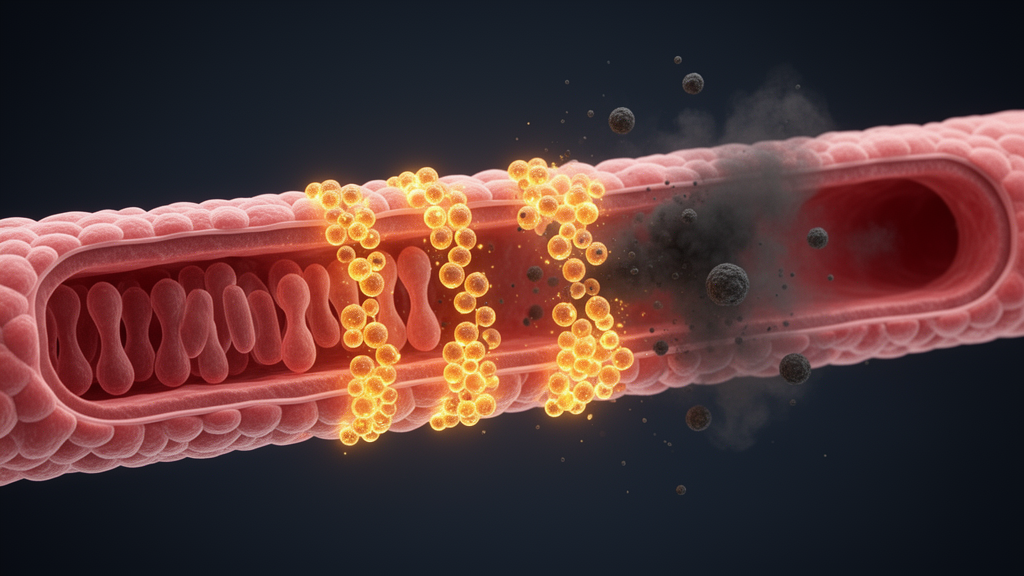
Cigarette smoke delivers far more than nicotine to the bloodstream. Its water-soluble toxicants dissolve into the plasma and reach the thin layer of endothelial cells that lines every blood vessel, where they provoke the oxidative stress that helps drive smoking-related vascular disease. A new laboratory study published in Frontiers in Pharmacology reports that when human endothelial cells were exposed to cigarette smoke-conditioned culture medium, their survival depended almost entirely on one molecule: intracellular glutathione. Vitamin C, long celebrated as a cellular antioxidant, offered at most a modest and transient benefit and could not compensate when glutathione was lacking.
Researchers led by Gloria Oñate and Coralía I. Rivas at the Universidad de Concepción in Chile, together with colleagues at other Chilean institutions, set out to disentangle the relative contributions of glutathione and vitamin C in endothelial antioxidant defense. Both molecules participate in redox chemistry, and earlier work in animals and cultured cells had shown they can cooperate: disrupting glutathione synthesis in rats and guinea pigs causes dysfunction and mortality that vitamin C supplementation can partially ameliorate. What remained unclear was whether vitamin C could step in for glutathione specifically during exposure to soluble cigarette smoke toxicants, a question with direct relevance to the endothelial dysfunction seen in smokers.
The team worked with primary human umbilical vein endothelial cells, or HUVECs, and exposed them to cigarette smoke-conditioned medium (CSM), prepared by bubbling the smoke of commercial filter cigarettes into warmed culture medium. Because no standardized unit exists for water-soluble smoke components, concentrations were expressed as cigarette equivalents per milliliter, with the stock diluted to defined equivalents for experiments. The researchers created four cellular conditions: cells with normal glutathione levels of roughly 2.5 to 4 millimolar, the same cells preloaded with 1.5 to 2 millimolar intracellular vitamin C, cells depleted of glutathione to below 50 micromolar using the synthesis inhibitor BSO plus diethyl maleate, and glutathione-depleted cells that were also vitamin C-loaded.
The results were striking. After 24 hours in medium conditioned with 10 cigarette equivalents, about 35 percent of glutathione-containing cells survived, whether or not they carried vitamin C. Cells lacking glutathione fared catastrophically: fewer than 3 percent survived the same exposure, again regardless of vitamin C status. At milder exposures of 0.1 and 1 equivalent, more than 95 percent of glutathione-containing cells lived through 24 hours, while glutathione-depleted cells dropped to 70 to 80 percent survival. Cell viability at 24 hours, in short, tracked intracellular glutathione, not vitamin C.
Measuring glutathione over time revealed a biphasic pattern. Within the first hour of smoke exposure, measurable glutathione fell rapidly, with the size of the drop proportional to the smoke concentration. Cells exposed to non-lethal concentrations then recovered their glutathione, often overshooting baseline by 24 hours, and this recovery correlated with survival. Cells exposed to 10 equivalents never recovered and died. The authors note an important measurement caveat: their enzymatic recycling assay quantified soluble GSH plus GSSG after protein precipitation, so the initial decrease could reflect oxidation, export, or redistribution into protein-bound pools rather than a single mechanism, and the study did not directly identify the chemical products formed.
Prolonged exposure reinforced the conclusion. Cells cultured for up to seven days in medium conditioned with 1 cigarette equivalent survived normally if they contained glutathione, with or without vitamin C, while glutathione-depleted cells exposed to the smoke failed to proliferate even without smoke and, when smoke was added, declined steadily until no viable cells remained on days six and seven. Vitamin C supplementation produced only a modest, transient protective effect during the first 24 to 48 hours in glutathione-depleted cells, which vanished thereafter. Interestingly, smoke exposure initially boosted glutathione in competent cells, reaching about 8 millimolar at day one before declining to roughly 2 millimolar by day seven.
To test whether smoke exposure broadly weakened antioxidant defenses, the researchers added a second challenge: after a one-hour exposure to smoke-conditioned medium, cells received 15-minute treatments with 0.01, 0.1, or 1 millimolar hydrogen peroxide. Among glutathione-containing cells, roughly 75, 35, and 10 percent survived the three peroxide doses at 24 hours, and vitamin C supplementation changed nothing. Glutathione-depleted cells were far more vulnerable, with fewer than 20 percent surviving even the lowest peroxide dose after smoke exposure and none surviving 1 millimolar peroxide. Survival, the authors conclude, depended on two converging factors: the glutathione content at the start of the challenge and the severity of the challenge itself.
The study also examined whether smoke damaged the cells’ ability to import vitamin C, which could otherwise explain its limited benefit. Using radiolabeled ascorbic acid and dehydroascorbic acid, the team found that 24 hours or seven days of smoke exposure did not impair transport of either form, regardless of glutathione or vitamin C status. One nuance emerged: cells lacking vitamin C transported ascorbate about 2.5-fold faster than supplemented cells, and after seven days of smoke exposure treated cells accumulated roughly twice as much vitamin C as controls. The limited protection, therefore, does not stem from blocked uptake, though the authors caution that their experiments addressed transport and accumulation only, not every aspect of intracellular vitamin C metabolism.
The findings carry clear limitations that the authors state plainly. The work was conducted entirely in vitro with primary HUVECs exposed to the water-soluble fraction of smoke, so it does not reproduce all effects of smoking in a living body, where smoke particulates, metabolites, immune cells, and systemic inflammation also act. Moreover, only two independent experiments were performed, each with three technical replicates, and because technical replicates are not independent observations, no inferential statistical analysis was performed. The glutathione-depleting BSO protocol also represents an artificial extreme rather than the gradual depletion smokers experience.
Within those bounds, the message is consistent across every experimental arm: glutathione availability and the capacity to recover intracellular glutathione are closely tied to endothelial cell survival under soluble smoke toxicant exposure, while vitamin C cannot substitute. The authors suggest that future research should identify the mechanisms behind glutathione recovery and test whether maintaining or restoring intracellular glutathione levels can increase endothelial resistance to smoke-associated oxidative stress. For now, the study reframes a familiar antioxidant story: in these human endothelial cells facing cigarette smoke chemistry, the intracellularly synthesized tripeptide, not the dietary vitamin, was the decisive line of defense.
Subject of Research: The role of glutathione and vitamin C in protecting endothelial cells from water-soluble cigarette smoke toxicants
Article Title: Intracellular glutathione availability, rather than vitamin C supplementation, determines endothelial cell resistance to water-soluble cigarette smoke toxicants
Article References: Oñate, G., Salgado, P., Guzmán, P. A., Muñoz, A., Alarcon-Navarro, C., Arriagada, S. P., Moraga-Cid, G., Muñoz-Montesino, C., Gatica, M., & Rivas, C. I. (2026). Intracellular glutathione availability, rather than vitamin C supplementation, determines endothelial cell resistance to water-soluble cigarette smoke toxicants. Frontiers in Pharmacology, 17, Article 1924584. https://doi.org/10.3389/fphar.2026.1924584
Image Credits: AI Generated
DOI: 10.3389/fphar.2026.1924584
Keywords: glutathione, vitamin C, endothelial cells, cigarette smoke, oxidative stress, HUVECs, antioxidants, cell viability, BSO, vascular disease, Intracellular, availability
News Source: Ophelia Keating. (October 29, 2026). Glutathione, Not Vitamin C, Shields Endothelial Cells From Smoke Toxicants. Scienmag.